

Standard
eBarimt
Tax Portal
ebarimt.mn
Tax Authority
General Department of Taxation
CTC Model
Electronic receipt registration and VAT-invoice transmission
B2G
N/A
B2B
VAT invoice within 7 days
Archiving
10 years
Pending Support by DDD Invoices
Mongolia has e-invoicing, delivered through eBarimt, the electronic payment receipt system run by the Mongolian Tax Administration (General Department of Taxation). It combines system-validated payment receipts for every sale with VAT invoices between VAT withholding taxpayers. It is not documented as a Peppol, UBL or pre-clearance model.
VAT withholding taxpayers must issue a uniquely numbered payment receipt for every sale, on paper or electronically, through a connected user system. Between VAT withholding taxpayers, a VAT invoice must also be created. Receipt data must generally reach the integrated system within three days, and B2B VAT-invoice data within seven days.
Latest news
НЭМЭГДСЭН ӨРТГИЙН АЛБАН ТАТВАРЫН ТУХАЙ
+(976)-11-323317-11-323317)
Login
mn
Legislation Acts
News
Төсөлд санал өгөх
- Login
Дан нэвтрэх
-
- НЭМЭГДСЭН ӨРТГИЙН АЛБАН ТАТВАРЫН ТУХАЙ
Сонсох / Сонгосон утга сонсох
Word
- Хэвлэх
Increase default text size
A
A
A
-
(2022-12-19-ний өдрийн орчуулгын хяналт) Unofficial translation
LAW OF MONGOLIA
July 9, 2015 Ulaanbaatar city
ON VALUE ADDED TAX
/Revised version/
CHAPTER ONE
GENERAL PROVISIONS
Article 1. Purpose of the Law
1.1. This legislation aims to manage the processes related to the imposition, collection, refund, and reporting of value-added tax (VAT).
Article 2. Legislation on value added tax
2.1. The legal framework for VAT includes the General Taxation Law, this specific law, and other relevant legal acts.
Article 3. Scope of the law
3.1. This law governs the VAT on goods imported into Mongolia, exported from Mongolia, and those sold within Mongolia.
Article 4. Definition of terms of this law
4.1. The terms in this law are defined as follows:
4.1.1. "Sales" refers to the transfer of ownership of goods, execution of work, and service provision.
4.1.2. "Goods" encompasses all assets except monetary ones.
4.1.3. "Work" is defined as per Chapter Thirty-one of the Civil Code.
4.1.4. "Service" includes any activity besides selling goods and performing work.
4.1.5. "Economic activity" involves selling goods, performing work, and providing services for profit or non-profit.
4.1.6. "Resident or non-resident" is defined according to the Business Entity Income Tax and Personal Income Tax Laws:
4.1.6.a. "Resident" is a taxpayer permanently based in Mongolia as per the relevant tax laws.
4.1.6.b. "Non-resident" is a taxpayer not based in Mongolia.
4.1.7. "Premises used for residential purposes" are buildings intended for living, subject to VAT.
4.1.8. "Day when obligation to withhold VAT arises" is when sales revenues reach 50 million tugrugs.
4.1.9. "Goods obtained from foreign governments" are those received through aid or loans for disaster relief.
4.1.10. "Settlement of payment" refers to cash or bank transfer payments.
4.1.11. "Integrated system administrator" manages electronic data on goods and services for tax purposes.
4.1.12. "User system supplier" provides certified systems for recording transactions.
4.1.13. "Value added tax invoice" is a document proving payment, detailing transaction information.
4.1.14. "Receipt" is a document verifying payment, issued by designated equipment.
4.1.15. "Unique payment number" is a special identifier for transactions.
4.1.16. "Registration tool" is a certified device for recording transaction details.
4.1.17. "Register equipment" includes devices like cash registers for recording sales.
4.1.18. "Register system" collects sales data for tax authorities.
4.1.19. "Day of registration as withholding VAT taxpayer" is when an entity is officially registered.
4.1.20. "Integrated system" processes sales data for entities in Mongolia.
4.1.21. "User system" is a certified system for managing transaction records.
CHAPTER TWO
IDENTIFICATION, REGISTRATION AND DEREGISTRATION OF TAXPAYERS AND WITHHOLDING TAXPAYERS
Article 5. Taxpayer and withholding taxpayer
5.1. A taxpayer is an individual purchasing goods for personal use without reselling.
5.2. Entities with sales reaching 50 million tugrugs must withhold VAT and remit it to the government:
5.2.1. Those selling goods and services in Mongolia.
5.2.2. Those importing goods and services.
5.2.3. Those exporting goods and services.
5.3. Foreign business branches with sales over 50 million tugrugs are subject to this law.
5.4. VAT does not apply to salaries, wages, pensions, and similar payments.
5.5. Sales of fixed assets are excluded from the 50 million tugrug threshold.
5.6. Sales income must be verified with primary accounting documents.
Article 6. Registration of withholding tax payer
6.1. Entities required to withhold VAT must register within 10 working days.
6.2. The tax department registers entities within three days of application.
6.3. This does not apply to entities dealing only with VAT-exempt goods and services.
6.4. Changes in business structure do not affect VAT obligations.
6.5. Entities with sales 20% above the threshold can voluntarily register.
6.6. The same registration period applies for voluntary registration.
6.7. Registration automatically includes the entity in the tax system.
6.8. Deregistration occurs if no taxable revenue is earned for 12 months.
6.9. Taxpayer names are publicized monthly.
6.10. Deregistered entities retain obligations from their registration period.
6.11. Procedures for registration and deregistration are approved by tax authorities.
CHAPTER THREE
GOODS, WORKS AND SERVICES SUBJECT TO TAX
Article 7. Goods, works and services subject to tax
7.1. VAT applies to all goods, work, and services sold in Mongolia, imported, or exported.
7.2. The following activities are also covered:
7.2.1. Sale of rights.
7.2.2. Deregistered entities retaining goods upon liquidation.
7.2.3. Notary services.
7.2.4. Debt payments settled through goods or services.
7.2.5. Transactions by non-residents to residents.
7.2.6. Utility services like electricity and water.
7.2.7. Leasing goods or granting usage rights.
7.2.8. Renting accommodations or granting usage rights.
7.2.9. Renting properties or granting usage rights.
7.2.10. Transfer and sale of intellectual property and proprietary information.
On June 26, 2026, parliament amended the Law on Value Added Tax. From 1 January 2027 the mandatory VAT-registration threshold rises from MNT 50 million to MNT 400 million of annual sales. Voluntary registration stays at MNT 10 million.
Businesses below the new threshold will no longer be required to register. Existing registrants are not deregistered automatically: the VAT Law ties deregistration to 12 consecutive months of returns.
This is a VAT registration change only. It does not remove the broader duty to document sales through the approved receipt system.
Tired of scrolling through information about e-invoicing?
- Register on the platform as a software vendor or a end-client
- Start and complete the integration
- Send your first invoice into the test environment
- Switch to production!
How eBarimt works
Mongolia's model centres on eBarimt, the electronic payment receipt system run by the General Department of Taxation. Sales data flows from each seller's connected system into a central database. The aim is stronger VAT control and reliable input-tax claims.
Official sources describe a registered, system-validated receipt. They do not document eBarimt as a Peppol, UBL or pre-clearance system.
evolution of e-invoicing in Mongolia
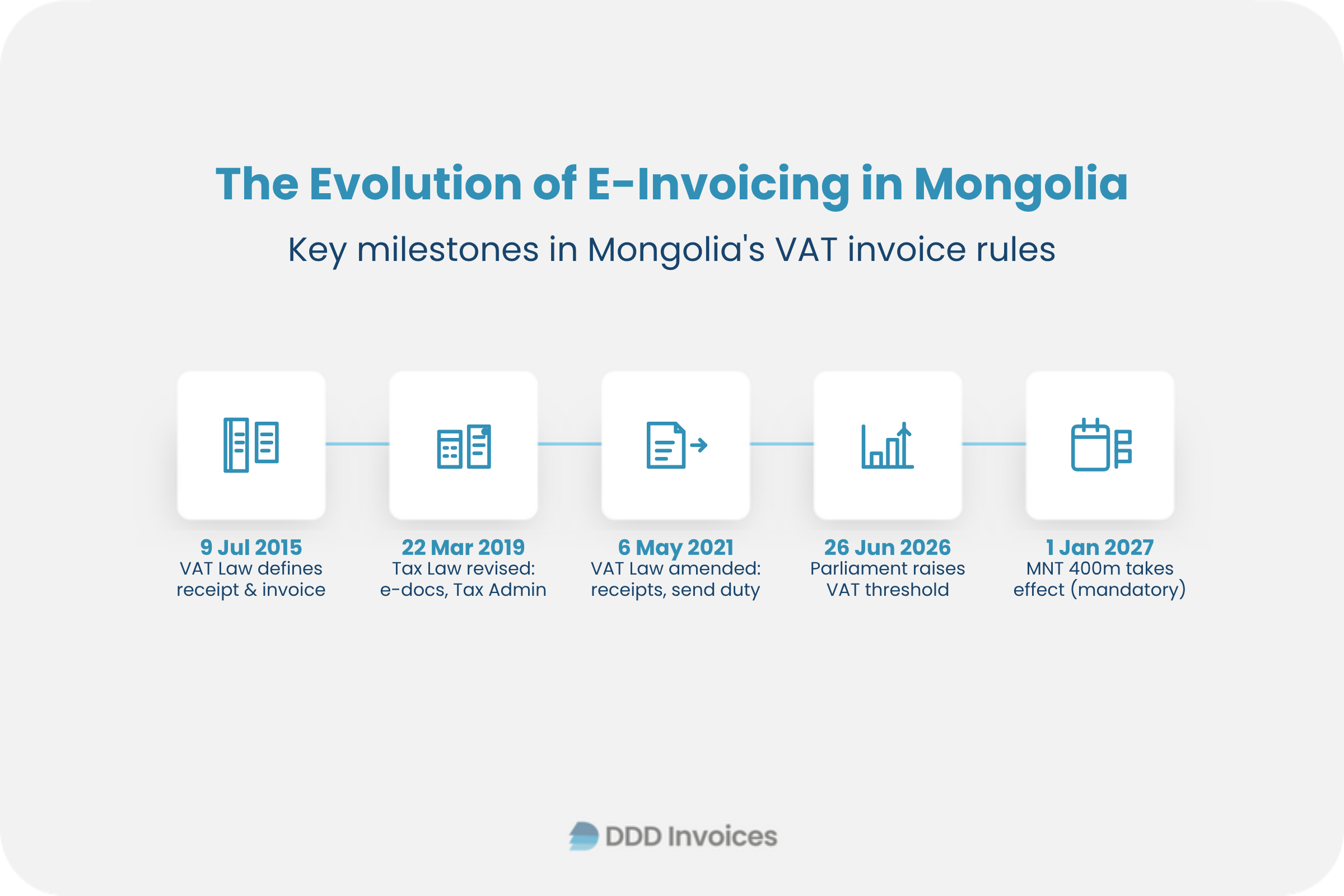
- July 9, 2015: the revised Law on VAT defines the payment receipt, VAT invoice, user system and integrated system.
- March 22, 2019: the General Law on Taxation is revised, defining electronic tax documents and the Tax Administration.
- May 6, 2021: the VAT Law is amended on receipts, VAT invoices and transmission duties.
- June 26, 2026: parliament raises the VAT registration threshold.
- 1 January 2027: the MNT 400 million mandatory threshold takes effect.
B2G e-invoicing in Mongolia
No separate B2G e-invoicing mandate is confirmed in the sources reviewed. Sales to public bodies follow the same rules as other sales: a payment receipt for each sale and, where both sides are VAT withholding taxpayers, a VAT invoice.
Government buyers are not described as using a dedicated invoice-routing channel. Services provided by government organisations are VAT-exempt under Article 13.5.12.
B2B e-invoicing in Mongolia
Under Article 14.3, a receipt is required for each sale between VAT withholding taxpayers. A VAT invoice is then issued for one receipt or for several combined. The buyer's input-tax deduction depends on that VAT invoice (Article 14.4).
Article 17.3.4 requires B2B VAT-invoice records to be sent to the integrated system within seven days. A plain PDF, a scan or a standalone ERP record does not meet this requirement.
Typical onboarding steps:
- Registration: confirm VAT withholding status and taxpayer registration number with the General Department of Taxation.
- Connection: link your ERP or billing system to eBarimt through an approved user system supplier.
- Data mapping: map receipt and invoice fields: taxpayer ID, unique payment number, item code, quantity, price, payment and tax amounts.
- Testing: check that receipts and VAT invoices reach the integrated system, then reconcile them with accounting records.
A unified e-invoicing API can take over the connection and data-mapping steps for software providers working across several markets.
B2C e-invoicing in Mongolia
Under Article 17.3, a VAT withholding taxpayer must record each payment in the user system and issue a receipt for each sale to the buyer. Receipt data must reach the integrated system within three days.
Each receipt carries a unique payment number, built from the seller's registration number, branch number, payment date and sequence number. Receipts include taxpayer identification, item details, and payment and tax amounts. Cash registers and POS terminals count as registration machines.
Imports, exports and non-resident services:
- Imports: VAT of 10% applies to imports. The base is customs value plus duty and excise (Articles 9 and 11). VAT arises on the customs declaration date.
- Exports: qualifying exports, declared goods and services to non-residents are zero-rated under Article 12.
- Non-resident services: supplies by a non-resident to a resident are taxable under Article 7.2.5. Detailed reverse-charge mechanics are not confirmed here.
E-reporting and VAT compliance
Mongolia has no separate periodic e-reporting regime confirmed beyond eBarimt transmission and VAT returns. Electronic invoice reporting does not replace the monthly VAT return.
VAT is 10% standard, with 0% for qualifying exports. Under the VAT Law, VAT is paid and the return filed by the 10th of the following month.
Corrections, cancellations and returns must follow official eBarimt procedures. Reconcile eBarimt data with your ledgers every month. Under Article 11 of the Accounting Law, accounting documents and financial statements must be kept for at least 10 years.
Penalties for non-compliance
Penalties sit in the VAT Law and the Law on Violations. The Tax Administration's VAT guide lists the figures below. Verify them against current law before publication.
Offence | Fine | Escalation or closure |
|---|---|---|
Failure to provide payment receipts | 2% of previous month's sales | Not confirmed |
Receipt issued at a different price from the selling price | 20% of previous month's sales | Not confirmed |
Unpaid tax | 0.1% of unpaid tax per day | Not confirmed |
Underpaid or unregistered VAT | 40% of the tax imposed | 50% if repeated after audit |
Your trusted partner for e-invoicing
Every sale in Mongolia needs an eBarimt receipt, and every B2B sale between VAT withholding taxpayers needs a VAT invoice. Getting both right, on time, across your ERP and POS, is where most teams lose hours.
DDD Invoices removes that work with one unified e-invoicing API. You issue, receive and archive compliant invoices in 30+ countries, without building each local integration yourself. Mongolia is not yet on our coverage page, so support is pending.
Still have questions?
In the 30min free call we will discuss:
- your requirements in invoicing
- how integration works
- demo of the product
- next steps
FAQs
Who must use eBarimt in Mongolia?
VAT withholding taxpayers must issue a receipt for each sale through a connected user system. Between them, a VAT invoice supports the buyer's input-tax deduction.
When must eBarimt data be sent?
Receipt data must generally reach the integrated system within three days. B2B VAT-invoice data must be sent within seven days.
What changes on 1 January 2027?
The mandatory VAT registration threshold rises from MNT 50 million to MNT 400 million. Voluntary registration remains at MNT 10 million.
Does eBarimt replace the VAT return?
No. Monthly VAT returns are still filed and paid by the 10th of the following month, alongside eBarimt reporting.