


Standard
N/A
Tax Portal
TPOS
Tax Authority
Fiji Revenue and Customs Service (FRCS)
CTC Model
Post-audit
B2G
N/A
B2B
Voluntary
Archiving
7 years
Pending DDD Invoices support
Fiji's hotels, importers and distributors bill many regional groups. E-invoicing in Fiji is not yet a structured exchange: the Fiji Revenue and Customs Service (FRCS) digitizes sales through its VAT Monitoring System (VMS).
Fiji has no B2B, B2G or B2C e-invoicing mandate, Peppol network or clearance format. VAT-registered businesses must issue a tax invoice with prescribed particulars at 12.5% for each taxable supply. Gazetted sectors must also issue VMS fiscal invoices, with the last Phase 3 groups due by December 31, 2026.
Latest news
Fiji has no e-invoicing mandate. Instead, the Fiji Revenue and Customs Service (FRCS) runs the VAT Monitoring System (VMS), where accredited devices sign each fiscal invoice and send the sale to FRCS, online or offline. Businesses in gazetted groups with turnover of FJ$50,000 or more must comply by December 31, 2026, the same day FRCS stops VMS Version 2.0.
FRCS issued a final VMS reminder on October 22, 2026. Businesses with turnover of FJ$50,000 or more in gazetted groups must run an accredited fiscal device by December 31, 2026. Expect closer input tax checks, as FRCS flagged duplicated invoices.
The VAT (Budget Amendment) Act 2026 applies from August 1, 2026. Hotels now account for VAT at checkout or the end of the stay, so invoice dates must follow. The 2026-2027 Budget measures left the 12.5% rate unchanged.
Tired of scrolling through information about e-invoicing?
- Register on the platform as a software vendor or a end-client
- Start and complete the integration
- Send your first invoice into the test environment
- Switch to production!
What is e-invoicing and why has Fiji adopted it?
E-invoicing is the exchange of invoices as structured data that software reads without re-keying.
Fiji has not adopted it: under its post-audit model, PDF or paper tax invoices with the prescribed particulars are valid. FRCS focuses on the VMS, and the difference from fiscalization matters: fiscal invoices are signed records, not e-invoices. Structured e-invoicing is not yet announced.
The evolution of e-invoicing in Fiji
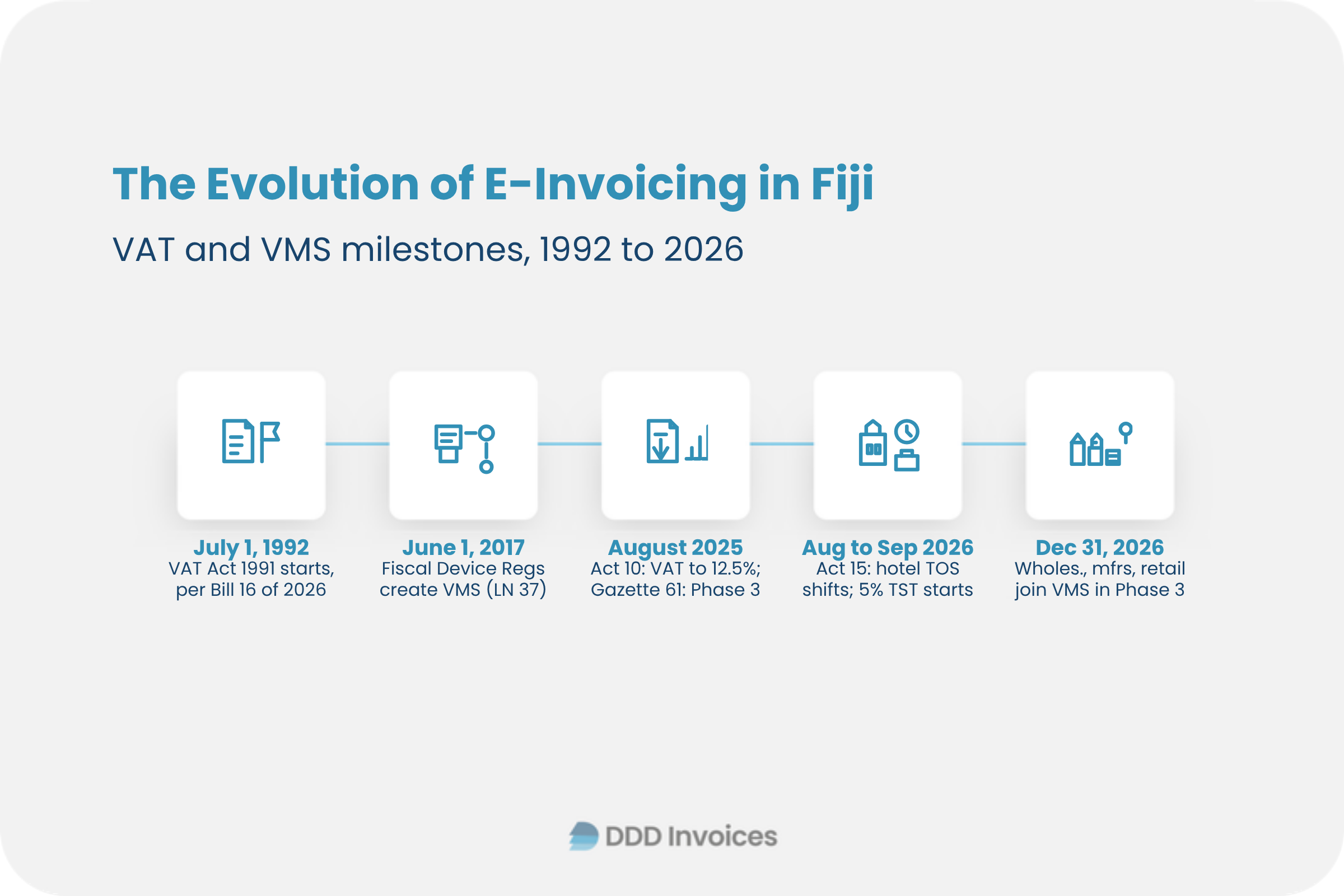
- July 1, 1992: The VAT Act 1991 commences, per the Bill No. 16 of 2026 note.
- June 1, 2017: The Electronic Fiscal Device Regulations (Legal Notice No. 37) create the VMS.
- August 2025: Act 10 of 2025 cuts VAT to 12.5% under the revised VAT Act; Gazette Notice 61 sets Phase 3.
- August to September 2026: Act 15 of 2026 moves the hotel time of supply, and the 5% Tourism Services Tax (TST) starts.
- December 31, 2026: Wholesalers, manufacturers and retailers join the VMS, per the Phase 3 timelines.
B2G e-invoicing in Fiji
B2G e-invoicing is not mandatory. Suppliers to public bodies issue the tax invoice required by section 41 of the VAT Act, with no portal or structured format.
B2B e-invoicing in Fiji
B2B e-invoicing is voluntary, so PDF or paper tax invoices remain valid. Section 41 requires one tax invoice per taxable supply, with the particulars in regulation 3 of the VAT Regulations 1991. In gazetted sectors, B2B invoices must be fiscal invoices with an FRCS signature and QR code. A proforma invoice never supports input tax, as FRCS’s invoice clarification confirms.
- Register within 21 days of exceeding FJ$100,000 turnover.
- Set up invoice fields: “tax invoice”, a serialized number, issue date, both parties’ names and addresses, supplier TIN (Taxpayer Identification Number), description and quantity.
- Show the tax: VAT charged and totals excluding and including VAT, with labels for 12.5%, zero-rated and exempt.
- Add TST as a separate 5% line if you are a tourism operator above FJ$2 million turnover.
- Handle cross-border supplies: zero-rate exports under Schedule 2 once earnings are remitted. FRCS Customs collects import VAT, and services from non-residents attract the VAT Reverse Charge under section 21.
- Test corrections: credit and debit notes under regulation 11 state the original and adjusted tax and the reason.
- Check supplier invoices on the public VMS portal before claiming input tax.
B2C e-invoicing in Fiji
B2C e-invoicing is not mandatory. Retail supplies and supplies of FJ$100 or less may use a simpler tax invoice, and supplies of FJ$10 or less need none unless requested.
Gazetted sectors issue a VMS fiscal invoice for every sale. Device rules are fiscalization requirements, outside e-invoicing.
E-reporting and VAT compliance
Fiji has periodic e-reporting: VAT-registered businesses file scheduled VAT returns through the TPOS portal. Returns are monthly if annual turnover is above FJ$300,000 and quarterly if it is at or below that. Each return is due by the last day of the following month, under section 33 of the VAT Act 1991.
Rates are 12.5% and 0%, plus exempt supplies. Input tax needs a valid tax invoice, credit note or debit note under section 39(5). Section 79 of the VAT Act requires records to be kept in Fiji, in English, for 7 years.
Penalties for non-compliance
Penalties range from 20% surcharges under the Tax Administration Act 2009 to FJ$25,000 fines under VAT Act section 72.
Offence | Fine |
|---|---|
No tax invoice issued (VAT Act s. 72(2)) | Up to FJ$5,000 per month of default; FJ$15,000 second time; FJ$25,000 after |
False or incomplete tax invoice (s. 72(4)) | FJ$10,000 or 3 times the tax; FJ$20,000 or 3 times on repeat |
Late VAT return (TAA s. 43) | 20% of tax plus 5% per month |
Late VAT payment (TAA s. 44) | 25% of unpaid tax plus 5% per month |
Improper records (TAA s. 45) | 20% of tax; 75% if knowing or reckless |
Invalid supplier invoice (VAT Act s. 39(5)) | Input tax refused |
Your trusted partner for e-invoicing
Fiji asks for accurate 12.5% tax invoices, not structured e-invoices, while Australian and New Zealand parents already work with Peppol. DDD Invoices offers a unified e-invoicing API so your ERP can issue, receive and archive invoices across supported countries. Fiji is not yet on our country coverage list, so share your Fijian setup and we will watch FRCS changes with you.
Still have questions?
In the 30min free call we will discuss:
- your requirements in invoicing
- how integration works
- demo of the product
- next steps
FAQs
Is e-invoicing mandatory in Fiji?
No, Fiji has no B2B, B2G or B2C e-invoicing mandate or clearance platform. VAT-registered suppliers must still issue tax invoices with prescribed particulars, and gazetted sectors must issue VMS fiscal invoices.
What must a Fiji tax invoice include?
A Fiji tax invoice shows the words "tax invoice", a serial number, the date and supplier TIN. It also lists both parties, a description, quantity, VAT charged and totals with and without tax.
How can buyers check a supplier's fiscal invoice?
Buyers can check a fiscal invoice on the FRCS public VMS portal, with or without its QR code. Doing this before claiming input tax helps avoid refused deductions for invalid or duplicated invoices.
When are VAT returns due in Fiji?
Fiji VAT returns are due by the last day of the month after each taxable period. Businesses above FJ$300,000 turnover file monthly, while smaller registered businesses file quarterly through TPOS.


