

Standard
Revenue Service web service protocol
Tax Portal
Revenue Service e-services portal
Tax Authority
Revenue Service, Ministry of Finance of Georgia
CTC Model
Centralized portal with buyer confirmation, no pre-clearance
B2G
N/A
B2B
N/A
Archiving
3 Years
Pending support by DDD invoices
Georgia's Revenue Service, under the Ministry of Finance, lists more than 470,000 registered legal entities on its e-services portal. E-invoicing in Georgia happens there, through electronic tax invoices that buyers confirm or reject.
VAT-registered businesses must issue a tax invoice for each supply to another taxable person, and electronic invoices run through the Revenue Service portal. Since October 1, 2026, buyers must confirm or reject received invoices by the 5th day of the following month, or lose their other e-services.
Latest news
A Revenue Service confirmation rule for the e-services portal applies from October 1, 2026. Received tax invoices or special tax invoices still pending on the 5th day of the following month now block the buyer's other e-services. The block covers the main user and all sub-users, leaving only the invoice modules open until they are answered.
From November 1, 2026, an Order No. 996 amendment makes corrective tax invoices show any VAT increase or decrease directly.
Tired of scrolling through information about e-invoicing?
- Register on the platform as a software vendor or a end-client
- Start and complete the integration
- Send your first invoice into the test environment
- Switch to production!
What is e-invoicing and why has Georgia adopted it?
E-invoicing is the exchange of invoices as structured electronic data. In Georgia's centralized model, sellers issue tax invoices in the Revenue Service system and buyers confirm or reject them. A valid tax invoice backs the buyer's input VAT deduction.
The evolution of e-invoicing in Georgia
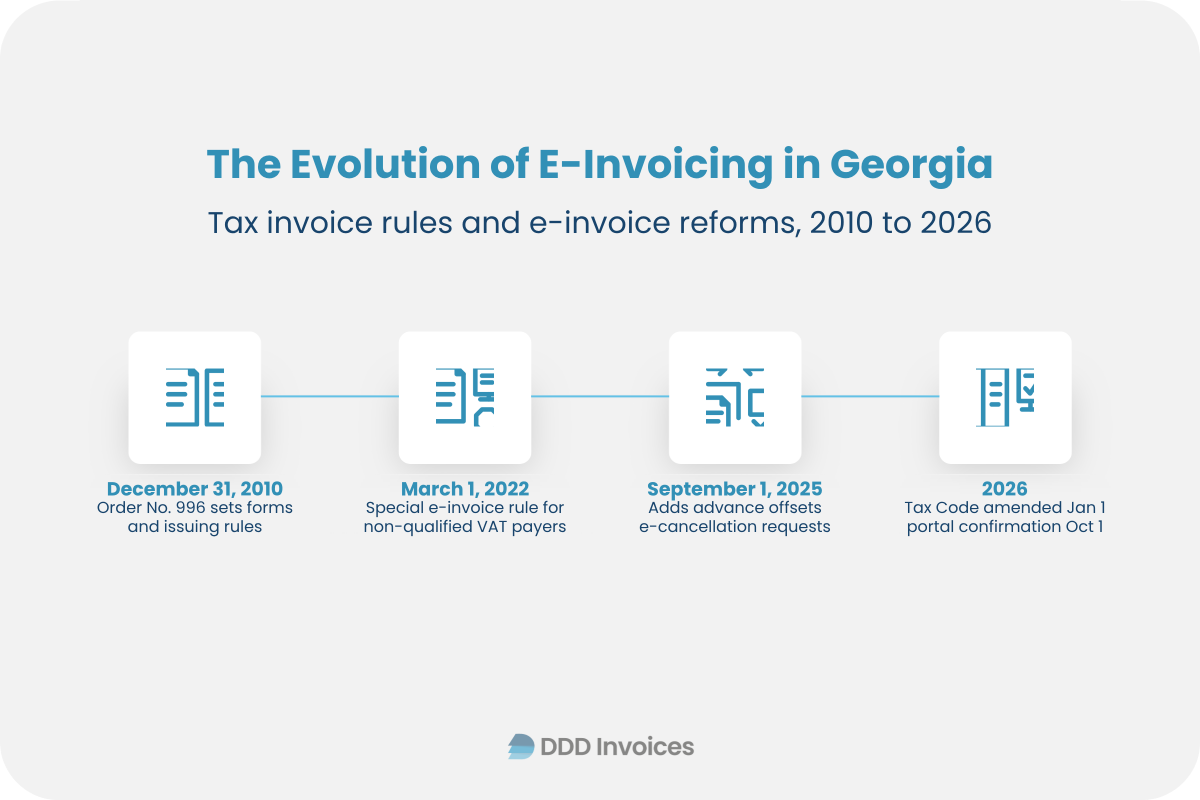
- December 31, 2010: Minister of Finance Order No. 996 sets tax invoice forms and issuing rules.
- March 1, 2022: Order No. 3751 lets the Revenue Service restrict invoice rights and apply a special e-invoice rule to non-qualified VAT payers.
- September 1, 2025: Order No. 207 adds advance offsets, consolidated invoices and electronic cancellation requests.
- 2026: Law No. 1061 amends the Tax Code from January 1, and portal confirmation is enforced from October 1.
B2G e-invoicing in Georgia
The Tax Code sets no separate B2G e-invoicing rule, so public-sector suppliers follow the B2B tax invoice rules. Tenders run through the Unified Electronic System of Public Procurement under the Law on Public Procurement, and the B2G e-invoicing guide compares other countries.
B2B e-invoicing in Georgia
Tax invoices are mandatory when a VAT-registered seller supplies another taxable person, on paper or electronically under Tax Code Article 180. A requested invoice must reach the buyer within 30 calendar days under Order No. 996, Article 54.
- Special tax invoices: form III-06, issued at supply, carries transport details instead of a waybill, and petroleum products have their own.
- E-waybills: needed when goods move within Georgia for business or a buyer asks, and one invoice can cover several waybills.
- Register for VAT: within 2 business days of passing GEL 100,000 of taxable supplies in any 12 consecutive months.
- Secure portal access: enable two-step SMS verification and create sub-users.
- Connect your software: use the Revenue Service web service protocol, testing first with portal test users.
- Confirm and file: answer received invoices by the 5th day of the following month, then attach them to the VAT return.
Revenue Service sites offer English, but amending acts such as Order No. 207 are published in Georgian.
B2C e-invoicing in Georgia
Consumer sales need a tax invoice only on request, under Article 180(3). Businesses taking cash must record it on a cash register, with listed exemptions. Plans for unified-system cash registers and e-commerce terminals from May 1, 2028 are pending official confirmation. Receipts fall under fiscalization rules, not e-invoicing.
E-reporting and VAT compliance in Georgia
Georgia has no separate periodic e-reporting obligation. Confirmed invoices are attached to the monthly VAT return, filed and paid by the 15th of the following month.
- Rate: 18% under Tax Code Article 166. Articles 170 and 171 exempt without the right of deduction, and Article 172 with it.
- Non-residents: services they supply in Georgia are reverse charged under Article 161, and digital sellers to consumers file quarterly.
- Other regimes: Small Business individuals pay 1% of income, or 3% once gross income passes GEL 500,000. Companies pay Estonian-style 15% profit tax only on distributed profit.
- Records: tax documents are kept 3 years from the end of the relevant year (Article 43). Accounting documents need 6 years under the Law on Accounting, Reporting and Audit.
Penalties for non-compliance in Georgia
Tax Code Articles 280 to 286 set fines from GEL 200 to 200% of the VAT on a fake invoice.
Offence | Fine |
|---|---|
No VAT registration (Article 282(1)) | 5% of taxable transactions while unregistered |
Refusing a requested tax invoice (Article 282(2)) | 100% of the transaction's VAT |
Fictitious or fake tax invoice (Article 282(3)) | 200% of the VAT shown |
Deduction on a fictitious or fake document (Article 280) | 200% of the deducted VAT |
Goods moved without a waybill, or one not issued or accepted (Article 286(1)) | GEL 500, or a warning the first time |
Cash taken without a cash register (Article 281) | GEL 200, or a warning the first time |
Your trusted partner for e-invoicing in Georgia
Tax invoices are mandatory for VAT payers to issue, and a received invoice left unanswered past the 5th blocks other e-services. DDD Invoices flags missing or incorrect data through a single API before processing, and it can archiveinvoices where supported. Georgia has no DDD connection yet, but a call can scope your Georgian entity while your ERPruns markets from the country coverage list.
Still have questions?
In the 30min free call we will discuss:
- your requirements in invoicing
- how integration works
- demo of the product
- next steps
FAQs
How do buyers confirm tax invoices in Georgia?
Buyers confirm or reject each received tax invoice in the Revenue Service portal or web service. Since October 1, 2026, invoices still pending on the 5th day of the following month block other e-services.
What is a tax document in Georgian VAT?
A tax document is a Minister of Finance form that replaces both the waybill and tax invoice. Under Article 72¹ of the Tax Code it still supports VAT deduction and can be issued electronically.
When must a business register for VAT in Georgia?
Apply within 2 business days of passing GEL 100,000 of taxable supplies in any 12 consecutive months. VAT is due from the transaction that crosses the threshold, and voluntary registration is also allowed.
Why do foreign digital sellers pay VAT in Georgia?
Foreign providers selling digital services to Georgian consumers who are not VAT payers owe Georgian VAT. They file quarterly returns through the VAT Portal on Digital Services by the 20th after each quarter.