There is a saying: “Nothing is certain in life except death and taxes”. So if taxes are certain, at least complying with them should be easy, right? Right…
The world of business transactions is rapidly evolving.
The way companies interact with one another for business purposes is currently being shaped by a global wave called “electronic invoicing”, with governments being the main reason for widespread adoption.
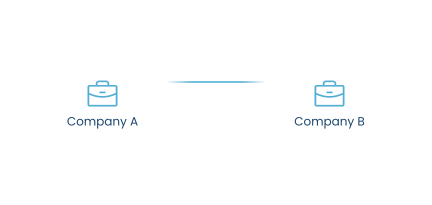
Looking back, however, the exchange of business documents has always been essential as the basis for, or proof of, transactions and has typically followed direct exchanges between companies.
From paper to APIs
For most of history, documents were exchanged in physical form. Then, with the rise of computers in the 1960s, business documents gradually became file- and code-based.During the Electronic Data Interchange (EDI) era, larger enterprises adopted electronic document exchange through private, tightly coupled integrations between long-established business partners, primarily to automate procurement and accounting workflows. For most companies, however, connecting systems through EDI was too costly, complex, and operationally burdensome to justify. As a result, the vast majority of businesses continued to rely on paper-based processes and manual document handling.
Then, in the 1990s, Adobe introduced the PDF format, enabling documents to be shared digitally in a consistent visual layout across devices and operating systems. Businesses quickly adopted PDFs for exchanging invoices and other commercial documents, and even today — nearly 50 years after the first EDI document exchanges — PDFs are still widely used.
But while PDFs worked well for humans, they were never designed for machines or for structured software-to-software data exchange. Behind nearly every “digital” document, manual processing and data entry still remained.
Then modern APIs evolved to such a degree that they allowed communication over various networks, systems and geographical locations in an easier, faster & reliable way.
This allowed a wider set of institutions to look into areas of optimisations of data flows — including the governments.
Governments
For most governments, taxes represent one of the primary sources of public revenue, while invoices and receipts serve as key records of economic and business activity.Traditionally, this has been tracked through mandatory periodic reporting, but this system is not perfect, allows for loopholes (grey economy) and doesn't provide fully accurate data. The result is the VAT gap: the difference between how much taxes governments expect to collect and what they actually receive.
As governments want to close the VAT gap, the development of fast and reliable APIs allowed them to automate & tighten reporting requirements. This has led to the rise of Continuous Transaction Control (CTC) mandates.
Under CTC mandates, companies must report transactions to tax authorities in real time. This allows governments to monitor tax collection more accurately and reduce fraud.
For the first time, governments are no longer just observing transactions after the fact, but are becoming part of them, sometimes being placed in between companies.
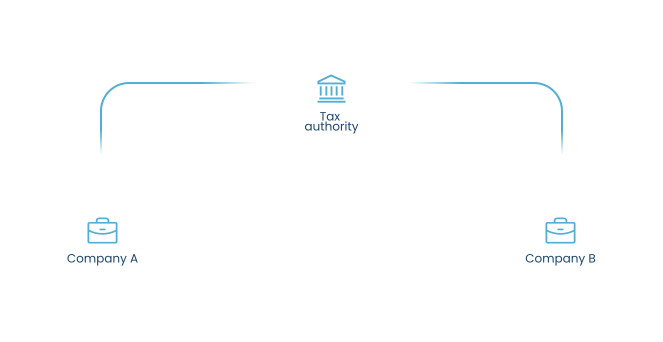
To enable this, APIs require structured data formats — and governments have chosen electronic invoicing as the foundation for real-time tax reporting. In short, e-invoicing has become a mechanism for automated tax reporting and consequently collection tracking.
Because each government typically requires a locally specific e-invoice, and establishes a local tax portal in which all transactions/invoices have to be reported, this results in a highly fragmented landscape of different formats, tax rules, legal systems, languages, and authentication methods — just to stay compliant.
With regulations tightening, and the areas of transaction, exchange of business documents, payments, taxes & sustainability overlapping and integrating, complexity only grows.
A new approach is needed.
A truly unified API, AI processing for any unstructured business document, and pre-built integrations that connect the systems faster. These flexible entry points feed data into our e-invoicing engine, which transforms it into locally compliant e-invoices and automatically delivers them to the appropriate tax authority and recipient. On the incoming side, the platform standardises invoices and business documents from any source into a single API, and provides a streamlined data flow with ERP, accounting, and other back-end business systems.
By processing documents not only structurally, but also contextually, we transform what was once just a static document into actionable business logic, enabling not only compliance, but also intelligent process automation.
This represents a modern, unified solution for global operations — designed for companies launching internationally, expanding into new markets, and operating legal entities across multiple jurisdictions.
That's why DDD Invoices exists.
A standardisation to bring simplicity in the new era of business transactions.
To allow companies and people to do what they do the best: grow without friction and experience the borderless business world.
Because each government typically requires a locally specific e-invoice, and establishes a local tax portal in which all transactions/invoices have to be reported, this results in a highly fragmented landscape of different formats, tax rules, legal systems, languages, and authentication methods — just to stay compliant.
With regulations tightening, and the areas of transaction, exchange of business documents, payments, taxes & sustainability overlapping and integrating, complexity only grows.
A new approach is needed.
Simplicity, standardisation and the future
To solve this issue thoroughly and globally, a standardised, but flexible compliance abstraction layer between the regulators and the business sector was designed.A truly unified API, AI processing for any unstructured business document, and pre-built integrations that connect the systems faster. These flexible entry points feed data into our e-invoicing engine, which transforms it into locally compliant e-invoices and automatically delivers them to the appropriate tax authority and recipient. On the incoming side, the platform standardises invoices and business documents from any source into a single API, and provides a streamlined data flow with ERP, accounting, and other back-end business systems.
By processing documents not only structurally, but also contextually, we transform what was once just a static document into actionable business logic, enabling not only compliance, but also intelligent process automation.
This represents a modern, unified solution for global operations — designed for companies launching internationally, expanding into new markets, and operating legal entities across multiple jurisdictions.
That's why DDD Invoices exists.
A standardisation to bring simplicity in the new era of business transactions.
To allow companies and people to do what they do the best: grow without friction and experience the borderless business world.

Denis V. P.
co-founder & CEO

Dušan Pondelak
co-founder & chief architect