
Standard
UBL 2.1 XML
Tax Portal
JoFotara portal
Tax Authority
Income and Sales Tax Department (ISTD), Ministry of Finance
CTC Model
Centralized clearance
B2G
2023
B2B
2023
Archiving
4 Years
Pending support by DDD invoices
Jordanian experts built the national invoicing platform to handle 60 million invoices a day. E-invoicing in Jordan runs on JoFotara, which the Income and Sales Tax Department (ISTD) operates with the Ministry of Digital Economy and Entrepreneurship (MoDEE).
Any seller of goods or services worth JOD 1 or more must issue invoices through JoFotara, unless it falls in a narrow exempt category. ISTD validates each invoice, sent as UBL 2.1 XML from linked software, and returns a QR code. Since April 1, 2025, local purchases count as deductible expenses only with JoFotara invoices.
Latest news
ISTD approved version 1.5 of its technical integration guide on May 14, 2026. It keeps Base64-encoded UBL 2.1 XML inside JSON and documents three response statuses: SUBMITTED, ALREADY_SUBMITTED and NOT_SUBMITTED.
ERP flows must resend failed calls with the same ID and UUID, then store and print the returned QR code.
Tired of scrolling through information about e-invoicing?
- Register on the platform as a software vendor or a end-client
- Start and complete the integration
- Send your first invoice into the test environment
- Switch to production!
E-Invoicing in Jordan: Current Requirements for 2026
E-invoicing is the exchange of invoices as structured electronic data. Jordan follows a clearance model: Article 4 of Regulation No. 34 of 2019 adopts invoices issued by JoFotara or a linked system. ISTD calls it a data reform that adds no tax and speeds audits and tax clearances.
The evolution of e-invoicing in Jordan
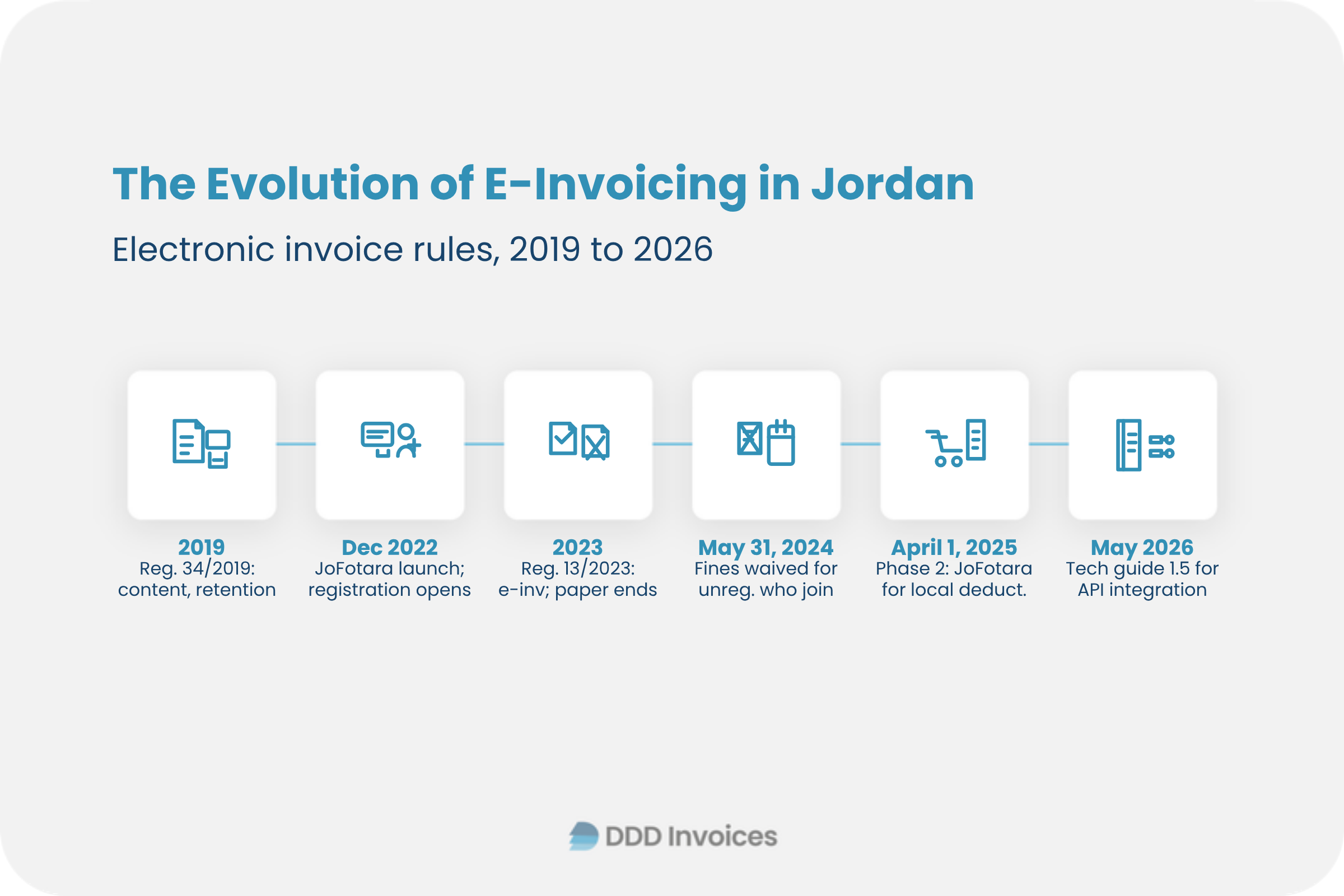
- 2019: Regulation No. 34 of 2019, issued under Article 23(f) of the Income Tax Law, sets invoice content, retention and exemptions.
- December 2022: ISTD and MoDEE launch JoFotara and open registration.
- 2023: Amending Regulation No. 13 of 2023 recognizes JoFotara e-invoices and ends the need for paper copies.
- May 31, 2024: ISTD waives fines for unregistered businesses that join by this date.
- April 1, 2025: Phase 2 starts under Amending Regulation No. 2 of 2025, so deductible local purchases need JoFotara invoices.
- May 2026: ISTD approves technical guide version 1.5 for API integration.
B2G e-invoicing in Jordan
Sales to the public sector follow the same JoFotara rules. A Minister of Finance circular limits ministries and public bodies to suppliers registered in JoFotara, and buyers check registration on an ISTD query page.
B2B e-invoicing in Jordan
JoFotara is mandatory for B2B sales, whether or not the seller is registered for GST, and sellers outside GST issue income invoices. Instructions No. 1 of 2019 exempt listed shops, traditional restaurants and home businesses with annual sales up to JOD 75,000. Licensed crafts up to JOD 30,000 and bread-only bakeries up to JOD 150,000 are also exempt.
- Sign in to e-services: open National Invoicing from ISTD's e-services portal with an active tax number.
- Create the account: set the admin username and password, as the 2026 joining guide shows.
- Pick a path: add sub-users to issue on the portal, or use device linking to get a Client ID and Secret Key.
- Integrate: send each invoice with a unique ID, UUID and income source sequence (activity number), then print the returned QR code.
B2C e-invoicing in Jordan
Consumer sales use the same invoice types and QR code, and buyer details are optional on cash invoices under JOD 10,000. Markets may issue one consolidated daily invoice with ISTD approval (Article 7). ISTD's cash machine guidelines also treat a machine tape as an invoice for some retail activities, a fiscalization topic outside this guide.
E-reporting and GST compliance in Jordan
Jordan has no separate periodic e-reporting, because each invoice reaches ISTD through JoFotara when it is issued.
- GST: 16% standard under Article 6 of the General Sales Tax Law, plus special tax on Table (1) goods and services.
- Registration: JOD 75,000 of sales in 12 months for trade and industry, or JOD 30,000 for services, per ISTD guidance.
- Returns: general tax every two months and special tax monthly, paid in the following month (Article 16).
- Exports and imports: exports are zero-rated and use JoFotara export codes for cross-border invoicing, while imports pay GST at customs.
- Corrections: a return invoice (code 381) cites the original ID, UUID and total, covers quantities only and states a reason.
- Records: keep invoices 4 years under Article 8 of Regulation No. 34, where JoFotara data replaces paper, and GST records 5 years.
Penalties for non-compliance in Jordan
Article 15 of Regulation No. 34 refers penalties to the Income Tax Law. Article 64 sets JOD 200 to 500 per case, doubled on repetition.
Offence | Fine |
|---|---|
Not issuing an invoice or receipt when the buyer asks | JOD 200 to 500 |
Not keeping or presenting books and records | JOD 200 to 500 |
Repeating any Article 64 offense | Amount doubled |
Not issuing a proper invoice, treated as tax evasion (Article 66) | A penalty equal to the tax difference |
Repeated tax evasion | Prison from four months on a second case, up to three years from the fourth |
Your trusted partner for e-invoicing in Jordan
Invoices from your Jordanian entity must clear JoFotara and carry its QR code, a mandatory step that adds UBL 2.1 XML to your stack. DDD Invoices converts one standardized JSON payload into local XML through a unified e-invoicing API, covering issued, received and archived invoices where supported. Jordan is outside the country coverage list for now, so a call can map your three JoFotara invoice types to your ERP data.
Still have questions?
In the 30min free call we will discuss:
- your requirements in invoicing
- how integration works
- demo of the product
- next steps
FAQs
How do I connect an ERP to JoFotara?
Generate a Client ID and Secret Key under device linking, then post Base64-encoded UBL 2.1 XML to JoFotara. Store each returned status, UUID and QR code, and resend failed calls with the same ID and UUID.
What invoice types does JoFotara use?
JoFotara issues income invoices for non-GST sellers, general sales invoices for GST registrants and special tax invoices. Each is a new invoice (388) or a return (381), paid in cash or as a receivable.
When does a JoFotara invoice need the buyer's name?
The buyer's name is required on receivable invoices and on cash invoices of JOD 10,000 or more. Without it, the API returns a validation error, and development-zone invoices also need the buyer's tax number.
Why must a JoFotara invoice show a QR code?
The ISTD QR code proves the invoice was accepted, and the technical guide requires it on every invoice. Buyers scan it in the Sanad app to check the total, tax, date, seller name and tax number.