



Standard
N/A
Tax Portal
N/A
Tax Authority
General Commission for Taxes
CTC Model
N/A
B2G
N/A
B2B
N/A
Archiving
N/A
Pending DDD Invoices support
Every shipment cleared at a federal Iraqi customs centre now leaves an electronic record, yet no sales invoice reaches a tax system. The General Commission for Taxes (GCT) of the Ministry of Finance runs income tax and sales tax. E-invoicing in Iraq has no legal basis yet, and the Kurdistan Region runs a separate tax administration.
Iraq has no e-invoicing or clearance mandate; periodic sales-tax reporting exists, but a mandatory e-reporting requirement has not been verified. No invoice format or go-live date exists. There is no VAT: sales tax applies to listed services and goods, alongside customs duties. Importers must file electronic customs declarations in ASYCUDA, which replaced paper declarations on January 1, 2025.
Latest news
Iraq has no tax e-invoicing mandate, and the General Commission for Taxes has set no format or start date. Businesses can use electronic invoices by mutual agreement. Since 10 July 2026, customs has required importers to validate commercial invoices and certificates of origin electronically through ASYCUDA.
On October 6, 2026, Cabinet Resolution No. 544 suspended Cabinet Resolution No. 413 of 2026, as the Ministry of Finance announced the next day. From October 1, 2026, Resolution No. 413 had made importers prepay customs duties and estimated tax deposits through ASYCUDA. Only then could banks send import payments abroad. Importers who prepaid should ask their bank how those amounts will be settled.
The GCT also launched an electronic tax assessment system for large taxpayers in October 2026, so they can complete assessments and pay remotely. Neither change creates an e-invoicing duty.
What is e-invoicing and why has Iraq adopted it?
E-invoicing is the exchange of invoices as structured data that software can process without retyping.
Iraq has not adopted it, so there is no clearance model, platform or reporting format. Digitalisation targets customs instead, through the UNCTAD ASYCUDA project the Ministry of Finance funds to automate clearance and raise revenue.
The evolution of e-invoicing in Iraq
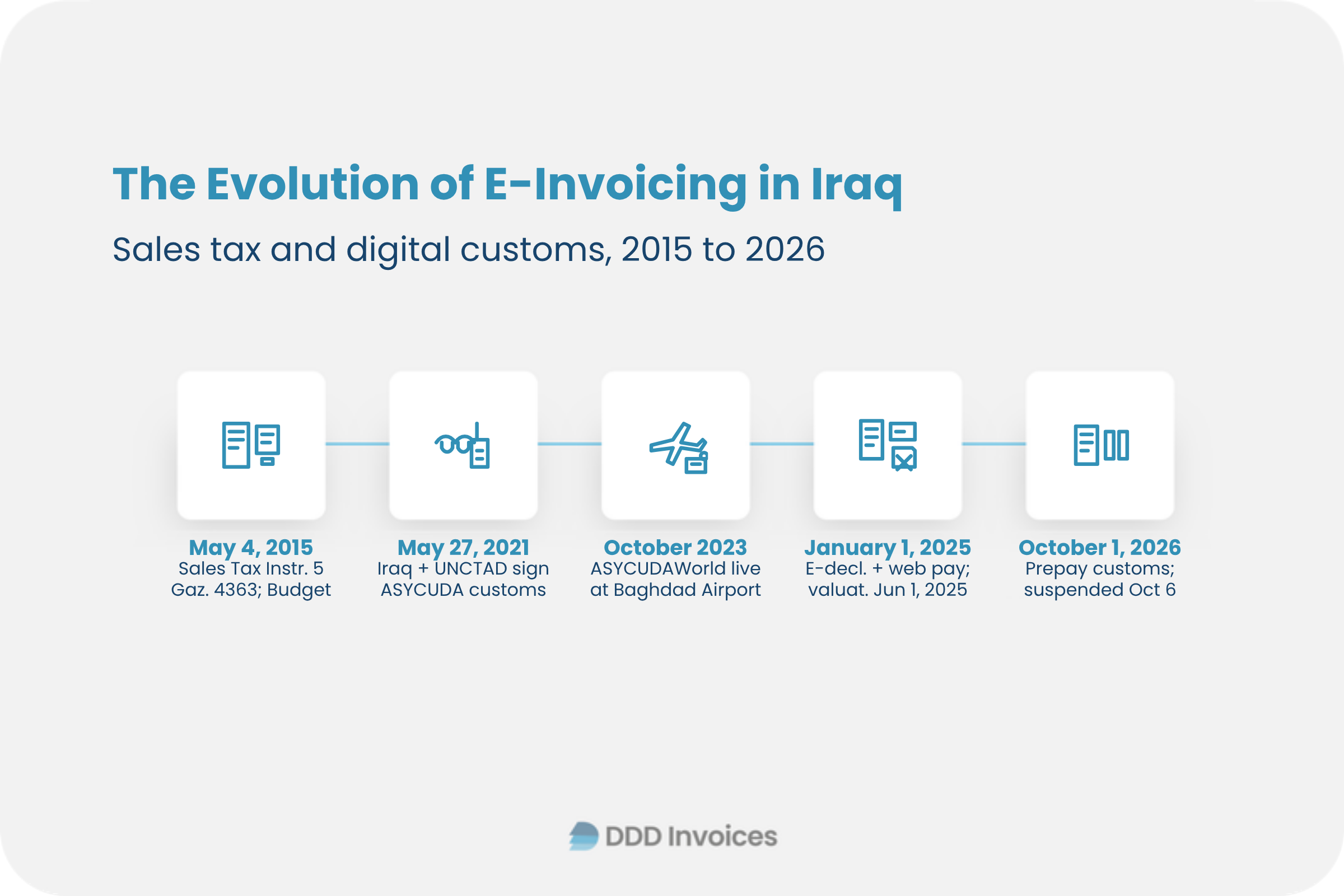
- May 4, 2015: Sales Tax Instructions No. 5 of 2015 appear in Official Gazette No. 4363, under the 2015 Federal Budget Law.
- May 27, 2021: Iraq and UNCTAD sign the ASYCUDA agreement to automate customs clearance.
- October 2023: ASYCUDAWorld goes live at Baghdad International Airport.
- January 1, 2025: electronic declarations and web payment replace paper; a valuation system follows on June 1, 2025 under Cabinet Resolution No. 270 of 2025, per the Ministry of Finance.
- October 1, 2026: advance customs collection under Cabinet Resolution No. 413 of 2026 starts, then is suspended on October 6, 2026.
B2G e-invoicing in Iraq
There is no B2G e-invoicing mandate, portal or format. Suppliers invoice ministries and state companies directly, in the form each contract requires. Teams that already use B2G e-invoicing portals elsewhere need no Iraqi connection today.
B2B e-invoicing in Iraq
B2B e-invoicing is not mandatory, and no law fixes an electronic format, signature or exchange network. No published GCT guidance lists mandatory invoice fields, so issue complete invoices that support your income tax and sales tax filings.
In the Kurdistan Region, the Ministry of Finance and Economy charges corporate income tax at a flat 15%. It assesses the tax from approved financial statements. Groups active in both areas deal with two tax administrations whose rules are not yet harmonised.
Federal crossings use ASYCUDA, and Kurdistan Region crossings were scheduled to join from October 1, 2026; full rollout there is not yet officially confirmed. UNCTAD plans an electronic single window linking clearance agencies as the next phase.
- Register with the GCT, or with the Kurdistan Region tax directorate for operations there.
- Declare imports in ASYCUDA, matching each declaration to its commercial invoice.
- Keep invoices, contracts and import documents behind every tax filing.
- Screen counterparties against the UN 1518 sanctions list and OFAC Iraq-related sanctions.
- Watch Ministry of Finance notices for any VAT or e-invoicing announcement.
B2C e-invoicing in Iraq
B2C e-invoicing is not mandatory, and no fiscal device or e-receipt rule applies to shops or online sellers. Mobile and internet providers must show sales tax to consumers and file quarterly accountant-certified reports under the 2015 sales tax instructions. A POS integration needs no local certification today.
E-reporting and VAT compliance in Iraq
Iraq has periodic reporting obligations for certain sales taxes. The General Commission for Taxes publishes a sales-tax reporting form documenting monthly payments for tourist establishments. However, the official sources reviewed do not establish a mandatory periodic electronic reporting requirement.
A general VAT regime was not established. Iraq applies selective sales taxes; confirm current rates and filing obligations with the General Commission for Taxes.
Penalties for non-compliance in Iraq
Iraq sets no e-invoicing penalties; exposure comes from tax, customs and sanctions rules, and no accessible official source lists current fines.
Offence | Penalty |
|---|---|
No e-invoice issued | Not applicable, no mandate |
Late or missing income tax filing | Delay fine under Income Tax Law No. 113 of 1982, amount not confirmed |
Customs value that does not match the invoice | Customs penalties, amount not confirmed |
Dealing with a listed person | Assets frozen under UN rules; US enforcement under OFAC sanctions |
Your trusted partner for e-invoicing
With no Iraqi mandate yet, regional groups mostly need clean commercial invoices and a setup ready for whatever rule comes next.
DDD Invoices connects your ERP once to a unified e-invoicing API covering 30+ countries. You can then issue, receive and archive invoices there after testing for free. Iraq is not on our country coverage list today, so a call lets us cover your other markets now and record your Iraqi needs.
Still have questions?
In the 30min free call we will discuss:
- your requirements in invoicing
- how integration works
- demo of the product
- next steps
FAQs
Is e-invoicing mandatory in Iraq?
No, Iraq has no e-invoicing, e-reporting or clearance mandate, and no go-live date exists. Businesses issue their own invoices, which must still support income tax, sales tax and customs filings.
Does Iraq have VAT?
No, Iraq has no VAT, so businesses file no VAT returns and claim no input tax. Sales tax applies instead to listed items such as mobile services, air tickets, cars, tobacco and alcohol.
What is ASYCUDA in Iraq?
ASYCUDA is the UNCTAD customs system Iraq uses for electronic declarations, valuation and duty payments. It handles customs data only, so it does not issue, validate or exchange sales invoices between businesses.
Why match commercial invoices to ASYCUDA data?
Customs values in ASYCUDA rest on the commercial invoice, shipping documents and declared goods. Matching records help importers clear goods smoothly and answer any later customs or tax authority questions.


