

Under the Estatuto Tributario, fiscalization in Colombia runs on electronic sales documents validated before issue, without fiscal printers or certified cash registers. The Dirección de Impuestos y Aduanas Nacionales (DIAN) oversees it through its sistema de facturación, rewritten by Ley 2155 of 2021.
Merchants, professionals and VAT (IVA) or consumption tax (INC) taxpayers must cover every sale with a DIAN-validated factura electrónica de venta or POS electrónico. Paper POS tickets ended by July 1, 2024, and since April 1, 2025 sellers may ask buyers only for name, ID and email.
Latest news
Colombia's fiscalization is software-based: no fiscal printers or certified cash registers. The tax authority, DIAN, validates electronic invoices and POS documents online, making it a clearance model, not a hardware one.
On October 29, 2026, the government filed the Ley de Rescate Económico bill (Proyecto de Ley 477 de 2026), which would raise invoicing fines. It proposes 5% of defective invoices' value, capped at 3,500 UVT (tax value units), and a new fine for not invoicing. It was still in committee on November 24, 2026, so current penalties apply.
On November 25, 2026, the DIAN's draft UVT resolution proposed COP 55,673 for 2027. It is not yet confirmed, so 2027 fine caps stay provisional.
What does fiscalization mean in Colombia?
Fiscalization is recording each sale in a tax-authority-approved system that reports it.
Sellers issue a factura electrónica de venta (FEV) or a POS electrónico (electronic POS ticket). Each is a digitally signed XML with a unique code, called CUFE or CUDE, which the DIAN validates before issue.
Issuers use their own software, a proveedor tecnológico (technology provider) or the DIAN's free FEV service. They first complete habilitación (test enablement) and obtain numbering ranges under Resolución 000165.
Tired of scrolling through information about e-invoicing?
- Register on the platform as a software vendor or a end-client
- Start and complete the integration
- Send your first invoice into the test environment
- Switch to production!
Timeline
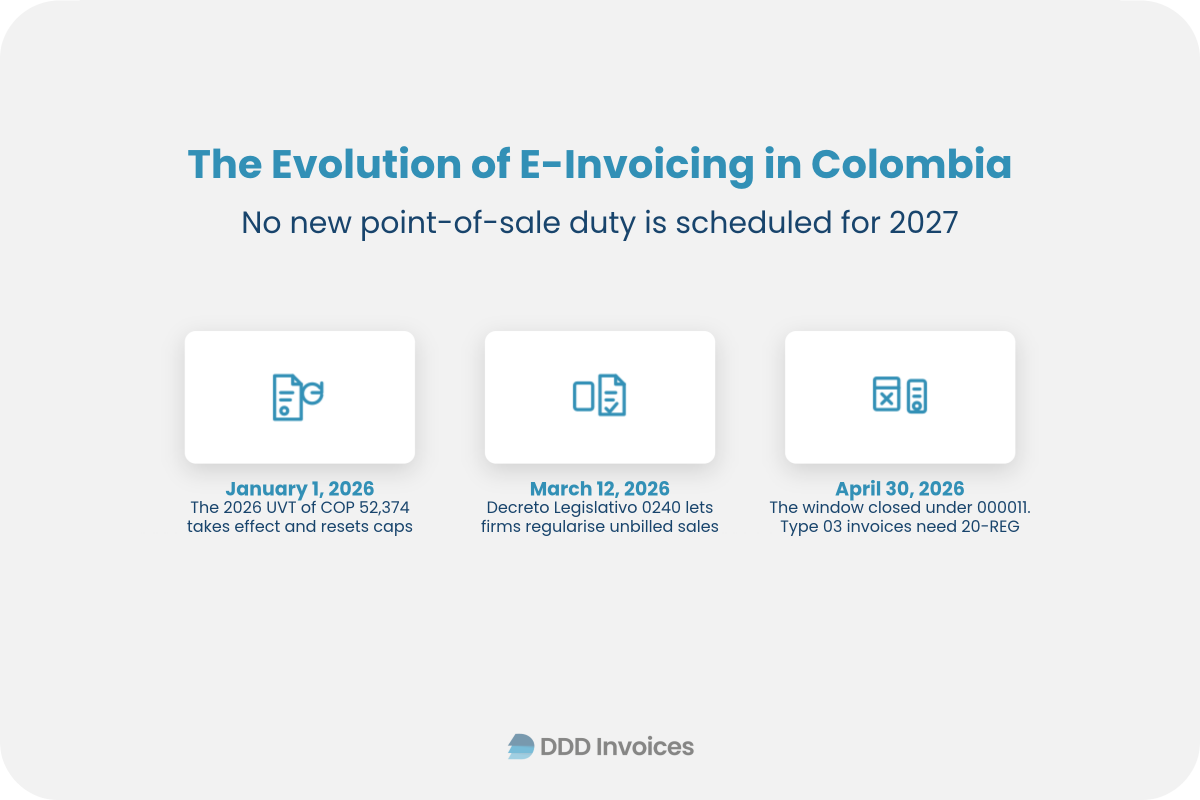
No new point-of-sale duty is scheduled for 2027.
- January 1, 2026: the 2026 UVT of COP 52,374 took effect under Resolución 000238, resetting every UVT-based cap.
- March 12, 2026: Decreto Legislativo 0240 let businesses regularise unbilled sales by declaring them.
- April 30, 2026: that window closed, after Resolución 000011 required type 03 invoices coded 20-REG.
With that window closed, every till and webshop needs validated documents, which a fiscalization-ready platform keeps on track.
What fiscal regulations are affecting the businesses?
Estatuto Tributario (Decreto 624 de 1989), articles 615 to 618
Articles 615 and 616-1 make merchants and professionals invoice every sale, and an FEV counts as issued only once validated and delivered.
Ley 2155 of September 14, 2021 rewrote article 616-1.
Decreto 1625 de 2016, Decreto Único Reglamentario (DUR)
Decreto 358 of March 5, 2020 replaced this decree's invoicing chapter. It names who must invoice and lists the documentos equivalentes (invoice substitutes such as POS tickets).
Resolución DIAN 000165 de 2023
Resolución 000165, published on November 2, 2023, is the core technical rule. Each document shows the seller's NIT (tax ID), number, items and taxes, plus its CUFE or CUDE and a QR code for customer verification.
Sellers deliver it by email or in print and fix errors with credit, debit or adjustment notes. During outages they keep invoicing, on paper if their own system fails, and transmit within 48 hours.
Records are kept until the related tax return is final, under Ley 962 de 2005. Resolución 000008 phased in the POS electrónico between May 1 and July 1, 2024.
Resolución DIAN 000202 de 2025: buyer data
In force since April 1, 2025, Resolución 000202 limits buyer data to name, ID and email, and only for named documents. Any other document goes to consumidor final (final consumer) under number 222222222222. The DIAN's lookup fills in name and email from the ID number, for invoicing only.
Resolución DIAN 000227 de 2025: Resolución Única
Published on September 25, 2025, Resolución 000227 compiles the invoicing rules into Part 1, Title 5. Cite it alongside the Resolución 000165 numbers many still use.
Who does fiscalization in Colombia affect?
Every merchant, liberal professional and IVA or INC taxpayer must invoice each sale. Natural persons meeting every article 437 condition, including income below 3,500 UVT (COP 183,309,000 in 2026), are exempt unless they opt in. Non-resident digital service providers need not invoice those services.
- B2C sellers: B2C e-invoicing is mandatory, through a POS electrónico or FEV with no value limit.
- B2B and B2G sellers: an FEV, or a POS electrónico naming the buyer, preserves the buyer's IVA credit and deductions.
- Special sectors: transport, cinema, event and utility documents turned electronic by November 1, 2024, and e-commerce platforms must let sellers issue FEVs.
- Software suppliers: proveedores tecnológicos need DIAN authorization, and no hardware is certified.
- Customers: must request the document and show it to DIAN inspectors.
Our guide to e-invoicing in Colombia covers B2B flows.
What are the implications and penalties?
Articles 651 to 657 of the Estatuto Tributario set the sanctions. COP figures use the 2026 UVT.
Offence | Penalty |
|---|---|
Not issuing an FEV or POS electrónico, or omitting literals b) to g) of article 617 | 3 days' closure, replaceable by a fine of 5% of the prior month's operating income |
Omitting literals a), h) or i) of article 617 | 1% of the operations concerned, capped at 950 UVT (COP 49,755,300), with closure on repeat |
Not transmitting documents properly | Article 651 fine, up to 7,500 UVT (COP 392,805,000) |
No devices need buying, but a consumidor final document gives the buyer no costs, deductions or IVA credit.
Your Trusted Partner for Fiscalization
Fiscalization in Colombia is mandatory, and its point-of-sale rules changed three times between 2024 and 2026.
DDD Invoices keeps one standardised API payload between your ERP or POS and each supported authority, so you issue, receive and archive without rebuilding. Colombia is still collecting interest on our country coverage list, so tell us which sales channels matter first.
Still have questions?
In the 30min free call we will discuss:
- your requirements in invoicing
- how integration works
- demo of the product
- next steps
FAQs
Does Colombia require fiscal printers or cash registers?
No, Colombia requires no fiscal printers, fiscal memory or certified cash registers for retail sales. The DIAN instead validates every factura electrónica de venta or POS electrónico before it is delivered.
What buyer data can a seller ask for in Colombia?
Sellers may request only name, ID and email, and only when buyers want a named document. Otherwise the document goes to consumidor final under number 222222222222, with no data requested.
What happens if the DIAN or the till system is down?
Sellers keep invoicing during a DIAN outage and must transmit the documents within 48 hours. If their own system fails, they issue paper invoices and transcribe each one within 48 hours.
What is the penalty for not issuing an invoice in Colombia?
The penalty is three days' closure of the establishment under Estatuto Tributario articles 652-1 and 657. Sellers can replace closure with a fine of 5% of the prior month's operating income.