



Standard
UBL 2.1 (XML)
Tax Portal
Facturando Electrónicamente (production), Habilitación (enablement)
Tax Authority
DIAN
CTC Model
Centralized clearance (pre-clearance)
B2G
2019
B2B
2019
Archiving
minimum 5 years.
Pending DDD Invoices support
Colombia runs a clearance-style invoicing system. DIAN validates each sales invoice before it reaches the buyer. The system also covers payroll, support documents, point-of-sale (POS) documents and invoice factoring.
VAT- and INC-responsible taxpayers, merchants and SIMPLE regime taxpayers must issue a factura electrónica de venta, with confirmed exceptions. The legal basis is Article 615 of the Tax Statute and Decree 358 of 2020. The invoice is a digitally signed UBL 2.1 XML, validated by DIAN, or by an authorized technology provider, before delivery. It carries a CUFE and a QR code. The validated XML is the invoice, and the PDF is only its graphic representation. DIAN's rules are now consolidated in Resolution 000227 of 2025.
Latest news
On 23 September 2025, DIAN issued Resolution 000227. It is a single consolidated resolution that absorbs Resolutions 000042 of 2020 and 000165 of 2023, so those should no longer be cited on their own.
Resolution 000227 keeps in force the annexes of the resolutions it compiles, including Annex 1.9 for the sales invoice and Annex 1.0 for the electronic equivalent document. Separately, Resolution 000202 of 2025 limits the buyer data an issuer can request. DIAN's autocomplete service fills in the buyer's details from the ID. If the buyer isn't in that database, issuers may ask only for the name, ID type and number, and email.
What is e-Invoicing and why is Colombia adopting it?
E-invoicing is issuing and exchanging invoices as structured, machine-readable data (usually XML) that systems can process automatically.
Colombia's model is prior validation: every invoice goes to DIAN first and reaches the buyer only once validated. DIAN's Sistema de Factura Electrónica also covers credit and debit notes, the support document, electronic payroll, the electronic equivalent document (DEE) and RADIAN. Resolution 000227 aims to unify and simplify DIAN's tax rules so they are easier to apply and consult.
The evolution of e-Invoicing
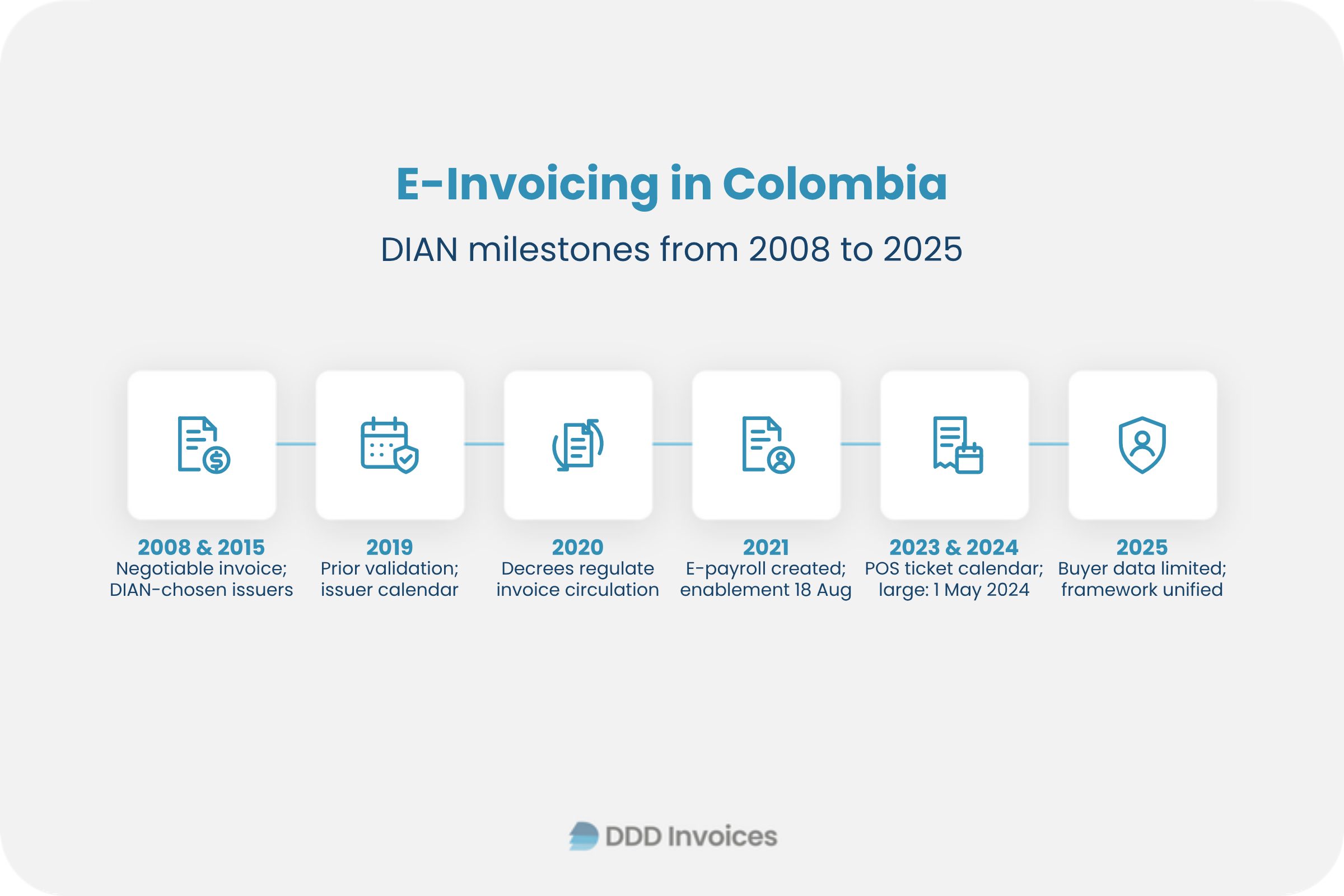
- 2008: Law 1231 allowed the electronic invoice as a negotiable instrument. It left the rules for putting it into circulation to the government.
- 2015: Decree 2242 set up e-invoicing for taxpayers DIAN selects. DIAN resolutions naming them take effect at least three months after publication.
- 2019: Resolution 000020 named the issuers obligated to issue the electronic sales invoice with validation before issuance and set the calendar.
- 2020: Decree 358 regulated the electronic sales invoice, and Decree 1154 regulated its electronic circulation as a negotiable instrument.
- 2021: Resolution 000013 of 11 February 2021 created the electronic payroll support document. DIAN's calendar had employers start enablement on 18 August 2021, by employee-count group.
- 2023: Resolution 000165 of 1 November 2023 set the electronic equivalent document calendar, including the POS ticket.
- 2024: Resolution 000008 of 31 January 2024 moved the large-taxpayer POS date to 1 May 2024 from 3 February. It also staggered later groups to 1 June and 1 July.
- 2025: Resolution 000202 limited buyer data, and Resolution 000227 consolidated the framework.
B2G electronic Invoicing in Colombia
Colombia has no separate B2G channel. Suppliers to public entities issue the same DIAN-validated invoice as to any other customer. There is no Peppol requirement.
B2B electronic Invoicing in Colombia
B2B e-invoicing is mandatory because the VAT- and INC-responsible taxpayers, merchants and simple regime taxpayers must issue electronic invoices, with exceptions on DIAN's obligation page. The issuer signs a UBL 2.1 XML and sends it to DIAN's validation service. DIAN returns an application response, and the issuer delivers the XML, the response and the QR-coded PDF to the buyer. Colombia is not post-audit, and contingency is the only exception. Invoices carry a CUFE, and other documents, such as credit and debit notes, carry a CUDE.
Before going live, complete habilitación with DIAN's test set and obtain a numbering-range authorization. You can issue with your own software, a technology provider or DIAN's free solution, which suits only low-volume, non-integrated invoicing.
DIAN validation is not buyer acceptance. The buyer can register receipt, express or tacit acceptance, or a claim. Tacit acceptance applies when the buyer makes no claim within three business days of receiving the goods or service. RADIAN is DIAN's separate register for invoices that circulate as negotiable instruments. A validated invoice does not become one automatically.
B2C e-Invoicing in Colombia
B2C e-invoicing is mandatory in Colombia because the obligation depends on who the seller is, not on who the buyer is. Businesses required to invoice must document consumer sales electronically, with either the electronic sales invoice or the electronic equivalent document (DEE) for POS cash registers. Exceptions listed by DIAN still apply. Businesses that choose to issue a POS ticket instead of a sales invoice must now issue it as the DEE.
The DEE counts as issued only once DIAN validates it and it is delivered to the buyer. It carries a CUDE and a QR code. If the buyer wants the document in their own name, the issuer may ask for only the three buyer data points DIAN allows.
E-reporting and VAT compliance
Colombia has no periodic e-reporting for invoice data. Taxpayers still file standard periodic tax returns. VAT-responsible taxpayers file VAT returns on Form 300 every two months, every four months or annually, depending on their gross income. DIAN also requires exogenous information reports under Article 631 of the Tax Statute.
Under Article 632, keep XML files and validation responses for the legal retention period at least five years from 1 January of the year after they are issued or received.
What happens if businesses don't comply?
An electronic invoice counts as issued only when it is validated and delivered to the buyer, under Article 616-1 of the Tax Statute. If validation is unavailable, the issuer may deliver the invoice without it and must send it for validation within 48 hours of the problem being fixed, as set out in DIAN's contingency guide.
Issuing invoices without certain Article 617 requirements is sanctioned under Article 652 with a fine of 1% of the value of the operations concerned, capped at 950 UVT. Failing to invoice, or issuing invoices with other missing requirements or repeated defects, can lead to a three-day closure of the establishment under Article 657. Buyers without a valid invoice risk losing deductible VAT, costs and deductions under Article 771-2.
Your trusted partner for e-Invoicing
Colombia runs a prior-validation system. VAT- and INC-responsible taxpayers, merchants and SIMPLE regime taxpayers must issue a digitally signed UBL 2.1 XML invoice, which DIAN validates before the buyer receives it.
DDD Invoices covers this through one e-invoicing API integration. Send invoice data from your ERP, marketplace or SaaS platform, and we build, sign, transmit to DIAN for validation, deliver and archive each document. Your team doesn't have to build and maintain Colombia-specific technical logic.
Still have questions?
In the 30min free call we will discuss:
- your requirements in invoicing
- how integration works
- demo of the product
- next steps
FAQs
Is a PDF a valid invoice in Colombia?
No. The validated XML, signed and approved by DIAN, is the legal invoice. The PDF is only its graphic representation and has no legal value without the XML.
Does DIAN validation mean the buyer accepted?
No. DIAN validation checks the invoice's format and data. Acceptance is a separate buyer event. RADIAN is a further step that applies only when the invoice circulates as a negotiable instrument.
Can I use DIAN's free invoicing tool?
Only for low volumes of manual invoices, because it has no API or ERP integration. Integrated or high-volume businesses should use their own software or a technology provider.
Which resolution should I cite?
Resolution 000227 of 2025, which consolidates the earlier resolutions, including 000042 of 2020 and 000165 of 2023.


