



Standard
N/A
Tax Portal
N/A
Tax Authority
Inland Revenue Department
CTC Model
N/A
B2G
N/A
B2B
N/A
Archiving
5 Years
Pending support by DDD invoices
Tuvalu licenses its .tv internet domain worldwide, yet no e-invoicing platform links its own businesses. The Inland Revenue Department of the Ministry of Finance and Economic Development runs the Tuvalu Consumption Tax (TCT), charged in Australian dollars. E-invoicing in Tuvalu means correct TCT invoices and records.
Tuvalu has no e-invoicing mandate, clearance model or Peppol requirement. Businesses must apply for TCT registration within 7 days of taxable supplies reaching AUD 100,000 in 12 months. Registered suppliers give registered buyers a Consumption Tax invoice at the time of supply and file returns within 30 days after each quarter.
Latest news
On November 6, 2026, the Ministry reported that the Procurement Bill 2026 had been tabled in Parliament. It would replace the Public Procurement Act 2013 and phase in electronic procurement, but its summary does not mention e-invoicing.
The Bill also covers donor-funded projects and should pass by mid-2027, so plan for digital procurement while invoicing stays the same.
Tired of scrolling through information about e-invoicing?
- Register on the platform as a software vendor or a end-client
- Start and complete the integration
- Send your first invoice into the test environment
- Switch to production!
What is e-invoicing and why has Tuvalu adopted it?
E-invoicing is the exchange of invoices as structured data between systems. Tuvalu has not adopted it: its Consumption Tax Act fixes invoice content, not format, and nothing is cleared in real time.
TCT came with the 2009 reforms, which also introduced presumptive tax, the Taxpayer Identification Number (TIN)and a uniform 30% business profits rate. The ADB completion report links TCT to replacing import duty lost to regional tariff cuts.
Fiji's VAT rules, Kiribati's VAT and Australia's B2G Peppol framework, shared with New Zealand, do not apply in Tuvalu.
The evolution of e-invoicing in Tuvalu
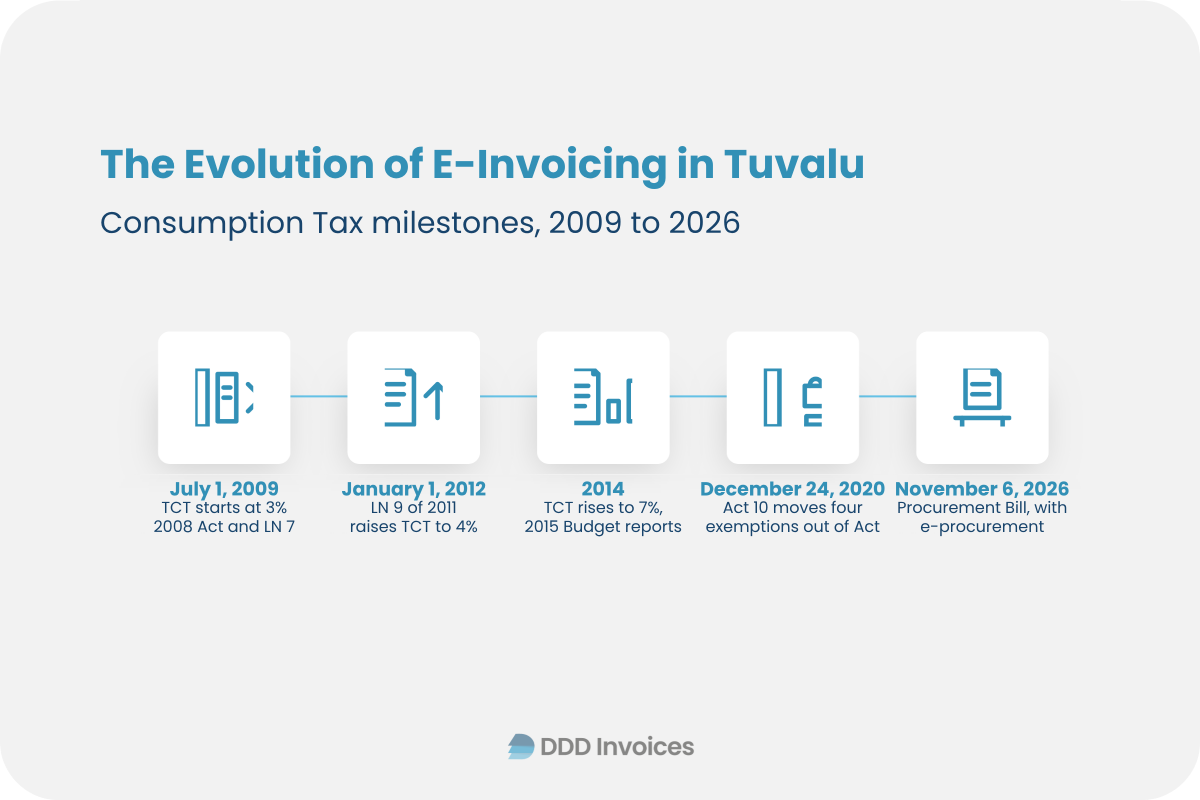
- July 1, 2009: TCT starts at 3% under the Consumption Tax Act 2008 and LN 7 of 2009.
- January 1, 2012: LN 9 of 2011 raises TCT to 4%.
- 2014: TCT rises to 7%, the 2015 National Budget reports.
- December 24, 2020: Act No. 10 of 2020 moves four exemptions, including basic foods and aviation fuel, out of the Act.
- November 6, 2026: The Procurement Bill 2026, proposing e-procurement, is reported tabled.
B2G e-invoicing in Tuvalu
B2G e-invoicing is not mandatory, and there is no government invoicing portal. Public buyers registered for TCT get normal section 19 invoices, and government imports, unlike public enterprise imports, are exempt under section 6(3)(a).
B2B e-invoicing in Tuvalu
B2B e-invoicing is not mandatory. Under section 19 of the Act, a registered supplier must give a registered buyer the original Consumption Tax invoice at the time of supply.
It must show "CONSUMPTION TAX INVOICE", both parties' names and addresses, a serial number and the issue date. It also lists the goods or services with quantity, the supply date, the consideration and the TCT charged.
Below AUD 500, regulation 12 allows short form invoices: heading, date, supplier name and TIN, the buyer's TIN if issued, and a brief description.
Correct overcharged tax with a TCT credit note and undercharged tax with a debit note, under section 20.
PDF or system-generated invoices can work if they carry every particular and the buyer agrees, but they are not structured e-invoicing. To get set up:
- Register: apply within 7 days of reaching the threshold under section 7, or register voluntarily.
- Fix templates: use all section 19 particulars on full invoices and the regulation 12 fields on short forms.
- Organise records: keep received originals, issued copies in date order and customs papers, ready for an e-invoicing API integration.
B2C e-invoicing in Tuvalu
B2C e-invoicing is not mandatory. TCT invoices are only required between registered persons, and section 21(7) bars issuing them in other cases.
Unregistered sellers below AUD 100,000 charge no TCT and may opt into presumptive tax on the Ministry's registration form.
E-reporting and VAT compliance in Tuvalu
Tuvalu has periodic tax reporting, which covers tax returns rather than single invoices, but no published online filing portal. Under section 22, returns in the approved form and payment are due within 30 days after each quarter.
The Ministry's form lists month-end dates such as 31 July, so treat 30 days as the deadline.
The Minister sets the rate between 3% and 10% under section 5. The Ministry's form states 7%, but the consolidated Regulations still show 4%, so confirm it with Inland Revenue.
Exports are zero-rated, while health, education and financial services, residential leases and Tuvalu Electricity Corporation fuel are exempt. Check basic foods and aviation fuel, dropped from the Act by Act No. 10 of 2020.
Importers pay TCT at the border under section 24, and section 18 lets buyers claim input tax only once they hold the TCT invoice.
The Act sets no retention period. Section 39 of the Income Tax Act requires business records for at least 5 years, kept in Tuvalu.
Penalties for non-compliance in Tuvalu
Sections 31 to 35 of the Consumption Tax Act set fines from AUD 200 to double the tax, plus travel bans and closures.
Offence | Fine |
|---|---|
Not registering when required (s.34(1)) | Double the TCT for the unregistered period |
Late return or payment (s.34(2) and (3)) | AUD 500 per return, and 10% then 2% a month on late tax, up to 100% |
Misstated tax (s.34(4) and (5)) | 50% if grossly careless, 100% if deliberate, cut to 25% or 50% of that after voluntary disclosure |
Invoice or record offences (s.35) | Up to AUD 200, AUD 400, then AUD 800, up to 2 years in prison, or both |
Unpaid TCT over AUD 500 (ss.31 and 32) | Travel ban until paid or arranged, and possible closure if unpaid 7 days after notice |
Your trusted partner for e-invoicing in Tuvalu
Your registered buyers in Tuvalu can claim input tax only once they hold a valid Consumption Tax invoice, even without an e-invoicing mandate. DDD Invoices validates invoice data through one e-invoicing integration, letting your ERPsend, receive and store invoices in every market we cover. Before you choose a Pacific setup, ask us, since our country coverage list shows Australia and New Zealand in progress but not Tuvalu.
Still have questions?
In the 30min free call we will discuss:
- your requirements in invoicing
- how integration works
- demo of the product
- next steps
FAQs
Is e-invoicing mandatory in Tuvalu?
No, Tuvalu has no e-invoicing mandate, platform or required format for businesses or public bodies. Registered suppliers must still give registered buyers a Consumption Tax invoice at the time of supply.
What must a Tuvalu Consumption Tax invoice show?
It must show "CONSUMPTION TAX INVOICE", both parties' names and addresses, a serial number and the date. It also needs a description with quantity, the supply date, the consideration and the TCT charged.
When are Tuvalu Consumption Tax returns due?
TCT returns and payment are due within 30 days after each quarter ends, under section 22. A late return costs AUD 500, and late tax attracts 10% for the first month, then 2% monthly.
How long must businesses in Tuvalu keep invoices?
The Income Tax Act requires business records for at least 5 years after the year they relate to. Keep them in English or Tuvaluan, and in Tuvalu unless the Secretary agrees otherwise in writing.


