In 2024, the invoice became the main proof of a Philippine sale, and the Bureau of Internal Revenue (BIR) is digitizing it. E-invoicing in the Philippines centers on its Electronic Invoicing/Receipting System (EIS).
Large taxpayers, e-commerce sellers above micro size and users of computerized accounting or invoicing software must e-invoice by December 31, 2026. Each needs a Permit to Issue (PTI), then EIS Certification within six months. Micro taxpayers are exempt; sales reporting awaits separate rules.
Latest news
Under the BIR’s RMC No. 98-2026 of September 22, 2026, covered taxpayers must issue structured e-invoices by December 31, 2026. Large taxpayers, e-commerce sellers and users of accounting or invoicing software need a Permit to Issue (PTI) first, then EIS certification within six months. Micro taxpayers are exempt, and sales reporting to the BIR comes later.
Posted on October 22, 2026, RMC 112-2026 sets transition rules for RR 6-2026, which adds creditable withholding tax (CWT) to invoices. From January 1, 2027, covered e-invoicing systems must show a CWT field on every invoice, even when no CWT applies.
Under RMC 110-2026 of October 12, 2026, e-invoicing service providers need BIR accreditation before going live, so check your vendor's certificate. Your PTI duties remain.
Tired of scrolling through information about e-invoicing?
- Register on the platform as a software vendor or a end-client
- Start and complete the integration
- Send your first invoice into the test environment
- Switch to production!
What is e-invoicing and why has the Philippines adopted it?
E-invoicing is issuing invoices as structured data that software reads without manual entry.
The BIR wants data it can extract automatically, so RR 11-2025 rules out scanned paper invoices. Taxpayers that also report sales electronically get an extra one-time deduction on setup costs. There is no clearance step: sellers invoice buyers directly.
The evolution of e-invoicing in the Philippines
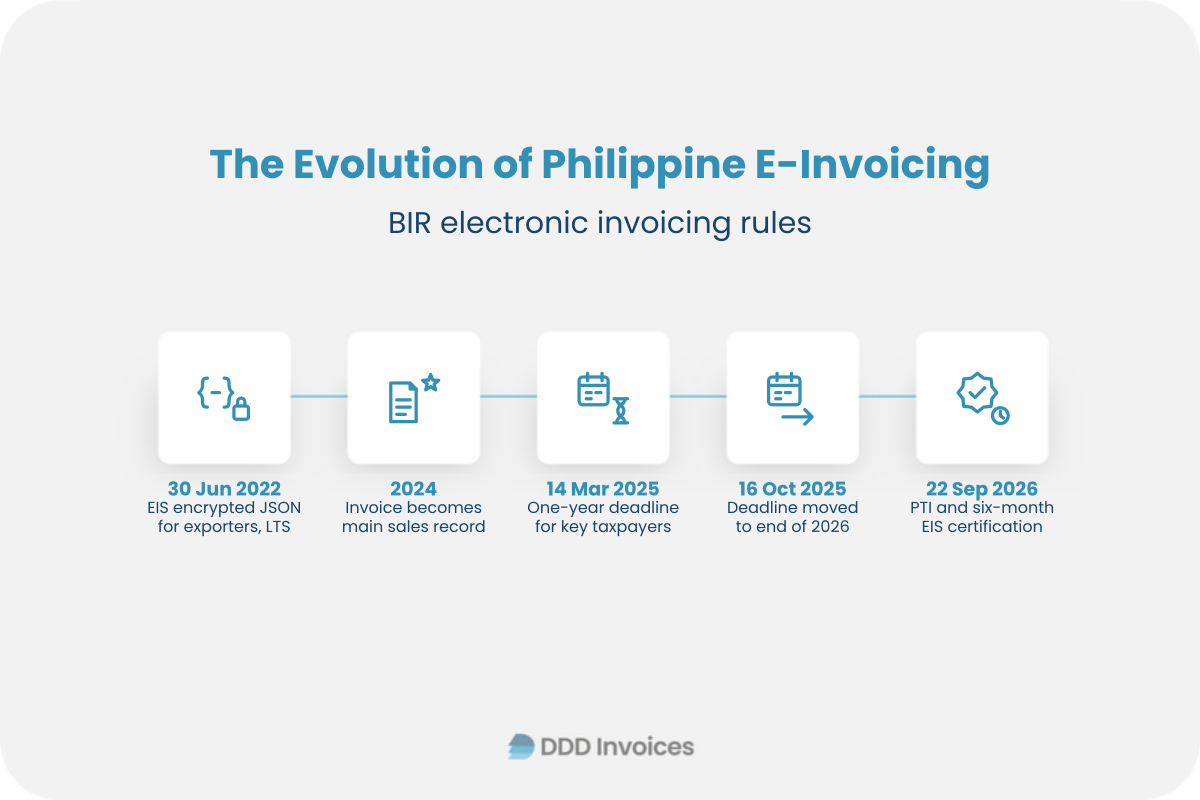
- June 30, 2022: RR 8-2022 applies the TRAIN Law through the EIS, using encrypted JSON, for exporters, e-commerce and Large Taxpayers Service (LTS) taxpayers.
- 2024: the Ease of Paying Taxes Act (EOPT, RA 11976) makes the invoice the main sales document. The CREATE MORE Act (RA 12066) updates Sections 237 and 237-A.
- March 14, 2025: RR 11-2025 takes effect with a one-year deadline for e-commerce, LTS and EOPT large taxpayers.
- October 16, 2025: RR 26-2025 moves the deadline to December 31, 2026 for all four covered groups.
- September 22, 2026: RMC 98-2026 adds the PTI and a six-month EIS Certification window.
B2G e-invoicing in the Philippines
Unlike countries with mandatory B2G e-invoicing, the Philippines has no separate B2G mandate, portal or date. Covered sellers e-invoice agencies like any customer; e-invoices must be verifiable electronically or manually as the BIR prescribes.
B2B e-invoicing in the Philippines
Under RR 26-2025, e-invoicing is mandatory by December 31, 2026 for small, medium and large e-commerce sellers; LTS taxpayers; EOPT large taxpayers with gross sales of PHP 1 billion or more; and users of CAS, CBA with e-invoicing, or other invoicing software. Micro taxpayers below PHP 3 million are exempt. Exporters and RBEs not already covered, along with POS users, will follow under later regulations.
Invoices are the principal sales documents; official receipts are supplementary. Include the particulars required by RR 7-2024, plus applicable CWT information under RR 6-2026. Obtain a PTI covering all branches and complete EIS certification within six months, as provided in RMC 98-2026. During outages, use BIR-authorized manual invoices, then replace them with e-invoices referencing their numbers.
B2C e-invoicing in the Philippines
B2C e-invoicing is mandatory for covered groups by December 31, 2026, and voluntary for others. B2C invoices need no buyer address or TIN, and may be printed when electronic delivery is impractical.
VAT-registered sellers invoice every sale; others invoice sales of PHP 500 or more, or any sale on request, under the EOPT Act. POS systems lacking electronic issuance and reporting produce no e-invoices.
E-reporting and VAT compliance
The Philippines requires quarterly VAT reporting through BIR Form 2550Q, due within 25 days after each taxable quarter. Electronic sales-data reporting is separate, with implementation for groups identified in RR 26-2025 subject to separate regulations. The standard VAT rate is 12%, while qualifying exports are zero-rated.
Nonresident digital services consumed in the Philippines attract 12% VAT, with Philippine business buyers accounting for VAT through reverse-charge withholding and remittance. Keep books and supporting records for five years from the day after the annual income tax return deadline, or from actual filing if late, under RR 7-2024
Penalties for non-compliance
Fines start at PHP 1,000 under Section 264 of the Tax Code; Sections 264-A and 115 add daily penalties and closure.
Offence | Fine |
|---|---|
No invoice, or one missing required information (Section 264(a)) | PHP 1,000 to PHP 50,000 and 2 to 4 years' imprisonment |
VAT-registered seller not issuing invoices (Section 115) | Business closure for at least 5 days |
Not transmitting sales data once required (Section 264-A) | Higher of PHP 10,000 or 0.1% of annual net income daily; permanent closure past 180 days a year |
Your trusted partner for e-invoicing
Covered taxpayers need structured data, a PTI and a tested system, as e-invoicing is mandatory by December 31, 2026.
DDD Invoices validates data and offers a sandbox through one unified e-invoicing API, letting your ERP issue, receive and archive invoices in 30+ countries. Our country coverage list shows the Philippines as collecting interest, so share your timeline and we can plan together.
Still have questions?
In the 30min free call we will discuss:
- your requirements in invoicing
- how integration works
- demo of the product
- next steps
FAQs
When is the Philippine e-invoicing deadline?
Covered taxpayers must issue e-invoices on or before Dec 31, 2026, under RR 26-2025 and RMC 98-2026. The Commissioner may extend that date, but no further extension had been issued by Nov 3, 2026.
What counts as a BIR e-invoice?
An e-invoice is structured data from a BIR-registered system, sent to the buyer electronically and ready for reporting. Scanned paper invoices and invoices typed in Word, Excel or Google Sheets never count as e-invoices.
Why isn't EIS sales reporting mandatory yet?
Sales reporting under Section 237-A is a separate duty that starts only after the BIR issues implementing rules. Until then, covered taxpayers issue e-invoices and must still pass EIS Certification within 6 months of the PTI.
How do you correct a Philippine e-invoice?
Issue a separate document that references the original, because an issued e-invoice cannot be deleted or altered. Use a credit note to reduce the invoiced amount, or a new e-invoice to increase it.