


Standard
N/A
Tax Portal
RAMIS (IRD e-Services)
Tax Authority
Inland Revenue Department (IRD)
CTC Model
Real-time reporting (Web API, phased)
B2G
N/A
B2B
Phased rollout
Archiving
5 Years
Pending support by DDD Invoices
Since May 1, 2026, tea brokers have sent Colombo Tea Auction invoices to the tax authority, showing where e-invoicing in Sri Lanka is heading. Under the National e-invoicing System, the Inland Revenue Department (IRD) is connecting ERP systems to RAMIS, its Revenue Administration Management Information System.
From October 1, 2026, every VAT-registered person in Sri Lanka must issue tax invoices in the revised Gazette 2481/22 format. Real-time Web API reporting to RAMIS is not yet mandatory for all. It is phasing in from exporters, with full Web API integration expected by the end of 2026.
Latest news
Since October 1, 2026, the revised tax invoice format has been mandatory for all VAT-registered persons. Gazette 2500/106 of August 6, 2026 set that date without changing the specification.
Non-compliant invoices risk rejection for the buyer's input tax claim.
Tired of scrolling through information about e-invoicing?
- Register on the platform as a software vendor or a end-client
- Start and complete the integration
- Send your first invoice into the test environment
- Switch to production!
What is e-invoicing and why has Sri Lanka adopted it?
E-invoicing means exchanging invoice data in a structured format that systems read automatically. Budget 2026 framed the National e-Invoicing System as a tool for tax compliance and VAT administration. Its model is real-time reporting that pre-fills buyers' purchase records in RAMIS.
The evolution of e-invoicing in Sri Lanka
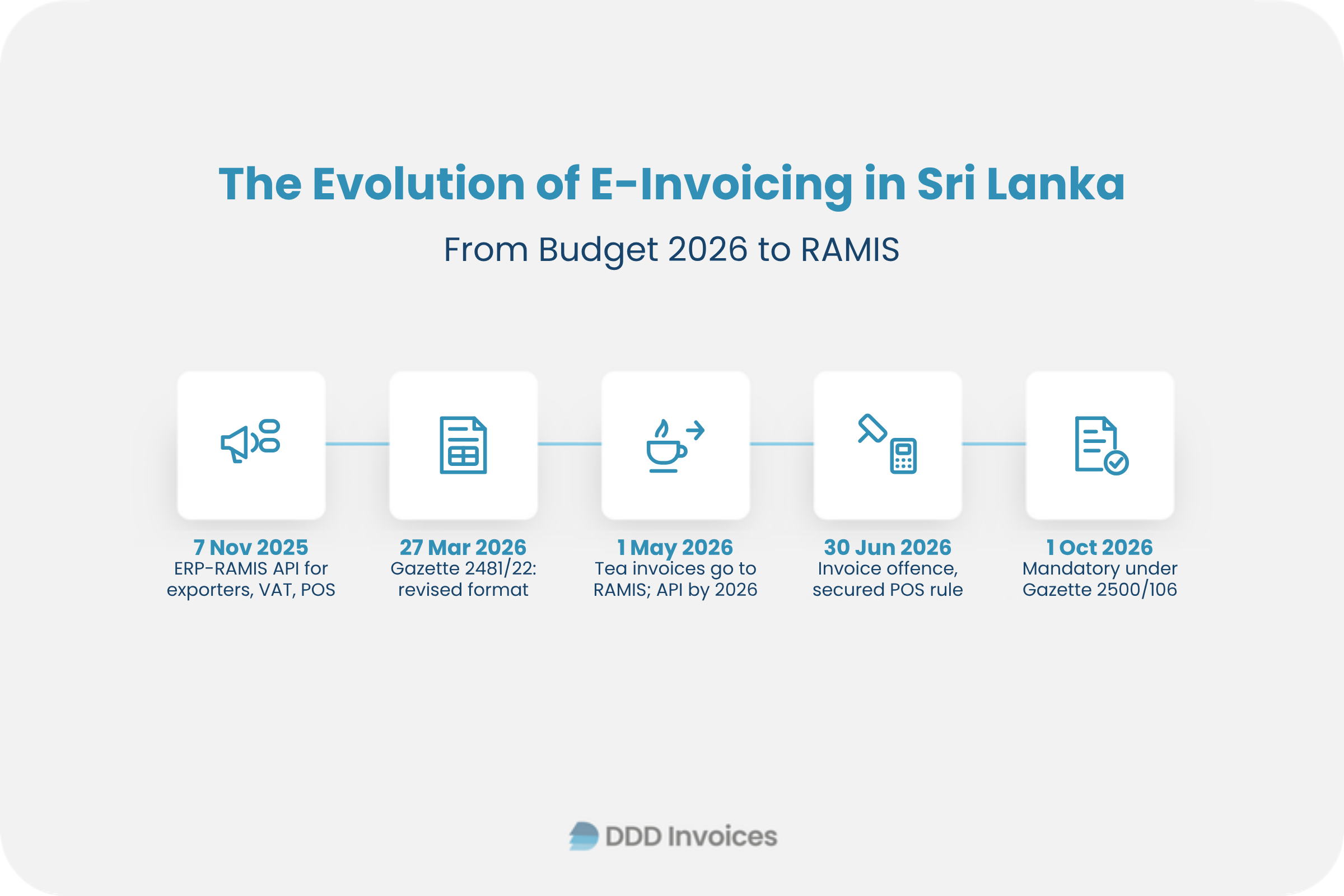
- November 7, 2025: Budget Speech 2026 announces an ERP-to-RAMIS API for exporters, then all VAT-registered taxpayers and POS machines.
- March 27, 2026: Gazette 2481/22 prescribes the revised tax invoice format.
- May 1, 2026: tea brokers start sending Colombo Tea Auction invoices to RAMIS. IRD Notice SEC/PN/VAT/2026-03 expects full Web API integration by the end of 2026.
- June 30, 2026: Act No. 14 of 2026 adds a tax invoice offence and a secured POS rule.
- October 1, 2026: the revised format becomes mandatory under Gazette 2500/106.
B2G e-invoicing in Sri Lanka
There is no B2G e-invoicing mandate or portal. Under VAT Act section 20, VAT-registered suppliers must issue tax invoices to public bodies, even unregistered ones. That covers government institutions, Provincial Councils, local government institutions and public corporations.
B2B e-invoicing in Sri Lanka
Real-time B2B reporting is not yet mandatory for all. IRD Notice SEC/PN/VAT/2026-03 brings in export-oriented enterprises first, then all VAT-registered persons. Selected garment exporters, tea exporters and tea manufacturers using brokers are already connected.
They send Schedules 01 (output tax), 04 (credit and debit notes) and 07 (zero-rated supplies). Buyers approve the pre-filled records before claiming input tax. Records cannot be amended or deleted, so tax errors are fixed only with credit or debit notes. Customs data will pre-fill Schedules 03 (imports) and 06 (exports).
Circular SEC/2026/E/03 explains the mandatory invoice content:
- Title: "TAX INVOICE".
- Parties: supplier TIN (Taxpayer Identification Number), name and address, plus the purchaser's if VAT-registered.
- Serial number: YYMMM_QQQQ_XXXXX, no spaces, 40 characters maximum.
- Dates: invoice date and date of supply, separately, in MM/DD/YYYY.
- Values: value before VAT, VAT and total in rupees, to two decimals; place of supply optional.
Persons approved for Web API integration before July 1, 2026 may omit the YYMMM_QQQQ_ prefix if integrated by December 31, 2026.
- Register: get a TIN and VAT registration.
- Contact: email [email protected] with integration queries.
- Authenticate: per the Web API quick guide, an SSID and password return a JWT token.
- Test: check numbering, dates and TINs before go-live.
B2C e-invoicing in Sri Lanka
There is no B2C e-invoicing mandate yet. Section 64B, added by Act No. 14 of 2026, will make every VAT-registered person use secured point-of-sale (POS) machines for all transactions and invoices. Compliance is due three months after a date not yet prescribed. Approved machines will record sales in real time, closer to fiscalization than e-invoicing. Under section 20, unregistered buyers get an ordinary invoice showing the VAT-inclusive total.
E-reporting and VAT compliance in Sri Lanka
Sri Lanka requires periodic electronic VAT-return filing through IRD e-Services, mandatory for taxable periods beginning July 1, 2025. Returns cover monthly or quarterly taxable periods and are due by the last day of the following month. VAT payments are due monthly by the 20th of the following month, as confirmed by the IRD’s VAT guidance.
Penalties for non-compliance in Sri Lanka
Sections 66 and 67 of the Value Added Tax Act, No. 14 of 2002, as amended by Act No. 14 of 2026, provide penalties following conviction before a Magistrate.
•Section 67: Failure to furnish valid tax invoices or other documents required under section 21 can lead to a fine of up to LKR 1,000,000, imprisonment for up to six months, or both.
•Section 66: Tax evasion or fraudulent refund claims can lead to a fine equal to twice the relevant tax or refund amount, plus a fine of up to LKR 1,000,000, imprisonment for up to six months, or both.
The increased penalties apply to relevant periods from October 1, 2025. The document-related offence under section 67 was added from July 1, 2026.
Your trusted partner for e-invoicing in Sri Lanka
With the revised format mandatory and Web API records locked once sent, data must be right first time. In covered markets, your ERP can send and collect invoices through DDD Invoices' unified e-invoicing API, which validates each record and archives it. Sri Lanka has not joined our country coverage list yet, so share your Web API timeline and we will plan next steps.
Still have questions?
In the 30min free call we will discuss:
- your requirements in invoicing
- how integration works
- demo of the product
- next steps
FAQs
What must a Sri Lankan tax invoice show?
It must show the title TAX INVOICE, the supplier's TIN and a YYMMM_QQQQ_XXXXX serial number. It also needs separate invoice and supply dates, plus the buyer's TIN if the buyer is VAT-registered.
When is e-invoicing mandatory in Sri Lanka?
No universal go-live date exists, but the IRD expects full Web API integration by the end of 2026. Export-oriented enterprises come first, then all VAT-registered persons, with selected garment and tea exporters already live.
How do businesses connect to RAMIS?
Businesses connect their ERP systems to RAMIS through the IRD's secure Web API for real-time invoice data. Failed records can still be uploaded as CSV files or entered in the RAMIS e-Service.
Why is Sri Lanka adopting e-invoicing?
Sri Lanka is adopting e-invoicing to improve tax compliance and make VAT administration more efficient and transparent. Real-time data also lets the IRD pre-fill buyers' purchase records and improve reporting accuracy.


