



Standard
STS's own ESF format: XML
Tax Portal
IS ESF
Tax Authority
State Tax Service under the Cabinet of Ministers of the Kyrgyz Republic (STS)
CTC Model
Clearance
B2G
N/A
B2B
July 1, 2020
Archiving
Six-year limitation period
Pending DDD Invoices support
Kyrgyz businesses issued 19.6 million electronic invoices worth KGS 1.7 trillion in 2023 alone. E-invoicing in Kyrgyzstan runs through the State Tax Service under the Cabinet of Ministers (STS) and its IS ESF platform for electronic invoices (ESFs). In 2026, Kyrgyzstan revised the mandatory ESF details, limited e-waybills to oil and petroleum products and launched the ESF 2.0 goods-tracking pilot.
All taxpayers except listed exempt groups must issue signed ESFs in the STS system. Goods ESFs are due within five working days of supply and services by the 10th working day of the following month. The mandate reached VAT payers, importers and exporters on July 1, 2020, and every other non-exempt taxpayer by May 1, 2023. Since September 1, 2026, oil, coal, alcohol and tobacco businesses must also use the ESF 2.0 pilot, which runs alongside IS ESF.
Latest news
Since September 1, 2026, oil, coal, alcohol and tobacco businesses must also use the six-month ESF 2.0 pilot. Resolution No. 613 now limits ETTN e-waybills to oil and petroleum products. Signed e-invoices (ESFs) stay mandatory for all non-exempt taxpayers.
On September 10, 2026, STS Order No. 372 applied Law No. 145, setting 15 mandatory ESF details that exclude bank details. ESF templates must now show consumer sales as "sales to the population", with fourteen 9s as the buyer TIN. Payment forms are cashless, cash, free of charge or barter; fuel-card sales get one monthly ESF.
Tired of scrolling through information about e-invoicing?
- Register on the platform as a software vendor or a end-client
- Start and complete the integration
- Send your first invoice into the test environment
- Switch to production!
What is e-invoicing and why has Kyrgyzstan adopted it?
E-invoicing means issuing invoices as structured data in an approved system.
The STS says ESFs raised VAT receipts and shrank the shadow economy. Kyrgyzstan uses a clearance model. Under the Resolution No. 141 procedure, IS ESF numbers each ESF, the seller signs it and buyers accept or reject it within 10 calendar days.
The evolution of e-invoicing in Kyrgyzstan
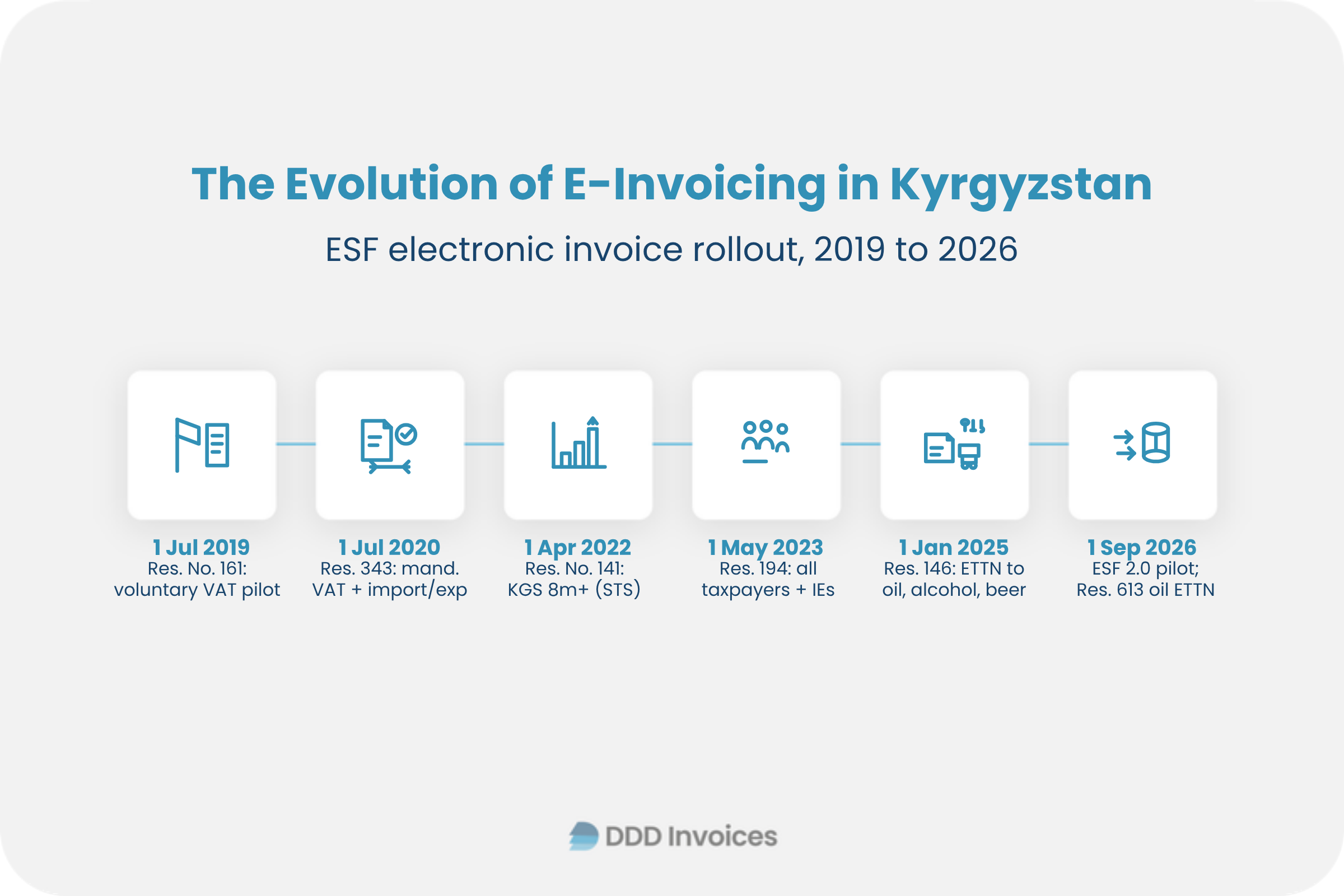
- July 1, 2019: voluntary pilot for VAT payers under Resolution No. 161.
- July 1, 2020: mandatory for VAT payers, importers and exporters under Resolution No. 343.
- April 1, 2022: Resolution No. 141 adds taxpayers with turnover above KGS 8 million a year, the STS confirms.
- May 1, 2023: Resolution No. 194 covers all non-exempt taxpayers, including individual entrepreneurs, per the STS timeline.
- January 1, 2025: Resolution No. 146 limits electronic waybills (ETTN) to petroleum products, marked alcohol and tobacco, and beer.
- September 1, 2026: the ESF 2.0 pilot starts, and Resolution No. 613 keeps ETTN only for oil and petroleum products.
B2G e-invoicing in Kyrgyzstan
Kyrgyzstan has no separate B2G mandate or portal, unlike countries with dedicated B2G e-invoicing. In-scope suppliers issue ESFs to public bodies like any buyer; unregistered buyers get a printout with the ESF number.
B2B e-invoicing in Kyrgyzstan
B2B e-invoicing is mandatory outside the exemptions in STS guidance. These include zero-rate single-tax payers earning up to KGS 15 million a year, patent traders, farmers selling own produce and consumer-only single-tax sellers.
Both parties appear by a 14-digit TIN, the personal identification number (PIN) for individuals. Goods ESFs are due within five working days of supply and services by the 10th working day of the following month, the STS notes.
ESF 2.0: under Cabinet Order No. 705-t, a six-month pilot adds a virtual warehouse and goods tracking. It is mandatory for oil, coal, alcohol and tobacco and voluntary for others. IS ESF keeps running, and pilot documents create no tax obligations.
E-waybills: Resolution No. 146 let ETTN documents skip marking codes until April 1, 2026. Since September 1, 2026, only oil and petroleum products need one; EAEU-traceable fridges, washers and TVs use ESF 2.0 under Resolution No. 613. A planned 2027 extension to medicines is not yet confirmed.
- Register: with a qualified e-signature, apply to your tax office; IS ESF registration on esf.salyk.kg follows within one working day.
- Integrate: map your data to the STS's own XML or API; developers get Tunduk test access under STS Order No. 348-P.
- Prepare: load goods into the STS Goods Catalogue and open an ESF 2.0 virtual warehouse in the Taxpayer Cabinet.
B2C e-invoicing in Kyrgyzstan
B2C e-invoicing is not mandatory per sale. Consumer sales run through registered cash registers (ККМ) or fiscal POS software that report receipts in real time.
Sellers issue ESFs on request; a monthly ESF covers consumer and marketplace sales by the 10th working day of the following month. Its buyer TIN is fourteen 9s, or fourteen 1s for marketplace sales. Paper ESFs cover IS ESF outages.
E-reporting and VAT compliance
Kyrgyzstan has periodic electronic VAT reporting through monthly Form STI-062 and supporting annexes. Returns are generally due by the 25th of the following month, with a month-end filing deadline for taxpayers administered by the designated STS functional unit. ESF e-invoicing does not replace this obligation, as established by the STS’s VAT-reporting procedure.
The standard VAT rate is 12%, while qualifying exports are zero-rated, subject to supporting-document requirements. VAT payment is generally due by the 25th of the following month. Taxpayers must correctly report taxable supplies, purchases and input VAT in their returns and supporting annexes.
Penalties for non-compliance
Code of Offences fines run from KGS 7,500 to KGS 65,000, using KGS 100 calculation units.
Offence | Fine (individuals / legal entities) |
|---|---|
Not issuing, or buying without, a mandatory ESF (Art. 309-2) | KGS 10,000 / KGS 28,000 |
Consumer sales without a cash register (Art. 318) | KGS 7,500 / KGS 23,000; repeat: KGS 20,000 / KGS 65,000 |
VAT credited on invalid ESFs, Tax Code Art. 163 | 100% of that VAT |
Undocumented goods missing from IS ESF (Art. 163) | 5% of their market value |
Your trusted partner for e-invoicing
Kyrgyz ESFs are mandatory for all but listed exempt groups, and their rules changed repeatedly in 2026. Through one API connection, DDD Invoices handles format and validation updates for teams issuing, receiving and archiving invoices from one ERP in 30+ countries. Kyrgyzstan is absent from our country coverage list today, so book a call to cover other markets and log Kyrgyz demand.
Still have questions?
In the 30min free call we will discuss:
- your requirements in invoicing
- how integration works
- demo of the product
- next steps
FAQs
What is an ESF in Kyrgyzstan?
An ESF is an electronic invoice created, signed and numbered in the State Tax Service's IS ESF system. It is valid only with the system-generated number and the seller's qualified electronic signature.
When is an ESF due in Kyrgyzstan?
Goods ESFs are due within five working days of supply, and export ESFs before goods leave. Services and consumer sales are due by the 10th working day of the following month.
How is an ESF corrected in Kyrgyzstan?
Issue a corrective ESF linked to the original for returns, price changes, refused services or payment refunds. Since April 29, 2026, it must show the date the reason for correction arose.
Why join the ESF 2.0 pilot now?
Oil, coal, alcohol and tobacco businesses must use ESF 2.0 already, though pilot documents carry no tax effect. Others can join voluntarily now to test the virtual warehouse before the pilot ends.


