



Standard
UBL 2.1 (XML)
Tax Portal
VERTX-BZ
Tax Authority
BTS
CTC Model
Centralized clearance (pre-clearance)
B2G
N/A
B2B
2027 (Large Taxpayers)
Archiving
N/A
Pending DDD Invoices support
Belize is introducing mandatory electronic invoicing through a phased rollout overseen by the Belize Tax Service (BTS). As of October 2026, voluntary implementation is underway, while the initial mandatory phase will focus on B2B transactions involving businesses that meet the Large Taxpayer criteria.
Businesses below the BZD 75,000 GST-registration threshold are excluded. For transactions brought into scope, suppliers must issue structured Electronic Tax Documents (ETDs), not standard PDFs or scanned invoices. The technical framework uses UBL-based XML, XAdES-EPES digital signatures and near-real-time validation before an invoice receives legal and fiscal recognition.
Latest news
On September 3, 2026, BTS announced its Orientation Manual for Issuers of Electronic Tax Documents, version 1.3 dated May 2026. The manual gives businesses and software providers the technical specifications for connecting to the VERTX-BZ receiving system and transmitting ETDs for validation and authorization.
The FY 2026/2027 Budget identified full e-invoicing implementation as part of Belize’s tax-modernization programme. However, BTS has not published one compulsory start date covering every GST-registered business; future phases and scope expansions will be announced separately.
What is e-Invoicing?
In Belize, an e-invoice is a structured document that can be processed automatically. It becomes a valid ETD only after it has been digitally signed, transmitted to BTS, validated and authorized; an ordinary ERP invoice, PDF or scanned image does not meet this definition by itself.
The BTS system supports electronic tax invoices, tax receipts, debit notes, credit notes and events such as cancellations or correction requests. Belize is adopting the system to obtain transaction-level GST data, improve compliance and support future simplification of tax reporting.
E-Invoicing evolution
Belize’s e-invoicing framework has developed through legislation, detailed GST regulations, system testing and voluntary adoption:
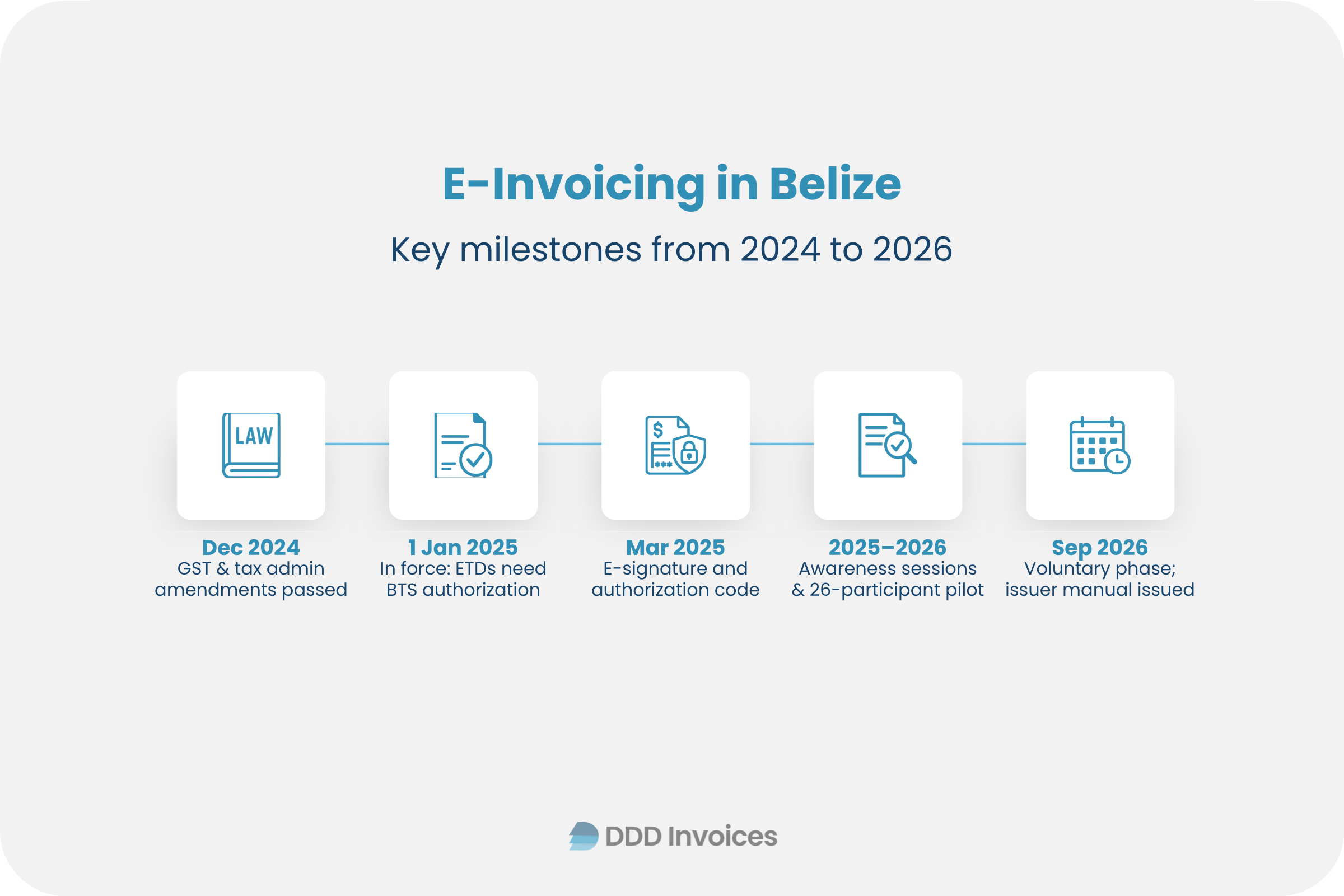
- December 2024: Belize passed the General Sales Tax (Amendment) Act, 2024 and the Tax Administration and Procedure (Amendment) Act, 2024. These amendments created the legal foundation for electronic tax invoices, tax receipts, debit notes, credit notes and other ETDs.
- January 1, 2025: The legislative amendments enabling e-invoicing took effect. They require electronic invoices and other ETDs to be authorized by the tax authority to receive tax recognition.
- March 2025: The General Sales Tax (Amendment) Regulations, 2025 established more detailed rules. Electronic tax invoices, receipts, debit notes and credit notes must follow the BTS-prescribed format and include an e-signature and unique authorization code.
- 2025–2026: BTS conducted nationwide awareness sessions attended by more than 700 participants and tested the system with 26 pilot participants. The pilot allowed BTS to assess system performance and gather feedback before wider implementation.
- September 2026: Belize’s voluntary e-invoicing phase began on September 1. On September 3, BTS published its Orientation Manual for Issuers of Electronic Tax Documents, providing technical guidance for integration with the VERTX-BZ receiving system.
B2G electronic Invoicing
Belize has not announced a government-only platform or B2G invoice format. BTS defines the current rollout as B2B but confirms that this scope includes business-to-government transactions. Therefore, supplies from a GST-registered business to a government entity may fall within the rollout when the supplier and transaction meet the applicable BTS criteria.
Businesses should follow the BTS ETD requirements and any procurement instructions issued by the relevant public authority.
B2B electronic Invoicing
B2B e-invoicing in Belize covers invoices from one GST-registered business to another. BTS identifies the customer by its Tax Identification Number (TIN). GST registration is generally mandatory once annual taxable supplies reach BZD 75,000. The initial mandatory ETD phase is limited to businesses meeting BTS's Large Taxpayer criteria, which BTS has not yet published.bts.
How the process works
- Generate: The ETD must follow Belize's UBL-based XML model. The model uses UBL 2.4 schemas that are identical to the relevant UBL 2.1 schemas, and UBLVersionID must contain "2.1".
- Sign: The XML must be digitally signed, using XMLDSig in XAdES-EPES format.
- Transmit: The issuer sends the ETD to BTS's reception system through web services.
- Authorize: BTS validates the file in real time and returns an authorization protocol. Under the previous-authorization model, the invoice can be legally issued only after this approval.
Fatal validation errors lead to rejection, and a rejected file has no legal value until it is corrected and resubmitted. Non-fatal inconsistencies may still be authorized with an alert.
B2C electronic Invoicing
B2C transactions are not part of the initial mandatory rollout and may be included in a later phase. Businesses that mainly sell to consumers are not required to submit those consumer transactions merely because they are registered for GST, unless BTS formally expands the transactional scope.
Nevertheless, the legal and technical framework already supports electronic tax receipts for sales from GST-registered businesses to non-registered customers. Tax receipts may use previous or subsequent authorization according to the permitted operating mode.
E-reporting and GST
Belize has periodic reporting: GST-registered businesses file a monthly GST return within 15 days after each tax period ends, and ETD submission does not replace it. BTS expects ETD data to support prefilled returns and replace separate ledger submissions later, but this isn't operational yet.
Authorized invoices can't be edited. Corrections use debit or credit notes that reference the original invoice, and cancellations or correction requests use electronic events. GST adjustments from these notes are reported on Lines 150 and 260 of the GST return.
During outages, permitted ETDs may be issued under subsequent authorization. They must show the contingency operation and be sent to BTS once service is restored. Businesses must keep GST records for at least six years, including invoices, credit and debit notes and customs documents. For audits, keep the signed XML, authorization protocol, graphical representation and related events accessible.
What happens without compliance?
A rejected file has no legal value as an ETD. The issuer must correct it and resend until BTS returns an authorization protocol, and the corrected file can reuse the same series and serial number. A file that fails only non-fatal rules isn't rejected. BTS can authorize it with an alert.
Existing GST penalties continue to apply. A GST return filed or paid late attracts a 10% late payment penalty and interest of 1.5% per month on unpaid tax. I didn't re-open the return guide in this session, so check those rates against the current GST Act before publishing.
Preparing for e-Invoicing in Belize
Belize is rolling out e-invoicing in phases under the Belize Tax Service (BTS). The mandatory phase currently covers B2B transactions involving large taxpayers, and BTS will announce any wider scope in advance. Invoices must be digitally signed, structured Electronic Tax Documents (ETDs) authorized by BTS before they are legally issued. A PDF or an ordinary ERP invoice does not qualify.
DDD Invoices helps businesses and software providers prepare their ERP, POS, accounting and SaaS platforms for the BTS ETD system. We support ETD data mapping, XML generation, digital signing, submission, handling of validation responses and secure archiving. With one integration, you can prepare for B2B e-invoicing in Belize and adapt as BTS expands the mandate.
Still have questions?
In the 30min free call we will discuss:
- your requirements in invoicing
- how integration works
- demo of the product
- next steps
FAQs
Is e-invoicing mandatory in Belize?
Belize is implementing e-invoicing in phases. The initial mandatory phase covers B2B transactions involving large taxpayers, while smaller businesses may participate voluntarily until BTS expands the scope.
What format does Belize require?
Belize requires structured XML under its UBL-based ETD model. Documents declare UBL version 2.1, must include an XAdES-EPES signature and require BTS authorization.
Are PDF invoices valid ETDs?
No. A PDF can represent the invoice visually, but only the structured, digitally signed and BTS-authorized document qualifies as an ETD.
Are B2C and cross-border transactions included?
B2C transactions are excluded from the initial mandatory phase, which covers taxable B2B activity in Belize. BTS has not announced an ETD obligation for foreign businesses with no local activity.


