
Standard
SAT FEL DTE
Tax Portal
SAT Agencia Virtual
Tax Authority
Superintendencia de Administración Tributaria (SAT)
CTC Model
Clearance, via SAT-authorised certifiers
B2G
Mandatory
B2B
Mandatory
Archiving
4 Years
Pending DDD Invoices support
E-invoicing in Guatemala is mandatory for B2G, B2B and B2C transactions under the Régimen de Factura Electrónica en Línea (FEL), regulated by the Superintendencia de Administración Tributaria (SAT) through Acuerdo de Directorio 13-2018
Every invoice is an XML Documento Tributario Electrónico (DTE), signed by the issuer, certified in real time by a SAT-authorised Certificador and sent to SAT before it reaches the customer. No Peppol, no separate B2G platform, no fiscal printer. Invoices of Q2,500 or more, must carry the buyer's NIT or CUI (Acuerdo Gubernativo 245-2022). Non-compliance can mean business closure for 10 to 20 days (Art. 85 and 86, Código Tributario).
Latest news
The FEL (Factura Electrónica en Línea) system governs electronic invoicing in Guatemala. This initiative is gradually being rolled out, focusing on taxpayer size, industry, and economic attributes.
SAT releases updated FEL XSD schemas and JSON catalogues in its official repository. Vendor advisories report new validations linked to the fuel-tax exemptions of Decreto 22-2026, changed export and fuel complements and a new ReferenciaDTE complement.
What does e-invoicing look like in Guatemala?
A Guatemalan e-invoice is a DTE: an XML file created and signed by the issuer, validated and signed by a SAT-authorised Certificador de DTE, given an SAT authorisation number (UUID) and transmitted to SAT in real time (Acuerdo 13-2018, Art. 1 and 13). Only a certified DTE has tax effect; the PDF or paper print is a representation of it.
Document types: Factura (FACT), Factura Cambiaria (FCAM), Factura Pequeño Contribuyente (FPEQ), Factura Especial (FESP), Nota de Crédito (NCRE), Nota de Débito (NDEB), Recibo (RECI), Recibo por Donación (RDON), Nota de Abono (NABN), plus the primary and agricultural regime invoices added by Decreto 31-2024.
E-invoicing evolution
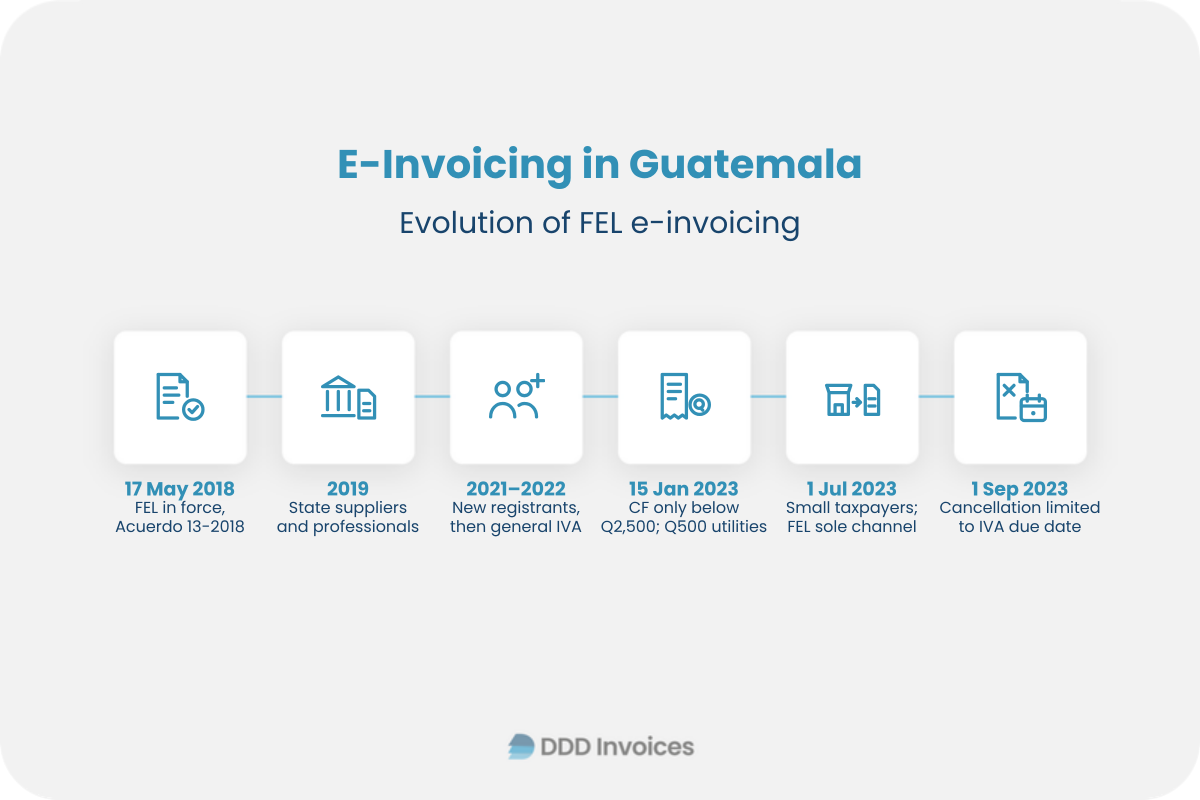
- 17 May 2018: FEL in force (Acuerdo 13-2018), amended by Acuerdos 26-2019 and 15-2020.
- 2019: state suppliers under procurement modalities of Decreto 57-92 from 1 April 2019; individual professional services to the public sector from 12 September (SAT-DSI-838-2019).
- 1 July 2021: new registrants may only be issued through FEL.
- 1 July 2022: all general IVA-regime taxpayers (SAT-DSI-1240-2021).
- 15 January 2023: CF allowed only below Q2,500 and below Q500 for water, electricity and telephone.
- 1 July 2023: all small taxpayers (SAT-DSI-1350-2022, deadline moved by SAT-DSI-400-2023). FEL becomes the sole channel.
- 1 September 2023: cancellation window limited to the IVA return due date (Reglas y Validaciones).
B2G regulations in Guatemala
Status: mandatory, in force. B2G was the first mandatory segment (2019 incorporation of state suppliers, then SAT-DSI-838-2019 for professional services from 12 September 2019). Since 1 July 2022, the general mandate covers every supplier. Public entities and entities funded by the state should not accept paper invoices. Goods and works suppliers issue FACT or FCAM (credit terms); small-taxpayer professionals issue FPEQ.
B2B regulations in Guatemala
Status: mandatory since 1 July 2022 (general regime) and 1 July 2023 (small taxpayers). Pre-printed invoice authorisations and blank-NIT invoices lost effect on those dates.
How a DTE flows:
- The issuer, enabled as Emisor FEL in Agencia Virtual, builds the XML and signs it (Acuerdo 13-2018, Art. 13).
- A Certificador de DTE (SAT's free service or an authorised private certifier) validates it against the Reglas y Validaciones, signs it, assigns the authorisation number and transmits it to SAT in real time.
- The issuer delivers XML, paper or PDF to the buyer, who also sees it in Agencia Virtual and the Planilla IVA-FEL.
B2C regulations in Guatemala
mandatory, in force. A retailer, restaurant or ticket seller issues a certified DTE for every sale, exactly like a B2B supplier. There is no fiscal printer or certified cash-register regime: Art. 85(4) Código Tributario makes any register or system not authorised by SAT a closure offence, and under FEL the certified DTE is the control
Consumidor Final rules (Acuerdo Gubernativo 245-2022, from 15 January 2023):
- Below Q2,500: "CF" allowed instead of NIT/CUI.
- Q2,500 and above: NIT or CUI mandatory; a customer who refuses it cannot be invoiced as CF.
- Water, electricity, telephone: CF only below Q500.
Small sales: small taxpayers invoice every sale above Q50 and may consolidate smaller sales into one end-of-day invoice (Ley del IVA, Art. 49); general-regime sellers invoice every sale at delivery (Art. 29 and 34).
Tired of scrolling through information about e-invoicing?
- Register on the platform as a software vendor or a end-client
- Start and complete the integration
- Send your first invoice into the test environment
- Switch to production!
E-reporting and VAT compliance in Guatemala
SAT administers periodic reporting through Declaraguate, but returns are summary filings, not invoice listings.
- IVA (general regime): The monthly return and payment are due within the calendar month after the period (12% standard rate).
- IVA (small taxpayer): 5% of gross monthly receipts.
- ISR (net profit regime): 25% on net profit. Quarterly advance payments are credited against the final liability, and the annual return is due by March 31.
- ISR (optional simplified regime): Tax is 5% on monthly income up to Q30,000 and 7% above that. It is paid through withholding or direct remittance within the first 10 working days of the following month. An annual informative return is due March 31.
- Withholdings: Non-resident withholding rates run from 5% to 25%, depending on the income type.
Archiving: keep DTEs and supporting records for at least the 4-year prescription period (Código Tributario, Art. 47; 8 years for unregistered taxpayers). Certifiers and SAT keep the certified XML, but the taxpayer remains responsible for its own copies.
Penalties for non-compliance
- Not issuing or delivering invoices, issuing documents not authorised by SAT (including paper after the FEL deadlines), or using unauthorised registers or systems: closure for 10 to 20 continuous days, doubled on resistance (Art. 85 and 86); replaceable on request by a fine of up to 10% of the last month's gross income, minimum Q10,000 (Q5,000 for small taxpayers).
- Repeat Art. 85 offence within 4 years: definitive closure and cancellation of the commercial registration (Art. 74).
- Invoices missing a formal requirement: Q100 per document, max Q5,000 per month (Art. 94(8)); illegible or incomplete invoices Q5,000 per month (Art. 94(17)).
- Late IVA return: Q50 per day, max Q1,000 (Art. 94(9)); omitted tax: 100% of the amount (Art. 89).
The operational cost is usually higher: a rejected DTE is not an invoice, the buyer cannot claim input IVA on it, and public entities will not pay without a valid authorisation number.
Your partner for e-invoicing in Guatemala
DDD Invoices provides a single REST API designed to abstract local invoicing requirements behind one integration. Businesses and software providers can keep their existing user experience, while country-specific document generation, validation and distribution logic is managed within the compliance layer. The same JSON used elsewhere can be mapped to SAT's GT_Documento XML with the right DTE type.
This approach is especially useful for businesses operating across several countries. Maintaining separate tax integrations for every market, including Guatemala and the rest of Central America, quickly becomes difficult to scale.
Still have questions?
In the 30min free call we will discuss:
- your requirements in invoicing
- how integration works
- demo of the product
- next steps
FAQs
What is a DTE and how is it different from a PDF invoice in Guatemala?
A DTE is the certified XML carrying a SAT authorisation number. The PDF or paper print is only its representation and has no tax effect on its own.
How does a company become a FEL issuer?
Enable itself as Emisor FEL in Agencia Virtual, obtain an advanced electronic signature and accredit one or more Certificadores (SAT's free one or an authorised private one).
When must an invoice show the customer's NIT or CUI?
On every DTE of Q2,500 or more, and on water, electricity or telephone invoices of Q500 or more, since 15 January 2023 (Acuerdo Gubernativo 245-2022).
Why do foreign suppliers not issue FEL invoices?
When the seller is not domiciled in Guatemala, the buyer is the IVA taxpayer (Ley del IVA, Art. 6(2)), so the obligation shifts to the customer.