
Standard
N/A
Tax Portal
ARD e-Filing
Tax Authority
Afghanistan Revenue Department (ARD)
CTC Model
N/A
B2G
N/A
B2B
N/A
Archiving
N/A
Pending DDD Invoices support
Afghanistan has stopped handing out paper tax forms, yet no invoice passes through a government system. The Afghanistan Revenue Department (ARD) of the Ministry of Finance collects returns through e-filing, but e-invoicing in Afghanistan has no legal framework.
Afghanistan has no e-invoicing, e-reporting or clearance mandate, and no invoice format or start date exists. Businesses issue their own invoices, and turnover is taxed through Business Receipts Tax (BRT), not VAT. Companies file BRT returns quarterly, and large taxpayers must file online through ARD e-filing.
Latest news
As of October 2026, Afghanistan still has no e-invoicing mandate, rollout plan or required invoice format. For your business, that means no government platform to connect to and no deadline to plan for. Official information is limited, so this guide will be updated if the ARD publishes a framework.
A Ministry of Finance notice reports leadership decree No. 3758 of May 13, 2023, which cut quarterly BRT for industry from 4% to 2%. It also exempted agriculture, industry and trade from the 7% contract tax.
Neither change adds invoicing duties, and no e-invoicing framework has been announced. Official information is limited, so this guide will be updated if the ARD publishes one.
Tired of scrolling through information about e-invoicing?
- Register on the platform as a software vendor or a end-client
- Start and complete the integration
- Send your first invoice into the test environment
- Switch to production!
What is e-invoicing and why has Afghanistan adopted it?
E-invoicing is the exchange of invoices in a structured format that software can process without manual entry.
Afghanistan has not adopted it: the Ministry of Finance's 2017 VAT plan foresaw paper and e-invoice rules for VAT taxpayers, but VAT never started. Since August 15, 2021, the ministry and the ARD have operated under the Taliban-led interim administration. No clearance or reporting model exists.
The evolution of e-invoicing in Afghanistan
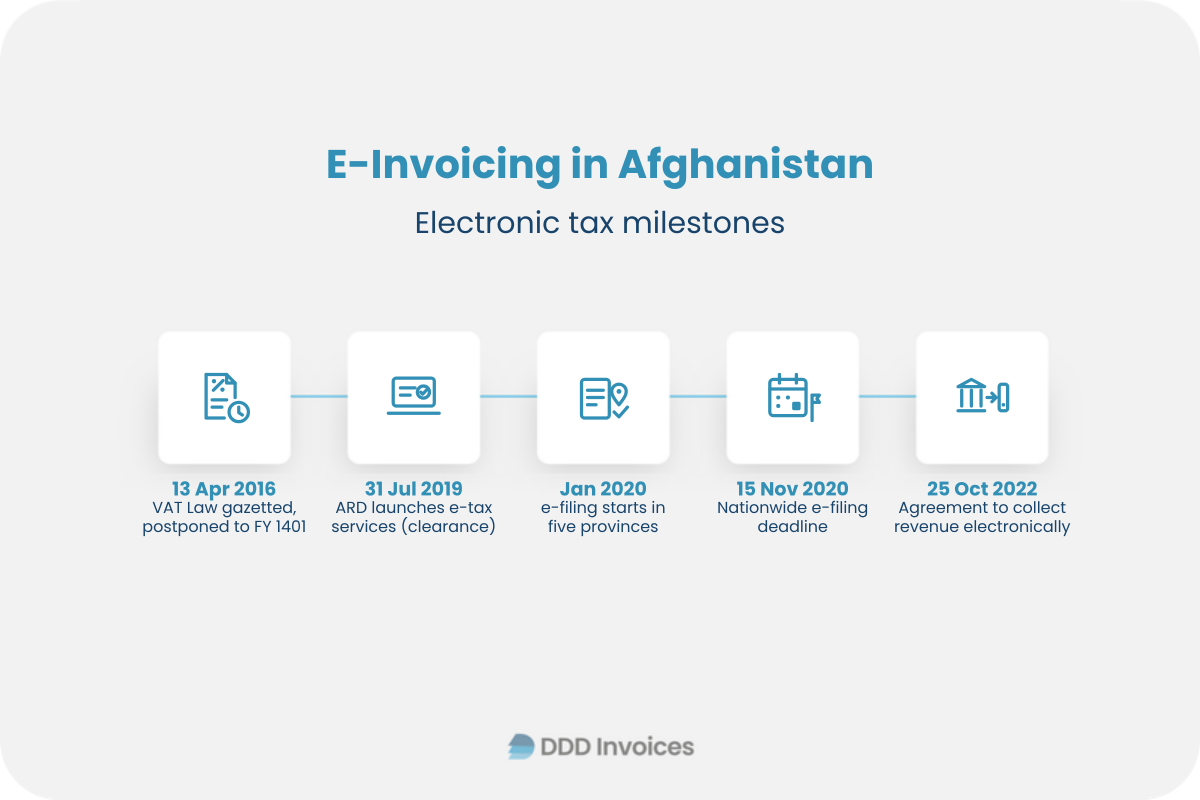
- April 13, 2016: the VAT Law appears in Official Gazette No. 1209, but its start is postponed, most recently to fiscal year 1401.
- July 31, 2019: the ARD launches electronic tax services for tax clearance, after cabinet approval of online declarations on July 9.
- January 2020: the ARD rolls out e-filing in five provinces, including Kabul, with a nationwide deadline of November 15, 2020.
- October 25, 2022: the Ministry of Finance, Da Afghanistan Bank and the national statistics authority sign an agreement to collect revenue electronically.
B2G e-invoicing in Afghanistan
There is no B2G e-invoicing mandate, portal or format, so suppliers invoice ministries and state-owned enterprises directly. Suppliers using a unified e-invoicing API for other governments can simply issue a PDF here.
B2B e-invoicing in Afghanistan
B2B e-invoicing is not mandatory, and no law sets an electronic format, digital signature or exchange network. No current official source lists mandatory invoice fields, so issue complete invoices that match your BRT returns.
UN sanctions under Resolution 1988 (2011) target listed individuals and entities associated with the Taliban, not Afghan trade as a whole. In the US, OFAC General License 20 authorizes most transactions involving Afghanistan and its governing institutions, with exceptions.
- Register with the ARD for a Taxpayer Identification Number (TIN).
- File quarterly BRT returns, online where required.
- Keep invoices, purchase records and contracts behind each return.
- Screen customers and suppliers against UN and US sanctions lists, and take legal advice.
- Watch Ministry of Finance notices for VAT or e-invoicing news.
B2C e-invoicing in Afghanistan
There is no B2C e-invoicing, e-receipt or fiscal device requirement for shops or online sellers, so a POS integration needs no local certification.
Shopkeepers and traders pay a fixed tax on sales. A leadership order exempts those with annual sales up to AFN 2 million and charges 0.3% of sales above that.
E-reporting and VAT compliance
Afghanistan has no periodic e-reporting, and no VAT is in force because the 2016 VAT Law never took effect. BRT applies instead, at differentiated rates on each production stage and without input tax credit. The ARD's core tax system, SIGTAS (Standard Integrated Government Tax Administration System), was rolled out beyond Kabul from 2015.
Companies file BRT returns every quarter, and late filers face additional tax. Large taxpayers must file returns online. So must seven types of medium taxpayers, with annual gross sales from AFN 50 million to under AFN 150 million. Paper tax forms are no longer issued. The record retention period is not yet confirmed.
Penalties for non-compliance
There are no e-invoicing penalties, and no accessible official source currently lists fixed tax fines. Penalties take the form of additional tax, and a late-2022 amnesty waived all accumulated additional tax, though principal arrears stayed due.
Offence | Penalty |
|---|---|
Late or missing BRT return | Additional tax and legal measures, amount not confirmed |
Earlier unpaid tax | Principal due; additional tax up to late 2022 waived |
No e-invoice issued | Not applicable, no mandate |
Your trusted partner for e-invoicing
Afghanistan has no e-invoicing mandate, so you need accurate invoices, timely BRT returns and records ready for any future framework.
DDD Invoices gives you one API to issue, receive and archive compliant invoices across every country we support, so your ERP or billing software connects once and we keep each country's format, validation and deadline rules up to date for you. Afghanistan is not yet on our country coverage list, and talking to us is the fastest way to put it on the roadmap.
Still have questions?
In the 30min free call we will discuss:
- your requirements in invoicing
- how integration works
- demo of the product
- next steps
FAQs
When will e-invoicing become mandatory in Afghanistan?
No date has been set, because the ARD has not published any e-invoicing law, format or rollout plan. Until that changes, businesses issue their own invoices and report through quarterly BRT returns.
What is the business receipts tax in Afghanistan?
BRT is Afghanistan's turnover tax on businesses, charged on gross receipts at rates that differ by business activity. It still applies because the 2016 VAT Law, which would have replaced it, never took effect.
How does ARD e-filing differ from e-invoicing?
ARD e-filing lets taxpayers submit tax returns online instead of on paper forms at a tax office. It handles returns and tax documents only, so it does not issue, validate or exchange invoices.
Why screen Afghan counterparties for sanctions?
UN sanctions freeze assets of listed Taliban-associated individuals and entities but do not ban Afghan trade. Screening customers and suppliers and taking legal advice helps you avoid dealing with a listed person.