



Standard
SON
Tax portal
DTE portal
Tax authority
DGII
CTC model
Clearance.
B2G
2022
B2B
2022
Archiving
10 years
Pending support by DDD invoices
El Salvador has a mandatory electronic invoicing framework based on Documentos Tributarios Electrónicos (DTEs). The framework is administered by the Dirección General de Impuestos Internos (DGII), which forms part of the Ministry of Finance (Ministerio de Hacienda).
The legal basis was introduced by Legislative Decree No. 487 of 30 August 2022, which amended the Tax Code to add the DTE rules, including Articles 119-A to 119-H. The reforms entered into force on 14 October 2022.
Rather than setting one single nationwide start date, the transitional provisions authorise the DGII to establish and communicate a gradual taxpayer-incorporation plan. The DGII publishes the relevant start dates and taxpayer groups through its official channels.
Latest News
The Ministry of Finance continues to incorporate taxpayers into DTE transmission systems and manage the electronic-invoicing framework through its dedicated portal. Businesses should confirm their own incorporation date and applicable technical rules directly with the DGII.
Tired of scrolling through information about e-invoicing?
- Register on the platform as a software vendor or a end-client
- Start and complete the integration
- Send your first invoice into the test environment
- Switch to production!
Why El Salvador Uses E‑Invoicing
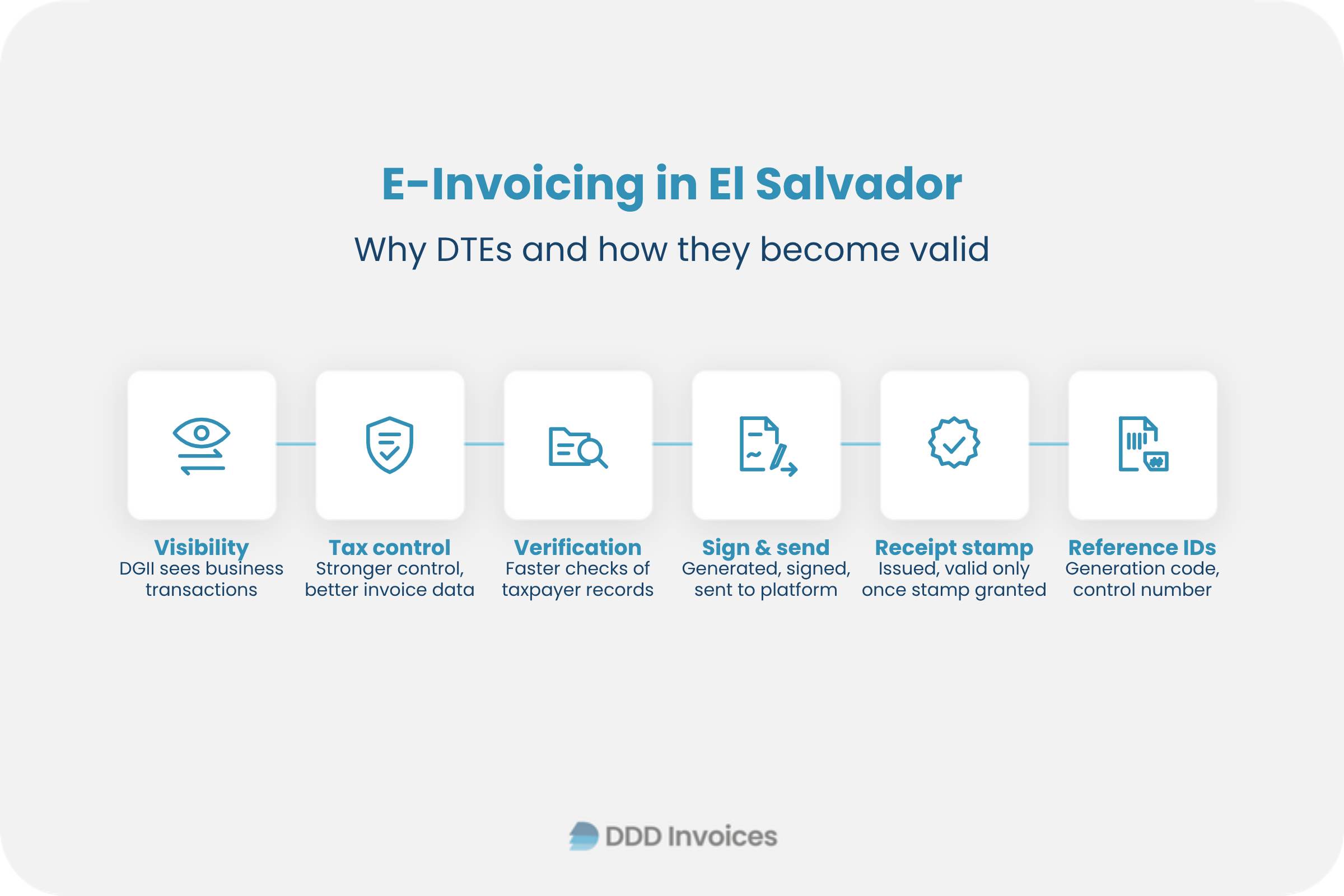
El Salvador’s DTE framework digitalises tax documents and gives the DGII greater visibility over commercial transactions. It is designed to strengthen tax control, improve the quality of invoice data, and support more efficient verification of taxpayers’ records.
Each DTE is generated, electronically signed, and transmitted to the Tax Administration’s platform for the grant of a Sello de Recepción. Under the Tax Code, a document obtains DTE status and is treated as issued once the Tax Administration grants that receipt stamp.
The Ministry of Finance’s DTE issuing guide confirms that the Sello de Recepción gives the electronic invoice tax validity. The readable document also contains a generation code and control number for later reference.
E‑Invoicing Timeline
- 2019: The Ministry of Finance began developing the electronic-invoicing pilot. Its 2019 annual report confirms the conceptual and IT development of the pilot, while the Ministry later stated that implementation work had been underway since June 2019.
- 30 August 2022: Legislative Decree No. 487 was approved, amending the Tax Code to introduce the rules for Documentos Tributarios Electrónicos (DTEs).
- 14 October 2022: The DTE-related Tax Code reforms entered into force. Ministry of Finance — DTE legal reforms
- 14 December 2022: The Ministry of Finance officially launched the Electronic Invoicing System.
- From 2023: The DGII has been authorised to incorporate taxpayers gradually into electronic invoicing and to publish the applicable start dates and taxpayer groups through official communications.
Who Is in Scope?
El Salvador’s DTE framework applies to VAT taxpayers that the DGII has incorporated into mandatory electronic invoicing. The DGII sets taxpayer groups and start dates through a gradual rollout, rather than applying one universal deadline.
Businesses should check their incorporation status and applicable start date through DGII communications and the Ministry of Finance’s DTE portal. Taxpayers not yet required to issue DTEs may adopt the system voluntarily to test their processes and prepare their systems.
B2G E‑Invoicing
B2G e-invoicing is available in El Salvador through the national DTE system. VAT-registered suppliers invoice public entities using the same DTE clearance model used for other domestic transactions.
The supplier creates a signed JSON DTE, submits it to the DGII for validation, and receives a Sello de Recepción. An official Ministry of Finance record shows a validated DTE issued by a private supplier with the Ministry of Finance as recipient.
B2B E‑Invoicing
For B2B transactions, the issuer generates the appropriate DTE in the DGII’s prescribed JSON format, applies an electronic signature, and submits it to the Ministry of Finance for validation. Once accepted, the DGII issues a Sello de Recepción, which gives the document tax validity; the issuer can then provide the buyer with the electronic document and a readable representation where needed.
Businesses should ensure their ERP, billing, accounts receivable, and accounts payable systems accurately manage customer tax details, invoice lines, VAT calculations, document numbers, totals, and credit or debit notes.
B2C E‑Invoicing
Consumer-facing businesses become subject to DTE obligations once incorporated by the DGII. This includes relevant retailers, hospitality businesses, e-commerce sellers, and service providers that issue invoices or receipts to final consumers.
POS and billing systems must be able to generate, sign, transmit, validate, and retain DTEs at the required transaction level. Businesses should also maintain a documented contingency process for technical or connectivity interruptions, including subsequent transmission of documents issued during the outage.
E‑Reporting and Tax Compliance in El Salvador
El Salvador has e-reporting. VAT taxpayers file periodic electronic returns through the Ministry of Finance’s online declarations service. The main one is the monthly VAT return (F‑07), supported by annexes listing sales to taxpayers, sales to final consumers and purchases, and the monthly withholding return (F‑14).
Taxpayers upload these annexes as files, and the VAT figures must match the VAT books (purchases, sales to taxpayers and sales to final consumers). The VAT return is due within the first ten business days of the following month.
Penalties for Non-Compliance
Article 239-A of El Salvador’s Tax Code sets specific penalties for DTE failures. The Ministry of Finance confirms that Legislative Decree No. 487 introduced Article 239-A as part of the DTE reforms.
- Failure to issue or deliver a required DTE: 50% of the transaction value for each document, with a minimum fine of two monthly minimum wages.
- Incorrect DTE content or failure to provide the required graphic representation: 30% of the transaction value for each document, with a minimum fine of two monthly minimum wages.
- Failure to transmit a DTE to the tax authority’s platform: 100% of the transaction value for each document, with a minimum fine of nine monthly minimum wages.
- Failure to send, late submission of, or incorrect-format submission of a contingency or invalidation event: nine monthly minimum wages.
- Failure to comply with technical DTE rules issued by the Tax Administration: nine monthly minimum wages.
These penalties apply per document or event where specified, so control failures can scale quickly for businesses processing large invoice volumes.
Your E‑Invoicing Partner
El Salvador’s DTE framework requires more than creating digital invoices. Businesses need reliable JSON data, electronic-signature controls, DGII validation, receipt-stamp evidence, contingency procedures, and compliant long-term storage.
DDD Invoices helps businesses connect these steps through one compliance layer. Integrate your ERP, billing, POS, marketplace, or accounting system through a unified API; DDD Invoices can transform standardised invoice data into the required local format, support authority submission flows, return validation status and evidence, and securely archive documents and related records.
As your business expands, you can manage country-specific invoicing, fiscalization, reporting, and retention requirements without building separate compliance infrastructure for every market. DDD Archive also supports storage aligned with local retention and accessibility rules, with records available through the dashboard or API.
Still have questions?
In the 30min free call we will discuss:
- your requirements in invoicing
- how integration works
- demo of the product
- next steps
FAQs
Is e-invoicing mandatory in El Salvador?
Yes. El Salvador has a mandatory electronic invoicing framework based on DTEs, but implementation is gradual and the DGII communicates incorporation dates for affected taxpayers. Taxpayers not yet required to participate may generally adopt the system voluntarily.
What is a DTE in El Salvador?
A DTE is a Documento Tributario Electrónico,the electronic tax document used in El Salvador’s e-invoicing regime. It must meet DGII specifications, be electronically signed, and be submitted to the tax authority for validation.
What format does El Salvador require?
El Salvador requires DTEs in structured JSON format.
Does the DGII validate invoices?
Yes. The issuer submits the electronically signed DTE to the DGII, which validates it and issues a Receipt Stamp containing a UUID after successful processing.


