



Standard
XML
Tax Portal
SRI en Línea / Facturador SRI
Tax Authority
Servicio de Rentas Internas (SRI)
CTC Model
Off-line issuance with immediate transmission and SRI authorization
B2G
Mandatory for covered suppliers
B2B
Mandatory, subject to taxpayer-regime exceptions
Archiving
7 years
Pending DDD Support
E-invoicing in Ecuador is mandatory for most taxpayers required to issue invoices. The broad adoption deadline was 29 November 2022, with affected preprinted documents losing validity from 30 November. RIMPE entrepreneurs must issue electronically, while negocios populares may choose permitted sales notes or electronic invoices.
The Servicio de Rentas Internas (SRI) administers the Comprobantes Electrónicos system through its Esquema Off-line, requiring electronically signed XML documents. From 1 January 2026, applicable electronic documents must be transmitted immediately to SRI. Businesses must follow the prescribed XML schemas, process authorization responses and deliver electronic documents to recipients.
Latest News
Since January 2026, immediate transmission to SRI has been mandatory for electronic sales documents, withholding certificates and complementary documents. In July, SRI updated its Esquema Off-line technical specification to Version 2.34, including software-provider identification requirements.
July’s Resolution NAC-DGERCGC26-00000027 also introduced registration obligations for covered software providers domiciled or permanently established in Ecuador. Providers must register an exclusive establishment and the prescribed RUC activity within 30 days of Official Register publication. Issuers must include their provider’s RUC in electronic documents’ additional information within 60 calendar days of publication. SRI’s provider-list publication starts in October 2026.
What Is E-Invoicing and Why Is Ecuador Adopting It?
E-invoicing enables structured invoice information to be exchanged and processed electronically.
Ecuador’s Esquema Off-line supports locally generated, electronically signed documents transmitted to SRI for validation. “Off-line” does not mean exemption from transmission. The framework strengthens document authenticity, integrity and tax administration while reducing paper use.
Under SRI’s technical specifications, supported documents include facturas, liquidaciones de compra, notas de crédito/débito, comprobantes de retención and guías de remisión. The signed XML is the electronic tax document. RIDE is its readable representation, not a substitute.
The Evolution of E-Invoicing in Ecuador
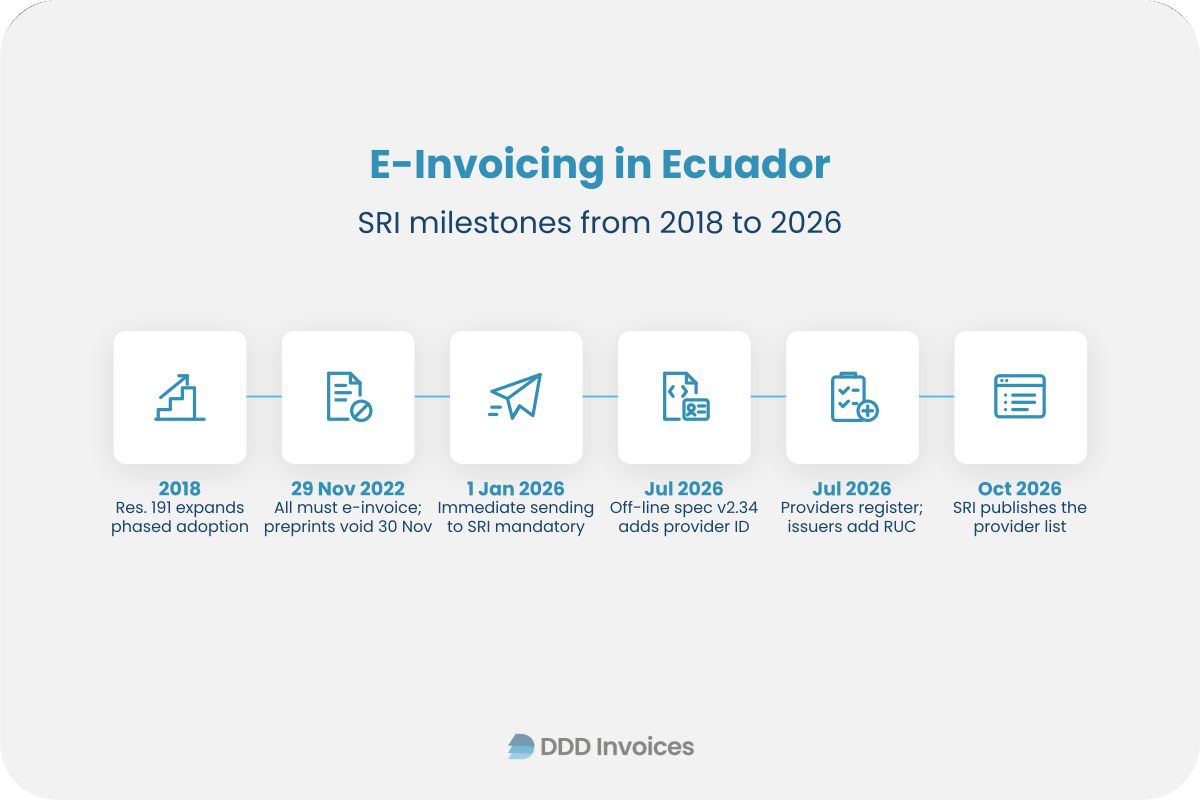
- 2018 — Resolution NAC-DGERCGC18-00000191 expanded phased mandatory electronic issuance. Resolution NAC-DGERCGC18-00000431, published on 28 December 2018, subsequently amended this resolution and the earlier NAC-DGERCGC17-00000430.
- 2022 — Resolution NAC-DGERCGC22-00000024 required remaining covered income-tax taxpayers obliged to invoice to adopt electronic issuance by 29 November, subject to exceptions. Designated withholding agents also had to implement ATS-version electronic withholding certificates.
- 2025–2026 — Resolution NAC-DGERCGC25-00000014, amended by Resolution NAC-DGERCGC25-00000017, revised annulment procedures and established immediate transmission from January 2026.
Current RIMPE guidance distinguishes entrepreneurs, who issue electronically, from negocios populares, who may choose permitted sales notes or electronic invoices with the required regime legends.
B2G Electronic Invoicing in Ecuador
Government suppliers use applicable electronic invoices and complementary documents under the SRI’s national electronic invoicing framework, rather than a separate nationwide B2G format. Public-sector withholding agents issue electronic withholding certificates where legally required. SRI authorization concerns tax-document status, not commercial acceptance or approval for payment. Its verification service expressly states that authorization does not validate the document’s information or the actual existence of the transaction.
B2B Electronic Invoicing in Ecuador
Covered suppliers identify business buyers by RUC and record transaction details and applicable IVA. Under the Reglamento de Comprobantes de Venta, Retención y Documentos Complementarios, supporting IVA credit requires buyer identification, separately stated tax and compliance with the relevant conditions.
The SRI technical specifications require businesses to:
- Generate XML against the applicable XSD, including the 49-digit access key.
- Apply the electronic signature.
- Transmit immediately to SRI.
- Process reception and authorization responses, correcting rejected documents.
- Deliver the electronic document and RIDE to the recipient.
SRI authorization concerns tax-document validation, not the buyer’s commercial acceptance. The SRI verification service distinguishes authorization from verification of the document’s information or the transaction’s actual existence.
Exports require the applicable export-invoice fields and permitted foreign-buyer identification specified in the SRI technical documentation. Imports remain subject to separate customs-document and IVA requirements. Imported services may require purchase liquidations and withholding under the applicable conditions described in the SRI’s IVA declaration guide.
B2C E-Invoicing in Ecuador
Covered sellers must also document consumer sales electronically. SRI’s electronic-invoicing guidance permits “Consumidor Final” invoices without identifying the customer for amounts up to USD 50. Above that amount, identify the buyer appropriately. Do not apply the USD 200 figure from older physical-invoicing guidance as the general electronic-invoice limit.
Where permitted, Consumidor Final uses identification code 07 and number 9999999999999, as specified in SRI’s technical specifications. From 1 January 2026, invoices issued and transmitted as Consumidor Final cannot be annulled or modified through credit notes under Resolution NAC-DGERCGC25-00000017.
E-Reporting and VAT Compliance in Ecuador
Ecuador requires periodic tax reporting, including IVA returns filed monthly or semiannually according to the taxpayer’s activities and regime. RIMPE entrepreneurs generally declare IVA semiannually. Withholding declarations and the Anexo Transaccional Simplificado (ATS) are also required where applicable, subject to reporting exemptions.
Corrections follow Resolution NAC-DGERCGC25-00000014, amended by Resolution NAC-DGERCGC25-00000017. Online annulment generally closes on the seventh day of the following month, with applicable working-day adjustments. Certain documents require recipient acceptance within five working days. Credit and debit notes must follow their legally permitted purposes.
System or connectivity failures do not automatically exempt issuers from transmission. Authorized preprinted documents may be used only under SRI’s exceptional-issuance conditions. Ordinary transmission is immediate from 1 January 2026, rather than subject to the former four-working-day allowance.
Article 41 of the Reglamento de Comprobantes de Venta, Retención y Documentos Complementarios requires seven-year retention, including electronic storage for electronic documents, subject to longer applicable statutory obligations.
What Happens If Businesses Don’t Comply?
Under Resolution NAC-DGERCGC24-00000022, penalties range from one to thirty unified basic salaries for failure to deliver sales documents or transmit electronic sales documents, depending on the infringement and taxpayer classification.
Your Trusted Partner for E-Invoicing in Ecuador (DDD)
DDD Invoices gives businesses a unified platform to create, send, receive and archive electronic invoices across supported markets. Its standardized API helps connect invoicing workflows with existing business systems, reducing the complexity of managing country-specific requirements.
For ERP vendors, SaaS platforms and other software providers, DDD offers automated client onboarding, API-based error handling and a consolidated dashboard to manage customers and invoice activity. Businesses planning an Ecuador integration can discuss XML mapping, electronic signatures, SRI authorization handling and document retention with the DDD team, confirming Ecuador coverage and implementation scope before deployment.
Still have questions?
In the 30min free call we will discuss:
- your requirements in invoicing
- how integration works
- demo of the product
- next steps
FAQs
Is e-invoicing mandatory in Ecuador?
Yes, for covered taxpayers. Under RIMPE rules, entrepreneurs must issue electronically, while negocios populares may choose permitted sales notes or electronic invoices.
What format does Ecuador require for electronic invoices?
Electronically signed XML conforming to SRI schemas. The RIDE is a readable representation, not a replacement for the XML document.
Does Esquema Off-line allow delayed transmission?
No. Immediate transmission to SRI has been mandatory since 1 January 2026. Businesses must also process authorization or rejection responses.
Does SRI authorization replace IVA declarations?
No. Businesses must still file monthly or semiannual IVA returns, plus withholding reports and ATS filings where required, subject to applicable exemptions.


