



Standard
XML
Tax portal
National NF-e portal
Tax authority
Receita Federal
CTC Model
Clearance
B2G
2006
B2B
2006
Archiving
five years
Pending Support by DDD invoices
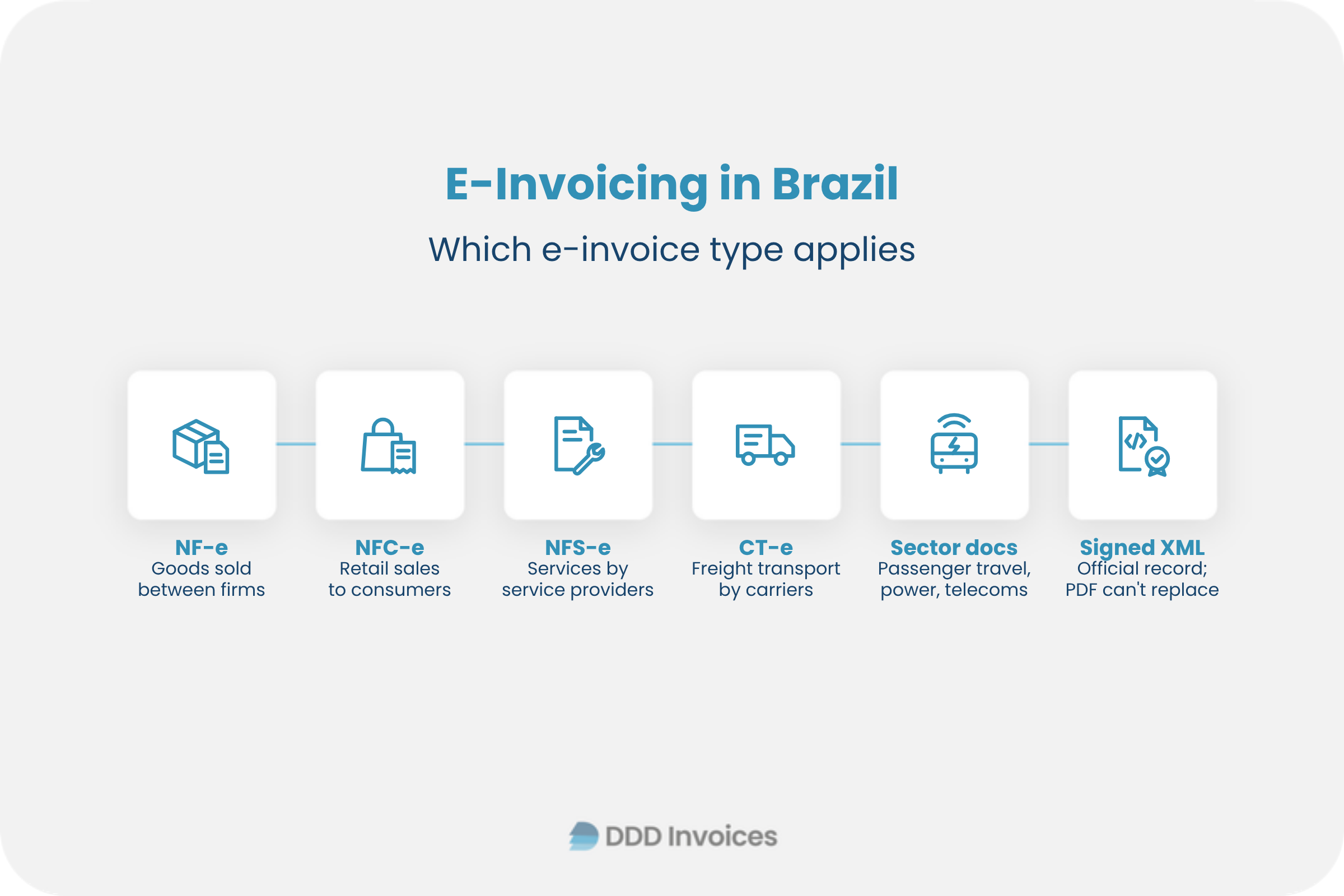
E-invoicing is mandatory in Brazil. Brazil’s e-invoicing system uses different electronic invoice types for different business transactions. Companies issuing goods invoices generally use NF‑e, retailers use NFC‑e for consumer sales, service providers issue NFS‑e, and freight carriers issue CT‑e.
The appropriate invoice type depends on the transaction. Brazil also has electronic documents for specific activities, including passenger transport, electricity, and telecommunications.
E-invoices are created in XML format, digitally signed, and sent to the relevant tax-authorisation system. The authorised XML is the official electronic invoice record, while a PDF or printed representation supports business and customer use but does not replace it.
Latest News
For electronic service invoices, businesses under Simples Nacional must issue NFS‑e through the National NFS‑e Issuer from 1 November 2026. Invoices may be issued through the national web portal, mobile application, or an ERP integration using the National NFS‑e API.
Tired of scrolling through information about e-invoicing?
- Register on the platform as a software vendor or a end-client
- Start and complete the integration
- Send your first invoice into the test environment
- Switch to production!
What Is E‑Invoicing in Brazil?
In Brazil, e-invoicing means issuing the appropriate electronic invoice, such as an NF‑e for goods, NFC‑e for retail sales, or NFS‑e for services, through the relevant government-authorisation system. Businesses create the invoice as structured XML, apply the required digital signature, and submit it for authorisation before relying on it as the official invoice record.
The authorised XML is the legally relevant electronic invoice. A DANFE is a printable representation of an NF‑e used to accompany goods and provide readable invoice details, but it does not replace or constitute the electronic invoice itself.
E-invoicing supports Brazil’s tax administration by standardising invoice information and enabling electronic validation and data exchange. It is also central to the consumption-tax reform: businesses must adapt invoice data for the new federal CBS, subnational IBS, and Selective Tax (IS) requirements, following the official rollout schedule and technical layouts.
E‑Invoicing Timeline
- 2006–2008: Brazil began the national NF‑e project and progressively expanded electronic fiscal documents across goods, transport, and consumer transactions.
- 2010s: State and municipal authorities broadened adoption of NF‑e, NFC‑e, CT‑e, NFS‑e, and other electronic document types.
- 2022: The national standard NFS‑e project was established to create a common service-invoice framework while allowing municipal participation.
- 2023: Constitutional Amendment No. 132 established the foundations for Brazil’s consumption-tax reform.
- 16 January 2025: Complementary Law No. 214 established the CBS, IBS, and Selective Tax framework.
- January 2026: Updated NF‑e and NFC‑e layouts began supporting CBS, IBS, and IS information.
- 3 August 2026: Mandatory implementation dates began for updated layouts covering several electronic fiscal documents, including NF‑e and NFC‑e.
- 1 November 2026: National NFS‑e issuance becomes mandatory for Simples Nacional micro and small businesses.
Who Is in Scope?
Brazil’s e-invoicing requirements depend on the type of supply and the authority responsible for authorising the invoice. Businesses must determine the appropriate invoice type for each transaction, rather than applying one single e-invoicing process to every sale.
- Goods suppliers: Businesses selling goods generally issue an NF‑e for B2B transactions and other goods supplies.
- Retailers: Businesses selling goods directly to consumers generally issue an NFC‑e.
- Service providers: Businesses providing services issue an NFS‑e, generally through the competent municipal system or the National NFS‑e environment where applicable.
- Transport providers: Freight and passenger transport businesses may need to issue an CT‑e, CT‑e OS, BP‑e, or another transport-specific electronic invoice.
- Utilities and communications providers: Sector-specific electronic invoices apply to water, gas, electricity, and telecommunications services.
From 1 November 2026, micro and small businesses under Simples Nacional that issue service invoices must use the National NFS‑e Issuer, either through its web application or an API integration.
B2G E‑Invoicing in Brazil
B2G e-invoicing exists in Brazil. Suppliers issue the same type of electronic invoice required for the underlying sale or service, for example, NF‑e for goods or NFS‑e for services, and then follow the public buyer’s procurement, acceptance, and payment process. The Receita Federal identifies NF‑e as documents used in B2B and B2G transactions.
For a goods supply to a public entity, the supplier generally issues an authorised NF‑e through the relevant state tax-authorisation environment. For services, the supplier issues an NFS‑e through the applicable municipal or National NFS‑e system; the National NFS‑e service allows the issuer to identify the customer using its CPF or CNPJ.
The electronic invoice alone may not complete the public-sector payment process. Federal suppliers also use government procurement systems such as Compras.gov.br and SICAF for registration, tender participation, contracting, and procurement administration; a contracting authority may require the supplier to submit invoice details, acceptance evidence, delivery records, or other contract-specific documents.
B2B E‑Invoicing in Brazil
For B2B goods sales, businesses generally issue an NF‑e in XML format and obtain authorisation before the goods circulate. The issuer must also provide the XML to the buyer.
For B2B services, businesses issue an NFS‑e through the applicable municipal or National NFS‑e system. The National system supports issuance through its web portal, mobile app, or ERP/API integration.
B2C E‑Invoicing in Brazil
Retailers generally issue an NFC‑e for consumer sales of goods. The customer-readable DANFE NFC‑e includes a QR code that can be used to access invoice information, and Brazil’s official guidance also provides for offline contingency issuance when authorisation systems are unavailable.
For consumer services, businesses issue an NFS‑e through the applicable municipal or National NFS‑e system. Other consumer transactions, such as passenger transport, electricity, and telecommunications, may require the relevant sector-specific electronic document.
E‑Reporting and Tax Compliance
Brazil has periodic electronic tax-reporting and bookkeeping obligations monthly. These obligations are managed through SPED and may include digital tax books such as EFD‑ICMS/IPI, which standardise fiscal information shared with federal, state, and Federal District tax authorities.
Penalties for Non‑Compliance
Penalties for e-invoicing and periodic tax-reporting failures vary by state and municipality; there is no single Brazil-wide penalty schedule. Consequences can include invoice rejection, restrictions on issuing or receiving electronic fiscal documents, late-filing fines, tax assessments, interest, and penalties based on the tax or document value.
Your E‑Invoicing Partner in Brazil
DDD Invoices helps businesses connect ERP, billing, accounting, marketplace, and point-of-sale systems to Brazil’s complex electronic fiscal-document environment through one unified API. Instead of building and maintaining separate integrations for multiple Brazilian document types and tax-authority environments, teams can submit standard invoice data while DDD Invoices manages local formats, validations, routing, status tracking, and compliant recordkeeping.
Brazil’s CBS and IBS requirements continue to evolve, so businesses should confirm their document types, authorisation channels and technical requirements with the relevant tax authorities. DDD Invoices can help you assess how your invoicing workflows fit these requirements and prepare for further changes.
Still have questions?
In the 30min free call we will discuss:
- your requirements in invoicing
- how integration works
- demo of the product
- next steps
FAQs
Is e-invoicing mandatory in Brazil?
Yes. Brazil uses mandatory electronic fiscal documents for many taxable transactions, but the required document depends on the transaction type, tax regime, and responsible authority. Common documents include NF‑e, NFC‑e, NFS‑e, and CT‑e.
What is the difference between NF‑e and NFS‑e?
NF‑e is generally used for goods and specified material supplies, while NFS‑e is used for services. NF‑e is normally authorised through the state tax administration, whereas NFS‑e is generally handled by the municipality or the National NFS‑e environment.
Is a PDF invoice valid in Brazil?
The legally relevant record is the authorised structured XML. A PDF or printable representation, such as a DANFE, is useful for business and customer purposes but does not replace the authorised electronic fiscal document.
What changed in Brazil in 2026?
Brazil is updating electronic fiscal-document layouts to support the consumption-tax reform, including information related to CBS, IBS, and IS. Official implementation dates vary by document type and taxpayer category.


