

.webp&w=3840&q=75)

Standard
N/A
Tax Portal
IPP / WAWF for federal procurement
Tax Authority
IRS
CTC Model
N/A
B2G
Mandatory for many federal contracts
B2B
N/A
Archiving
Generally 3 years
Pending DDD Invoices support
The United States has no nationwide e-invoicing mandate, tax-clearance platform or prescribed format for private B2B and B2C trade. The U.S. government says the country has no regulation focused on e-invoicing for the wider market and relies on industry initiatives and market-driven solutions. Electronic records are legally recognised, but parties generally choose whether to accept them.
The mandatory requirements sit in federal procurement. OMB Memorandum M-15-19 directed agencies to move appropriate procurements to e-invoicing by the end of fiscal year 2018. Federal suppliers must now use the method and format in their contracts. That is often Treasury's Invoice Processing Platform (IPP) or, for covered Department of Defense contracts, Wide Area WorkFlow (WAWF).
Latest news
No nationwide B2B or B2C e-invoicing or tax-clearance mandate took effect in 2026. Treasury's IPP guidance still presents IPP as a centralized service for participating agencies and vendors. It also confirms that no government-wide rule makes every vendor use IPP, because individual agencies can make it mandatory. For DoD, DFARS continues to require electronic payment requests and receiving reports through WAWF unless an exception applies.
The main federal change for fiscal year 2026 concerns G-Invoicing. From October 1, 2025, federal entities must route covered intragovernmental Buy/Sell settlements through G-Invoicing instead of starting them in IPAC. This affects transactions between federal entities, not invoices from commercial suppliers, who should keep using the channel named in their contract.
What is e-Invoicing and why is the US adopting It?
E-invoicing replaces manual invoice handling with electronic creation, transmission and processing. In the US, adoption is driven by procurement automation, faster processing and visibility over invoices and payments, not by tax-authority clearance.
The Invoice Processing Platform (IPP) is Treasury’s secure, web-based, centralised invoicing platform for participating federal agencies and their vendors. Suppliers should use IPP only where the relevant agency or contract requires or supports it.
The evolution of e-Invoicing in the US
E-invoicing in the US grew through federal procurement policy, not a national mandate. Commercial B2B and B2C adoption has stayed market-led.
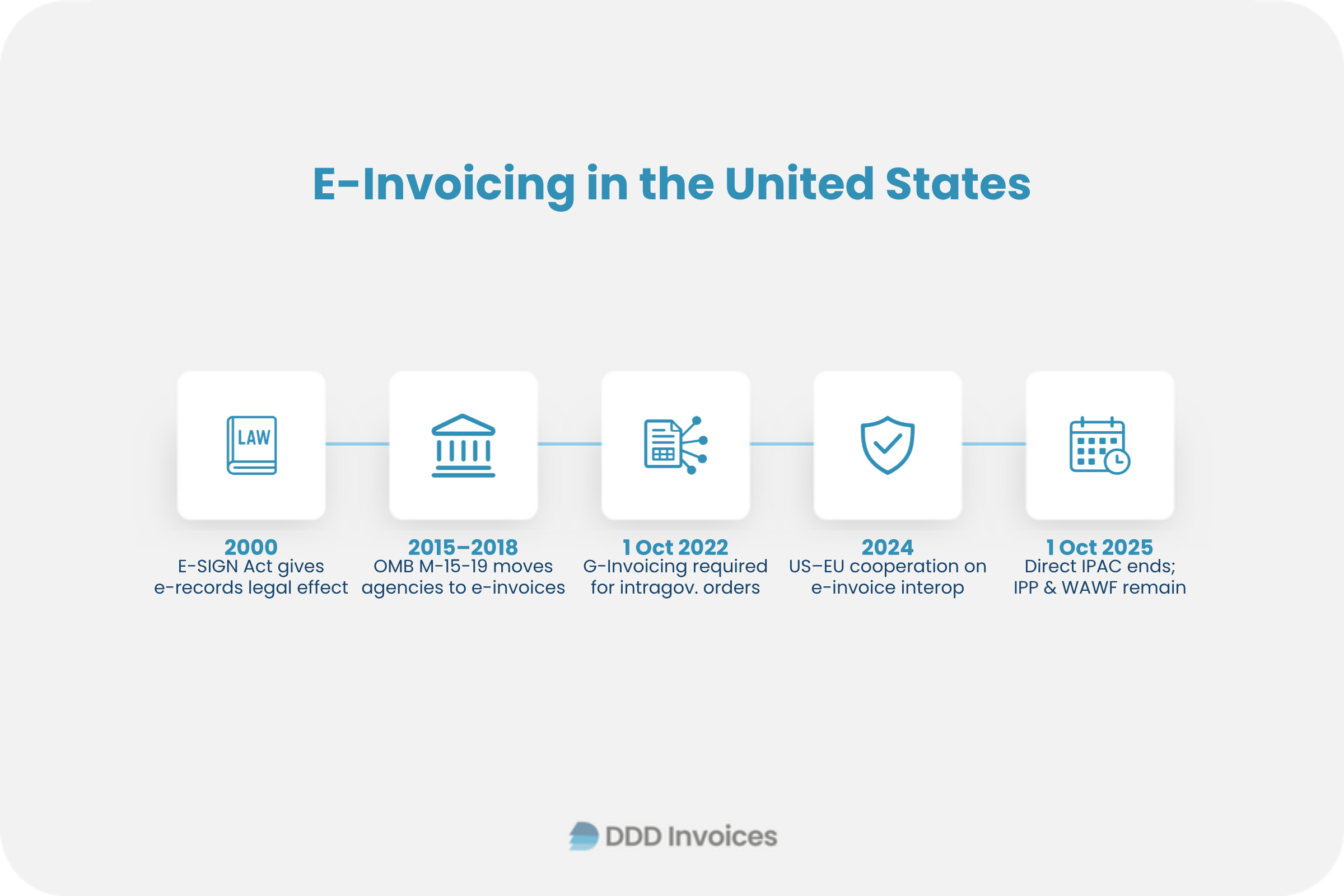
- 2000: The E-SIGN Act gave electronic records and signatures legal effect in interstate and foreign commerce. It did not require parties to accept them.
- 2015–2018: OMB Memorandum M-15-19 directed agencies to move appropriate procurements to e-invoicing by the end of fiscal year 2018. Agencies increasingly adopted shared or agency-specific systems.
- 2022: G-Invoicing became mandatory for federal entities' new intragovernmental orders from October 1, 2022.
- 2024: The US and EU announced cooperation on e-invoicing interoperability. US commercial adoption remains market-led.
- 2025–2026: Direct IPAC initiation for covered Buy/Sell settlements ended on October 1, 2025. IPP and WAWF remain the key supplier systems.
B2G electronic Invoicing
B2G is where US e-invoicing requirements are strongest, although there is no single system for all agencies. Vendors must follow their contract and agency instructions. A proper federal invoice must include specified contractor, contract, pricing, payment and supporting information. A defective invoice must generally be returned with reasons within seven days.
For covered DoD contracts, DFARS requires payment requests and receiving reports through WAWF, subject to limited exceptions. For Department of Energy commercial product and service acquisitions, contracting officers must include clause 952.232-7, requiring electronic invoice or voucher submission through VIPERS. G-Invoicing is separate because it manages transactions between federal entities rather than commercial vendor invoices.
B2B electronic Invoicing
There is no federal B2B platform or mandatory schema for ordinary domestic trade. Businesses can agree to use PDFs, portals, EDI, APIs or structured data, subject to contracts and federal, state, local and industry rules. A PDF may be acceptable when the parties and rules allow it. The E-SIGN Act does not force a private party to accept electronic records, and a PDF can't replace a submission method that a government contract specifies.
B2C electronic Invoicing
B2C: There is no federal B2C e-invoicing or clearance system. Businesses may issue paper or electronic receipts under state and local rules, which vary. The E-SIGN Act keeps its consent and disclosure safeguards, so consumers can't be forced to accept electronic delivery.
E-reporting, sales tax and retention
The US has periodic reporting only through the tax system. Businesses file sales and use tax returns with state and local authorities, monthly, quarterly or annually depending on the jurisdiction and their tax liability. They also file IRS returns and information reports, such as Form 1099-NEC, due by January 31 for the prior year.
Penalties for non-compliance
No nationwide penalty applies to commercial B2B or B2C businesses for not using structured e-invoices. The consequences arise mainly in federal procurement:
- A defective federal invoice can be returned as improper, which delays approval and payment.
- In IPP, invoices that fail validation can move to an exception status for correction, and buyers can reject invoices they won't pay.
- A DoD contractor that bypasses required WAWF submission without an authorised exception risks failing the contract's payment-request procedure.
Your trusted partner for e-Invoicing in the US
The US has no national B2B e-invoicing mandate, so adoption is voluntary, mainly through the Peppol-style DBNAlliance network. The obligations sit on the government side, where many federal agencies require invoicing through the Treasury's Invoice Processing Platform (IPP) or another system named in the contract.
DDD Invoices offers a unified API that standardizes invoice workflows and hides country-specific formats, validations and transmission rules. One integration covers B2B, B2C and B2G, from creation and validation to delivery and archiving, in whatever format customers need. For federal contracts, the contract stays the source of truth. DDD supports data preparation and workflow integration, while vendors still submit through the named agency platform.
Still have questions?
In the 30min free call we will discuss:
- your requirements in invoicing
- how integration works
- demo of the product
- next steps
FAQs
Is e-invoicing mandatory in the United States?
Not nationwide for ordinary B2B or B2C transactions. It is required for many federal procurements under the relevant contract and agency system.
Which e-invoice format is required?
There is no single nationwide commercial format. Federal suppliers must follow their contract and agency system requirements.
What is the difference between IPP and WAWF?
IPP is Treasury's platform for participating federal agencies and vendors. WAWF is the DoD system for covered electronic payment requests and receiving reports.
Is a PDF invoice valid?
Generally yes, when the parties and applicable rules allow it. It won't satisfy a contract that requires submission through WAWF or another designated platform.
.webp&w=3840&q=75)
.webp&w=3840&q=75)
