
Fiscalization in Haiti took a new shape on October 1, 2026, when one Code Fiscal replaced decades of scattered tax decrees.
Haiti requires no fiscal devices, real-time reporting or e-invoicing; since October 1, 2026, the Code Fiscal controls sales through invoices, returns and audits. Businesses need a tax number (NIF), invoice each sale in numbered duplicates and keep records 10 years; TCA payers file monthly by the 15th.
Latest news
On November 11, 2026, Minister Serge Gabriel Collin promised MEF support as firms adjust accounting, filing and record keeping to the code.
No implementing decisions were on the DGI or MEF sites by November 20, so apply the published text.
What does fiscalization mean in Haiti?
Fiscalization ties each sale to a record the tax authority can check, often through certified devices or real-time links. Haiti uses neither, so the DGI, part of the Ministère de l'Économie et des Finances (MEF), relies on four components:
- Numéro d'Immatriculation Fiscale (NIF): the permanent tax number needed for any tax step.
- Invoices: numbered in series, in duplicate, for each sale.
- Monthly TCA return: filed with a supplier-by-supplier list of purchase invoices.
- Audits: unannounced invoice checks and copies of accounting files.
On November 11, 2026, Minister Serge Gabriel Collin promised MEF support as firms adjust accounting, filing and record keeping to the code. No implementing decisions were on the DGI or MEF sites by November 18, so apply the published text.
Tired of scrolling through information about e-invoicing?
- Register on the platform as a software vendor or a end-client
- Start and complete the integration
- Send your first invoice into the test environment
- Switch to production!
Timeline
- September 30, 2026: replacement decree published.
- October 1, 2026: Code Fiscal in force.
- Next: MEF implementing decisions, not yet dated.
The TCA stays at 10%, but firms with turnover under HTG 10 million now charge none. The old simplified TCA returntaxed small firms' receipts above HTG 500,000. The code also widens DGI audit powers.
Update invoice templates now and track regulatory changes: the code's only transitional rule defers details to ministerial decisions.
What fiscal regulations are affecting the businesses in Haiti?
Décret du 19 décembre 2022 portant Code Fiscal
Haiti's first Code Fiscal aimed to simplify income tax and align the small-business regime with the TCA threshold. It also planned an Impôt Minimum Forfaitaire (minimum flat tax) and new TCA territoriality rules, but a public finance reform report records its delays.
- December 19, 2022: adopted; published January 20, 2023.
- October 1, 2024: planned start, pushed to October 1, 2025.
- October 10, 2025: the 2025-2026 budget annexes plan implementation from October 1, 2026.
- September 30, 2026: replaced before taking effect.
Décret remplaçant le Décret du 19 décembre 2022 portant Code Fiscal (2026)
Published in Le Moniteur Spécial N° 48-A, the decree merges the Code Général des Impôts (CGI) and the procedures book in 543 articles.
- Taxpayer duties: a NIF for every business and written notice to the DGI within 30 days of starting an activity.
- Rate: one 10% rate; exports, unprocessed farm produce, petroleum products, medical care and school supplies are exempt.
- Franchise: below HTG 10 million turnover, no TCA is charged or deducted, and invoices state "TCA non applicable-article 193 du CGI".
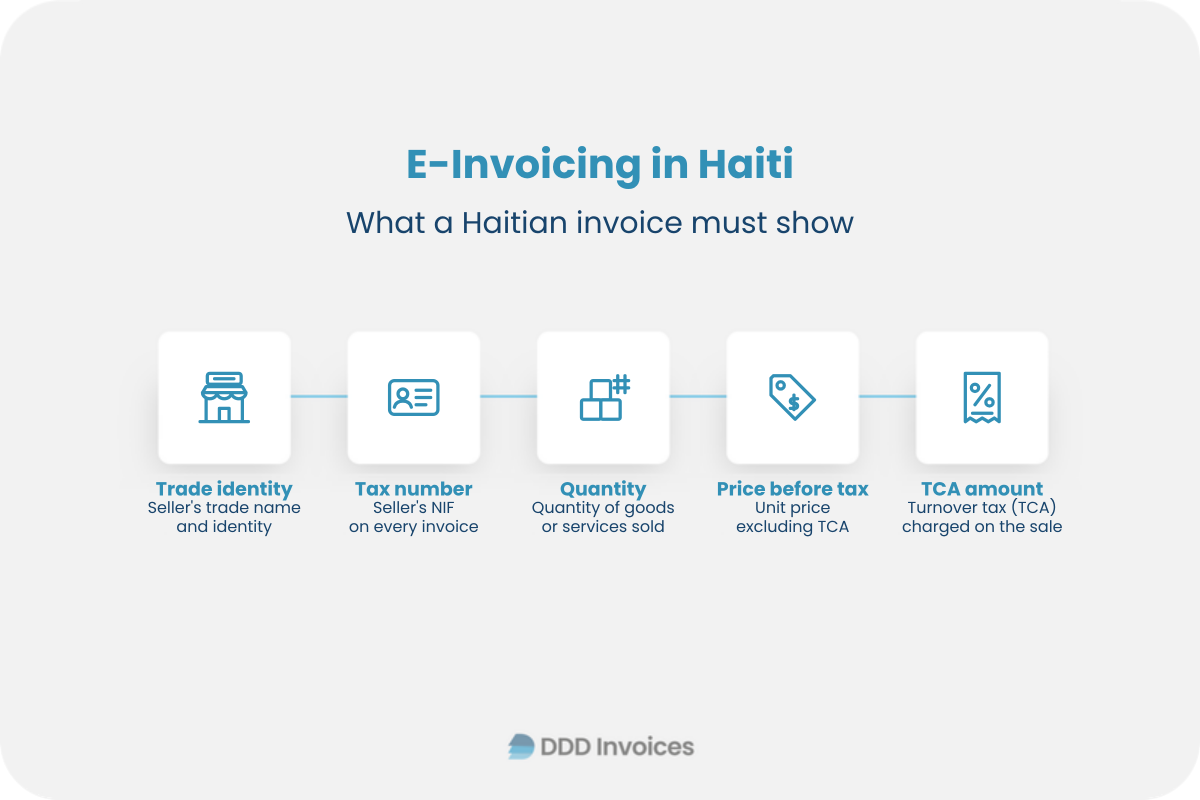
- Receipt content: date, number, seller name, company stamp and authorised signature, buyer name and address, quantities, prices before tax, rate, TCA and total.
- B2C sales: these B2C invoice rules are strict: the same mentions, on numbered duplicates, for almost every business sale.
- Reporting: a monthly TCA return between the 1st and the 15th, listing purchase invoices by supplier, or deductions are rejected.
- Deductions: limited to inputs and resale stock; TCA credits are never refunded.
- Retention: 10 years for books and invoices, so automate invoice archiving early; storage abroad needs online DGI access.
- Software: accounting and checkout systems must keep originals when records change, which a statutory audit trailprovides.
- Offline fallback and verification: none, as nothing is transmitted.
- September 30, 2026: published.
- October 1, 2026: in force (article 540).
- October 19, 2026: posted on the DGI document page.
- Pending: ministerial decisions on application.
Who does fiscalization in Haiti affect?
Any independent economic activity falls under the TCA, with no sector list or device rollout.
- B2C sellers: B2C e-invoicing is not mandatory, but shops still hand each customer a numbered invoice.
- B2B and B2G sellers: irregular invoices cost buyers their TCA deductions.
- Small firms: under HTG 10 million, a flat income tax of 2% (5% for services) applies to turnover above HTG 1 million.
- Event venues: owners file a DGI form before each show and pay TCA on ticket sales.
- Software suppliers: POS and accounting vendors face fines for tools allowing untraceable edits, as under Spain's Verifactu rules.
- Customers: no receipt verification tool exists.
For invoice formats, read the Haiti e-invoicing guide; Dominican Republic e-invoicing and Mexico's fiscalization rulesshow mandated systems nearby.
What are the implications and penalties?
The published Code Fiscal sets these sanctions in gourdes (HTG), mainly in articles 470 to 488:
Offence | Penalty |
|---|---|
No invoice issued by a TCA payer | 30% of the pre-tax amount; the customer is jointly liable |
Sale or purchase without a regular invoice | TCA due plus an 80% surcharge on that TCA |
Late or missing return | 10% surcharge plus HTG 5,000 to 100,000 a month |
Late payment of TCA | 10% surcharge plus 2.5% interest a month |
Record-altering software | Vendor: 10% of annual turnover; user: 80% surcharge |
Four months without returns | NIF suspended, blocking customs clearance |
Tax debt above HTG 100,000 | Premises closed for up to 15 days |
Tax fraud | HTG 1 million and 1 to 5 years in prison; ten times the fine for companies |
Late filers are also barred from public tenders, and the DGI can assess the tax itself.
What should foreign businesses check before trading with Haiti?
- Services: services used in Haiti carry TCA there, and Haitian payers apply a final 20% withholding tax to non-residents' fees.
- Representation: non-residents get a NIF through a local agent; foreign firms with a permanent establishment name a fiscal representative within 30 days.
- Sanctions: screen partners against the UN list, renewed for a year on October 14, 2026.
EU firms apply Regulation (EU) 2022/2309; Canadian firms follow the Special Economic Measures regulations. OFAC lists Viv Ansanm and Gran Grif as terrorist groups, flagged for secondary sanctions risk. Build these checks into your cross-border invoicing process.
Still have questions?
In the 30min free call we will discuss:
- your requirements in invoicing
- how integration works
- demo of the product
- next steps
FAQs
Does Haiti require fiscal printers or cash registers?
No, Haiti has no fiscal printer, cash register or real-time reporting rule under the Code Fiscal. Businesses instead issue numbered invoices for every sale and report TCA on monthly returns.
Do shops in Haiti have to give customers an invoice?
Yes, the Code Fiscal requires an invoice for almost every business sale, numbered by series in duplicate. The customer receives the original, while the seller keeps the copy for ten years.
How long must businesses keep invoices in Haiti?
Businesses must keep books, records and invoices for ten years under the Code Fiscal. Invoices may sit abroad only electronically, with immediate online access for the DGI and treaty cover.
What is the fine for not issuing an invoice in Haiti?
A seller liable for TCA who skips an invoice pays a fine of 30% of the pre-tax amount. If the seller does not pay, the customer becomes jointly liable for that fine.