



Standard
No mandatory structured format
Tax Portal
Belastingdienst Online Portaal
Tax Authority
Belastingdienst Suriname
CTC Model
No nationwide clearance or invoice-reporting mandate confirmed
B2G
N/A
B2B
N/A
Archiving
10 years
Pending DDD Support
E-invoicing in Suriname is optional, with no nationwide structured e-invoicing mandate confirmed in the official materials reviewed. Article 29 of the VAT Act 2022 permits paper invoices or electronic transmission with the recipient’s acceptance. Belastingdienst Suriname administers the VAT framework.
VAT took effect on 1 January 2023, as explained in Belastingdienst’s official VAT guidance. Businesses within scope must meet applicable invoice issuance and recordkeeping requirements. Electronic invoices must preserve authenticity of origin, content integrity and readability under Article 29. The official framework reviewed does not prescribe compulsory XML, JSON, Peppol or real-time government clearance.
Latest News
As of October 2026, the reviewed official sources do not announce a nationwide structured e-invoicing rollout. Belastingdienst’s VAT legislation page lists schedules reflecting the September 2023 VAT amendments, while its April 2025 VAT guidance explains invoice content, cash-register records and digital VAT returns. These requirements should not be confused with mandatory electronic invoice clearance.
What Is E-Invoicing and Why Is Suriname Adopting It?
E-invoicing enables businesses to create and exchange invoices electronically. In Suriname, it remains a legal option rather than a confirmed national clearance programme. Article 29 of the VAT Act 2022 permits electronic transmission with recipient acceptance and requires authenticity of origin, content integrity and readability. Electronically stored invoices must also retain information supporting their authenticity and integrity.
The Evolution of E-Invoicing in Suriname
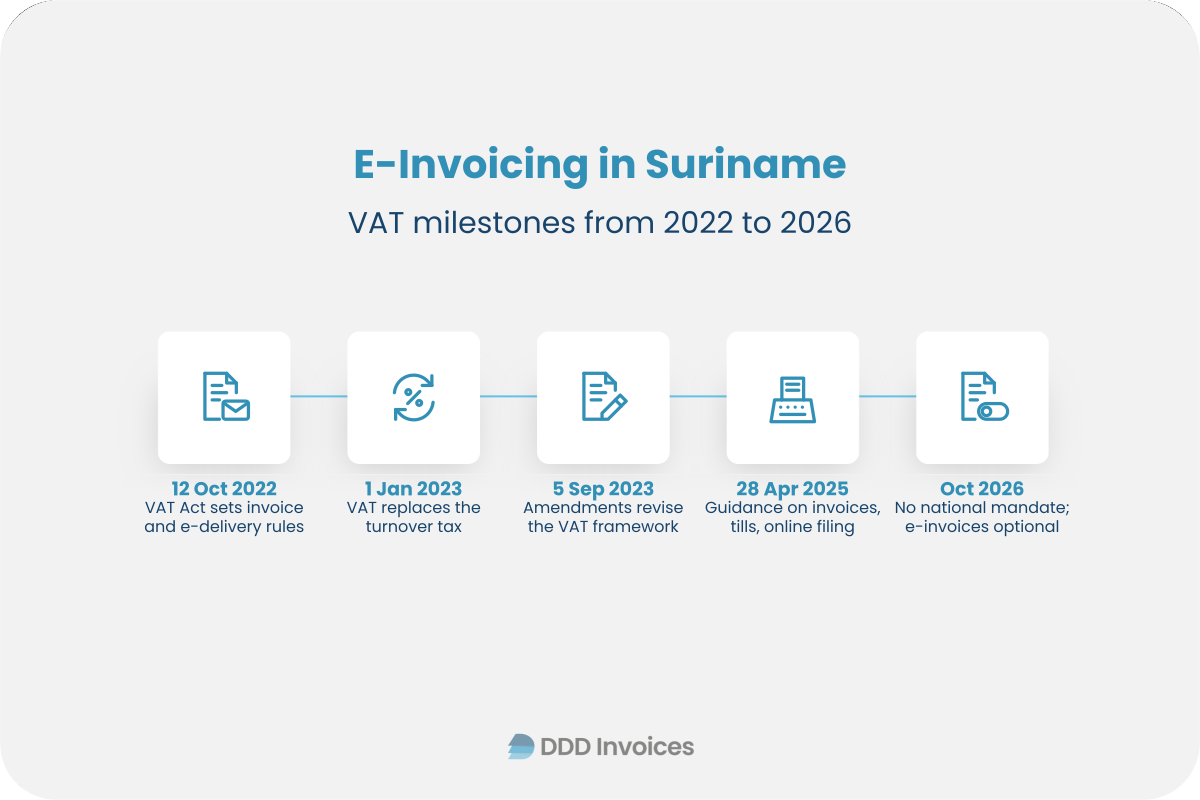
- 12 October 2022: The VAT Act 2022 established invoicing, electronic-delivery and administration provisions.
- 1 January 2023: VAT replaced the previous turnover tax, as confirmed in Belastingdienst’s official VAT guidance.
- 5 September 2023: Amendments revised the VAT framework, including the treatment of specified goods, as referenced on the official VAT legislation page.
- 28 April 2025: Belastingdienst issued an updated version of its VAT guidance, covering invoices, cash-register records and online VAT filing. This is the document’s version date; its URL indicates a June 2025 upload.
B2G Electronic Invoicing in Suriname
Government suppliers must apply the relevant VAT treatment and issue invoices where legally required. The official framework reviewed does not establish a separate nationwide B2G structured-invoice or clearance system. Electronic delivery remains subject to Article 29 of the VAT Act 2022.
Reverse-charge treatment should not be assumed merely because the customer is a public authority. Article 11(2) addresses supplies by a supplier not resident or established in Suriname, with no local fixed establishment making the supply, to a qualifying business recipient in Suriname. Its conditions must be assessed for each transaction.
B2B Electronic Invoicing in Suriname
Businesses must issue invoices for supplies to other businesses and applicable advance payments. Belastingdienst’s official VAT guidance states that invoices must generally be issued within 15 days after the end of the month of supply.
Suriname VAT invoice requirements, outlined on page 10 of the official guidance and in Article 28 of the VAT Act, include:
- Issue date and sequential invoice number.
- Supplier and customer names, addresses and applicable fiscal identification numbers.
- Description and quantity of goods or nature of services.
- Supply date.
- Amount excluding VAT, applicable rate, VAT amount and total including VAT.
- Exemption or reverse-charge particulars where applicable.
Article 14 of the VAT Act 2022 links input VAT deduction to compliant supporting invoices and eligible use. Receiving an electronic invoice does not independently establish deduction entitlement.
Cross-border transactions require separate assessment. Under Article 4(2), qualifying exports can receive zero-rating; businesses must retain evidence supporting that treatment rather than assume a foreign customer alone establishes eligibility. Imports follow the separate customs and import-VAT rules in Articles 18–20, while Article 14 requires an import document supporting eligible import-VAT deductions.
B2C E-Invoicing in Suriname
Consumer sales have different documentation rules from B2B transactions. Article 27(7) of the VAT Act 2022 permits businesses supplying non-business customers to use a cash-register system, with the applicable VAT rate shown on the receipt. This should not be interpreted as a general requirement to issue a full VAT invoice whenever no cash register is used.
Belastingdienst’s cash-register guidance on page 11 requires the system to allow a customer copy to be provided and a business copy retained. Receipts must include sequential numbering, supplier identification, transaction date, goods or services supplied, amounts excluding and including VAT, the VAT rate and amount, and exemption information where applicable.
E-Reporting and VAT Compliance in Suriname
Suriname electronic VAT filing operates through Belastingdienst’s online portal. Under Article 13(2) and (4) of the VAT Act 2022, VAT taxpayers generally submit monthly returns and pay the tax no later than the 15th of the following month. The Act specifies filing before the 16th, with payment due by the same deadline. A return is still required for a month without turnover or deductible VAT, as explained in Belastingdienst’s official VAT guidance.
Online filing is separate from invoice transmission. The reviewed VAT legislation and official guidance do not confirm nationwide SAF-T, transaction-level invoice reporting or electronic clearance obligations.
Businesses must preserve VAT invoices, receipts, cash-register records, corrective documents and supporting import/export records. Corrective documents should identify the original invoice and changes, with corresponding VAT adjustments handled under the applicable provisions of the VAT Act 2022.
Belastingdienst’s return-correction guidance on page 16 allows online corrections through “Corrigeer Aangifte” up to and including the 15th of the filing month. After that deadline, it directs taxpayers to submit an objection to the tax authority.
Article 30 of the VAT Act 2022 requires VAT administration records to be retained for ten years. For electronically stored invoices, Article 29 also requires retention of information supporting authenticity and integrity. No nationwide electronic-transmission contingency procedure was confirmed in the reviewed materials; businesses must continue to meet applicable invoice issuance and recordkeeping obligations during system interruptions.
What Happens If Businesses Don’t Comply?
Under S.B. 2025 no. 140, dated 13 November 2025, late VAT returns attract a penalty of SRD 2,500 per month or part-month, capped at SRD 10,000 per return period. This also applies to nil and refund returns. Late payment attracts a penalty of 50% of outstanding VAT, capped at SRD 10,000; no payment penalty applies where no VAT is payable.
Failure to file results in an ex officio assessment with initial filing and payment penalties of SRD 10,000 each, subject to reconsideration when a return is submitted as an objection. These are VAT-compliance penalties, not penalties for failing to join an unconfirmed structured e-invoicing mandate.
Your Trusted Partner for E-Invoicing in Suriname
DDD Invoices helps businesses and software providers streamline invoice creation, exchange and archiving through a single API across supported markets. Its standardized integration connects existing ERP and billing systems to simplify multi-country invoicing workflows.
For Suriname, confirm country coverage and available functionality with DDD Invoices before implementation, focusing on compliant invoice data, recipient acceptance and reliable records.
Still have questions?
In the 30min free call we will discuss:
- your requirements in invoicing
- how integration works
- demo of the product
- next steps
FAQs
Is e-invoicing mandatory in Suriname?
No nationwide structured e-invoicing mandate was confirmed in the official materials reviewed. Article 29 of the VAT Act 2022 permits electronic invoices with recipient acceptance.
Does Suriname require XML, Peppol or digitally signed invoices?
The reviewed framework does not prescribe a universal structured format or digital-signature standard. Electronic invoices must maintain authenticity of origin, content integrity and readability under Article 29.
Does online VAT filing mean invoices require government approval?
No. Belastingdienst’s online VAT filing procedures concern periodic returns and payments, not individual invoice approval. The reviewed VAT framework does not establish nationwide invoice pre-clearance or certification.
How long must businesses retain VAT invoices?
Article 30 of the VAT Act 2022 requires VAT administration records to be retained for ten years. For electronically stored invoices, Article 29 also requires retention of information supporting authenticity and integrity.


