



Standard
ARCA proprietary XML over SOAP Web Services (wsfev1, wsmtxca, wsfexv1)
Tax Portal
Comprobantes en Línea (ARCA)
Tax Authority
Agencia de Recaudación y Control Aduanero (ARCA)
CTC Model
Clearance
B2G
April 1, 2019
B2B
April 1, 2019
Archiving
10 years
Pending DDD Invoices support
Argentina cleared invoices through its tax authority years before Europe debated mandates. The Agencia de Recaudación y Control Aduanero (ARCA), successor of AFIP, authorizes every electronic invoice before it has legal effect. Businesses connect through its Comprobantes en Línea portal or SOAP/XML Web Services.
All VAT-registered businesses (responsables inscriptos), VAT-exempt taxpayers and monotributistas must issue electronic invoices authorized by ARCA with a CAE code, or use a homologated fiscal controller. The mandate has covered every category since April 1, 2019. From November 1, 2026, social and promoted monotributistas join, and from March 1, 2027, taxpayers outside the VAT scope must also issue electronic originals.
Latest news
Argentina’s e-invoicing mandate, active since April 1, 2019, is expanding under General Resolution 5824/26. From July 1, 2026, financial institutions, insurers and credit-card issuers join, a monthly electronic settlement mechanism begins, and VAT returns auto-populate for monotributo taxpayers. Pre-paid health-plan operators and schools follow by July 2027.
On August 31, 2026, ARCA published Resolución General 5893/2026. From November 1, 2026, social and promoted monotributistas must issue electronic invoices. Taxpayers not subject to VAT follow on March 1, 2027. Printed receipt books then survive only for contingencies.
Earlier, Resolución General 5866/2026 rewrote the invoicing rules from July 1, 2026. Resolución General 5827/2026 made Class E export invoices voluntary for samples and free shipments from February 24, 2026.
Limit | Value |
|---|---|
Identify the final consumer on the invoice | From ARS 10,000,000 per operation |
Window to request the CAE | 5 calendar days before or after the invoice date (10 days for services) |
Contingency invoicing allowed | Up to 5% of a branch's vouchers |
Tired of scrolling through information about e-invoicing?
- Register on the platform as a software vendor or a end-client
- Start and complete the integration
- Send your first invoice into the test environment
- Switch to production!
What is e-invoicing and why has Argentina adopted it?
Argentina runs a clearance model: an invoice has no fiscal effect until ARCA returns a CAE (Código de Autorización Electrónico). The goal is real-time VAT control and fewer fake invoices. There is no Peppol network or universal exchange format; each business talks to ARCA directly or through a provider.
The evolution of e-invoicing in Argentina
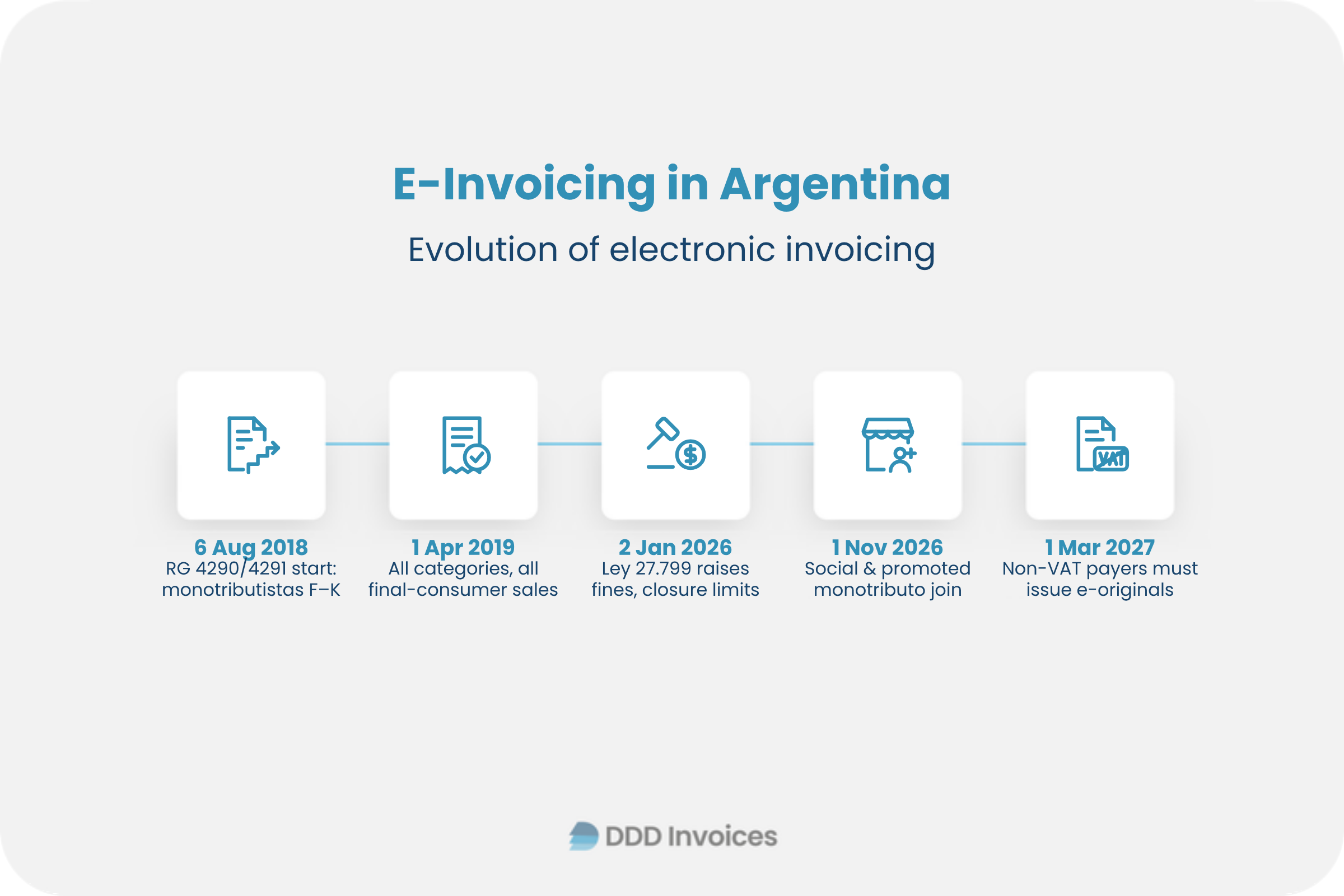
- August 6, 2018: RG 4290/2018 and RG 4291/2018 start the phase-in with monotributistas in categories F to K.
- April 1, 2019: every monotributista category and all final-consumer sales are covered.
- January 2, 2026: Ley 27.799 raises invoicing fines and closure thresholds.
- November 1, 2026: social and promoted monotributistas join under RG 5893/2026.
- March 1, 2027: taxpayers outside the VAT scope must issue electronic originals.
B2G e-invoicing in Argentina
There is no separate B2G platform. Suppliers to public bodies issue the same ARCA-authorized e-invoices as in any sale, and public buyers verify the CAE before paying. Withholding rules may apply; confirm them with each entity.
B2B e-invoicing in Argentina
B2B e-invoicing is mandatory for every VAT-registered or exempt business and monotributista. ARCA defines the invoice classes: Class A between responsables inscriptos, Class B to final consumers or exempt entities, Class C from monotributistas and exempt issuers. Class M replaces Class A for issuers under special ARCA control. Each document carries the issuer's CUIT and the VAT breakdown.
MiPyMEs selling to large companies must issue the Factura de Crédito Electrónica MiPyMEs under Ley 27.440 and make it available by midnight the next day.
Onboarding:
- Register: get a CUIT and a level 3 Clave Fiscal, then enable a dedicated point of sale.
- Choose a channel: Comprobantes en Línea for low volumes, or the SOAP Web Services (wsfev1, wsmtxca, wsfexv1 for exports) for ERP integrations.
- Get a certificate: request a digital certificate for testing (WSASS) and for production.
- Test, then go live: pass homologation, request the CAE within 5 days of the invoice date and deliver within 10 days.
B2C e-invoicing in Argentina
Every consumer sale, in store or online, requires a Class B or C e-invoice or a receipt from a homologated fiscal controller under RG 3561. Receipts read "A CONSUMIDOR FINAL" and stay anonymous below ARS 10,000,000; above that, the buyer's DNI, CUIL or CDI is recorded. Every electronic voucher carries the ARCA QR code. Retail activities listed in RG 4290 hand over a printed copy unless the buyer accepts a digital one.
When ARCA's services are down, Web Service users switch to the CAEA (Código de Autorización Electrónico Anticipado). This pre-issued code is requested up to 5 days before each fortnightly period; vouchers are reported afterwards. Portal users fall back on printed receipt books with a CAI. Contingency use above 5% of a branch's vouchers counts as non-compliance.
Fiscalization in Argentina is the RG 3561 fiscal controller regime.
E-reporting and VAT compliance
Argentina has periodic reporting: a monthly VAT return, with no SAF-T requirement. IVA (Impuesto al Valor Agregado) is 21% standard, 10.5% reduced and 27% for certain utilities, per ARCA's rate tables. Since the November 2025 period, responsables inscriptos file through IVA Simple (form F.2051) on ARCA's published due dates.
Corrections use electronic credit or debit notes referencing the original invoice, raised only by its issuer. Invoices and supporting records must be kept for 10 years under Article 33 of Ley 11.683, so plan compliant archiving early.
Penalties for non-compliance
Article 40 of Ley 11.683, as updated by Ley 27.799, punishes missing or non-compliant invoices with closure. Amounts are indexed to the UVA from January 1, 2027.
Offence | Sanction |
|---|---|
Not issuing invoices as required (operations over ARS 20,000) | Closure of the premises for 2 to 6 days |
Repeat offence within 2 years | Minimum and maximum doubled, plus possible suspension of licences |
Other formal breaches (Art. 39) | ARS 150,000 to 2,500,000, up to ARS 35,000,000 for serious cases |
Your trusted partner for e-invoicing
Argentina clears every invoice through ARCA, and the last paper exceptions end by March 2027. DDD Invoices gives software providers and businesses one API to issue, receive and archive compliant e-invoices across markets, with rule changes handled. Argentina is pending support on our platform; register your interest to be notified.
Still have questions?
In the 30min free call we will discuss:
- your requirements in invoicing
- how integration works
- demo of the product
- next steps
FAQs
Is e-invoicing mandatory in Argentina?
Yes. ARCA-authorized invoicing has been mandatory for responsables inscriptos, exempt taxpayers and monotributistas since April 1, 2019; RG 5893/2026 adds social and promoted monotributistas from November 1, 2026.
What is a CAE in Argentina?
The CAE is the authorization code ARCA assigns to each electronic invoice; without it the document has no fiscal effect. It is requested through Comprobantes en Línea or the Web Services within 5 days of the invoice date.
What is the difference between CAE and CAEA?
The CAE is granted per invoice in real time; the CAEA is one code issued in advance for a fortnight so Web Service users can invoice during outages. CAEA vouchers are reported afterwards and may not exceed 5% of volume.
How long must electronic invoices be kept in Argentina?
Ley 11.683 requires invoices and supporting documents to be kept for 10 years at the fiscal domicile. Issuers selling to consumers through Web Services must also store electronic duplicates.


