

From 1 January 2028, every company and sole trader in Slovenia will be required to exchange B2B invoices exclusively as structured e-invoices. For most organisations, the question is no longer whether to adopt e-invoicing but which provider to use and how to integrate it.
DDD Invoices and bizBox (developed by ZZI d.o.o.) are both Slovenian e-invoicing providers and both certified Peppol Access Points. They are, however, built on different operating models. bizBox is an established e-invoicing and EDI exchange network, deeply embedded in Slovenian and regional business software. DDD Invoices is an API-first infrastructure that combines e-invoicing, fiscal verification and tax-authority reporting in a single integration for Slovenia and 37 other countries.
This article explains what the ZIERDED law changes about choosing a provider, where each provider is stronger, and how to decide based on your role: a single company, a group with multiple legal entities, or a software provider.
DDD Invoices vs bizBox: Quick summary
Both providers will enable Slovenian businesses to exchange compliant e-invoices after 2028. The difference lies mainly in how you get there and what else you need along the way.
bizBox comes from traditional EDI document exchange and is deeply integrated into Slovenian business software. Its strength is the breadth of its network and its support for the full supply chain.
DDD invoices come from APIs and automation. Its strength is fast integration, combining e-invoicing and fiscal verification, and one consistent approach across countries and legal entities.
Because the law allows several providers at the same time, the choice does not have to be either-or.
Slovenia B2B e-invoicing mandate: What changes in 2028?
The Act on the Exchange of Electronic Invoices and Other Electronic Documents (ZIERDED, Official Gazette of the Republic of Slovenia No. 85/2025) fundamentally changes the Slovenian e-invoicing market:
Mandatory B2B e-invoicing: all business entities entered in the Slovenian Business Register, including sole traders, must exchange only e-invoices for domestic supplies of goods and services. Paper, PDF, and emailed invoices will no longer be accepted between businesses.
Exceptions: paper invoices remain permitted for consumers and foreign companies.
Slovenia e-invoicing key dates from 2027 to 2030
B2G e-invoicing through UJP has been mandatory in Slovenia since 2015, so public-sector flows stay the same. What is new is that the same discipline now applies to all businesses. ZIERDED sets the following timeline:
- 1 April 2027: the provisions on e-invoicing providers apply, and providers can apply to UJP for listing.
- 1 October 2027: UJP establishes the official list of providers. Listing requires an administrative decision and successful interoperability tests.
- 1 January 2028: B2B e-invoicing becomes mandatory in Slovenia. A business must use at least one listed provider and may use more than one.
- 1 July 2030: e-invoicing and digital reporting become mandatory for intra-EU cross-border transactions under ViDA (VAT in the Digital Age).
ZIERDED e-invoicing provider rules
Once the mandate applies, providers must meet these requirements:
- Interoperability: providers must enable exchange with other providers, including when they use different standards. Delivery and response messages must be forwarded by the next working day.
- Recipient register: each provider keeps a list of its recipients, and UJP maintains the consolidated recipient data.
- Standards: e-SLOG or the syntax of the European standard listed by the European Commission. Conversion between standards is the provider's responsibility.
Businesses with a small number of invoices can use the free miniBlagajna application.
Non-compliance carries fines of EUR 1,000 to 3,000 for legal entities, EUR 500 to 1,500 for sole traders and EUR 100 to 500 for responsible persons.
Slovenia's e-invoice flow after 2028
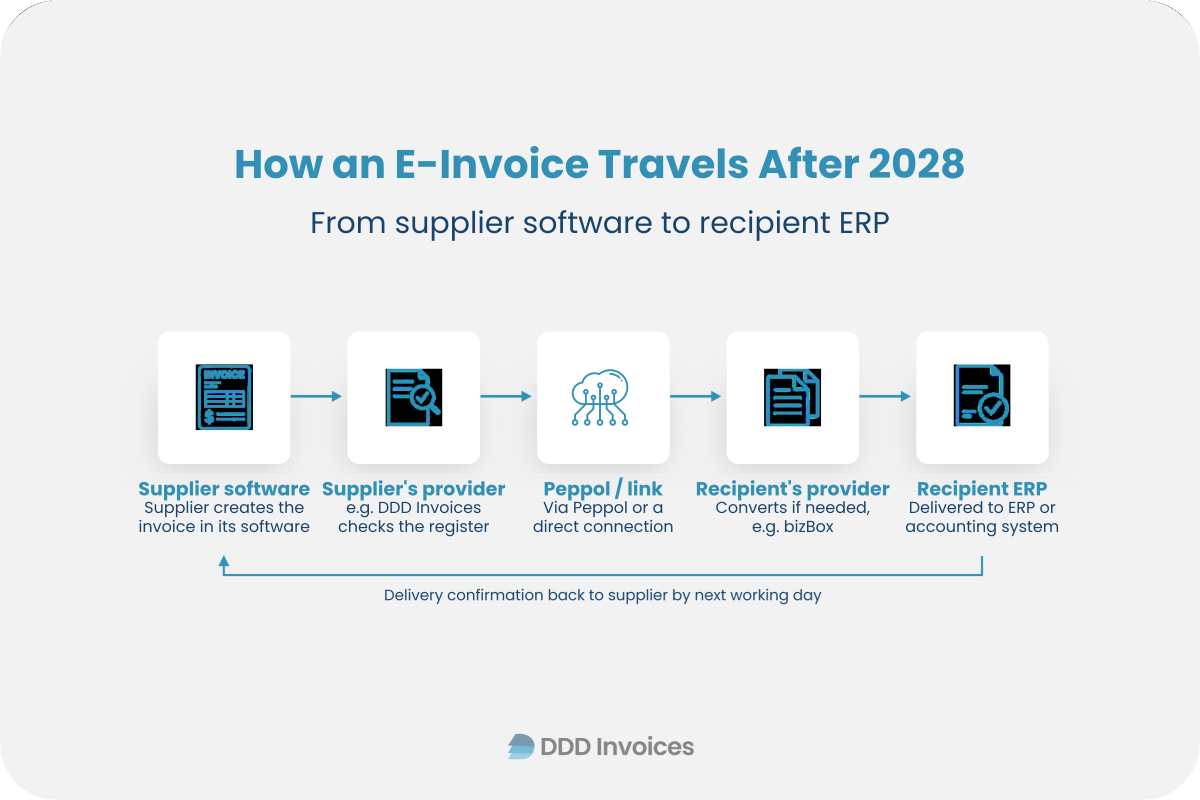
- The supplier creates the invoice in its business software.
- The software sends it to the supplier's provider.
- The provider checks the recipient register to find the recipient's provider.
- The invoice is delivered through the Peppol network or a direct provider-to-provider connection and, if needed, converted to the recipient's standard.
- The recipient's provider delivers it to the recipient's ERP or accounting system.
- A delivery confirmation returns automatically.
Why network size is no longer the deciding factor
Today, choosing a provider is largely a question of reach: who is on which network, and which interconnections has a provider agreed to?
If you can't reach a recipient through Peppol or your provider, delivery can be difficult. ZIERDED changes this. Once every listed provider must exchange e-invoices with every other listed provider, reaching a recipient no longer depends on which network you choose. The supplier sends to its own provider, and that provider delivers to the recipient's provider, whoever it is.
The criteria that matter therefore shift to:
- how much development and maintenance the integration requires,
- how much manual work remains when onboarding clients and trading partners,
- whether the provider also covers fiscal verification of invoices,
- whether the solution works across countries and legal entities,
- who handles adaptations when regulations change.
Slovenia currently has five certified Peppol Access Points: ZZI (bizBox), DDD Invoices, the Ministry of Finance (UJP), Countix and SNI. Peppol will be an important bridge between providers, but not the only one.
DDD Invoices vs. bizBox Comparison
Evaluation area | DDD Invoices | bizBox |
|---|---|---|
Primary operating model | Unified e-invoicing compliance layer | EDI and e-document exchange network |
Core objective | Standardise multi-country tax-compliance flows | Deliver e-documents between connected businesses and systems |
Geographic use case | International, multi-jurisdiction operations | Strongly relevant to Slovenian e-document exchange and connected networks |
Integration approach | Unified API, pre-built integrations and structured data transformation | Web application and accounting/ERP-connected document exchange |
EDI role | Structured business-document flows within a wider compliance framework | Rooted in established EDI and e-exchange network connectivity |
Local | Transform and submit data to applicable local tax portals | Local compliance and document delivery depend on the flow and market |
Country-specific formats | Managed through a central transformation layer | Handled through local standards, ERP integrations and network processes |
Multi-entity operations | Designed for centralised management across entities | Suitable where entities operate within the relevant network and implementation scope |
SaaS / embedded | API-first, multi-tenant and white-label-orientated use case | More naturally suited to business-facing e-document exchange |
Best fit | Businesses scaling across jurisdictions and systems | Businesses prioritising practical local e-document exchange |
Where DDD Invoices is stronger
- Live in hours: One standardised REST API, no SDK. Developers using AI tools can often integrate in hours.
- No XML: Send basic invoice data as JSON. DDD Invoices recalculates, validates and converts it to the format the country and recipient require.
- One API for compliance: E-invoice exchange, fiscal verification of cash invoices and tax-authority reporting.
- Full platform APIs: End-client onboarding, certificate handling, PDF customisation, dashboards and reporting.
- Multi-entity, multi-country: Consolidated group dashboards. Slovenia plus 37 other countries through the same integration.
- Free test environment: Test invoices go to the real tax authority and network test endpoints and return real delivery proofs.
- We handle regulatory change: New standard versions, implementing regulations and new countries are covered on our side, with no new development on yours.
What integration looks like in practice
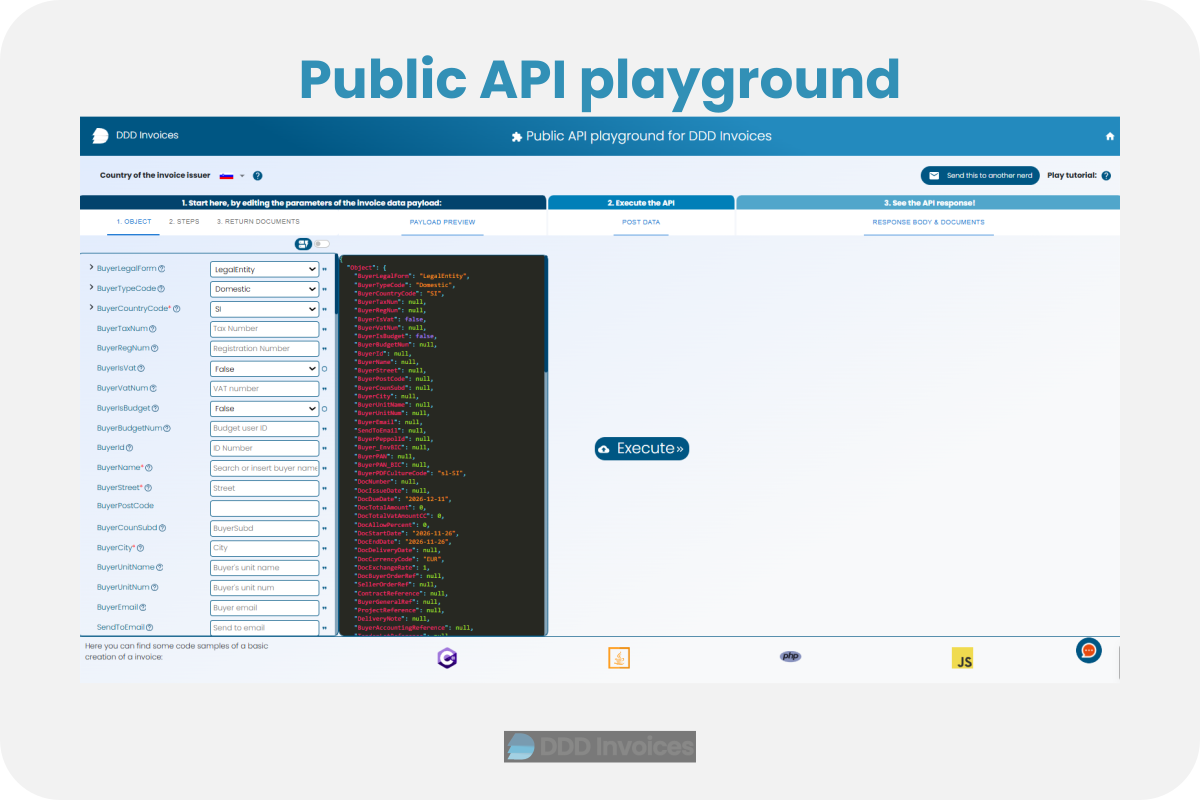
Your software sends a single JSON object to one endpoint. Here is a simplified domestic Slovenian B2B invoice overview:
How to receive e-invoices in Slovenia under the B2B mandate
ZIERDED requires businesses not only to issue e-invoices but also to receive them. Every company will need to be registered as a recipient with at least one provider so that suppliers' providers can find it in the recipient register.
DDD Invoices collects incoming invoices from the Peppol network, UJP, tax portals and other channels. It standardises them into one JSON data flow and pushes them into your ERP or accounting system, with the original XML and PDF attached. For software providers, this means their clients can receive invoices from all suppliers directly inside the application they already use.
Example: a Slovenian property management software provider
{Illustrative scenario}
A Slovenian property management platform serves 400 business clients. Some of them manage properties for owners in Croatia and Austria. From 2028, all of them must send and receive e-invoices.
With a network-only approach, the provider would need to generate e-SLOG XML in its own software, connect to the network, and onboard each client separately. Croatia and Austria would still need separate solutions, and fiscal verification would require another integration.
With DDD Invoices, the provider maps its invoice data to one JSON object once. Clients are onboarded via API from within the platform. Slovenian, Croatian and Austrian invoices, Peppol delivery, receiving and fiscal verification all run through the same integration. The provider can also resell e-invoicing as a paid feature.
Tired of scrolling through information about e-invoicing?
- Register on the platform as a software vendor or a end-client
- Start and complete the integration
- Send your first invoice into the test environment
- Switch to production!
For software providers: embed or depend
By 1 January 2028, every program that issues invoices must allow its users to send and receive e-invoices. Software providers have three options:
Become a provider yourself. This needs a UJP administrative decision, interoperability tests, Peppol certification, support for standards and continuous regulatory maintenance.
Depend on a single network. Clients pay an external provider for e-invoicing, and you earn nothing from it.
Embed the DDD Invoices API. Offer e-invoicing as a feature of your own product, under your own brand, and resell it with your own margin or through revenue sharing.
Slovenia e-invoicing provider checklist for 2028
Providers must be on the UJP list by 1 October 2027, and partners will expect working e-invoicing from 1 January 2028. Start now.
What you need to prepare
- Now to Q1 2027: Map all invoice flows and systems.
- Q1 to Q2 2027: Choose providers and test.
- By 1 October 2027: Confirm your provider is on the UJP list.
- Q4 2027: Register as a recipient, update partner data (tax numbers, Peppol IDs) and notify partners.
- Q4 2027: Run parallel tests, then go live.
What to ask every provider
- Will you be on the UJP list by 1 October 2027?
- Do you generate e-SLOG or UBL from basic data?
- How many manual steps does onboarding need?
- Do you cover fiscal verification?
- Can we reuse the integration in other countries?
- Is there a free test environment with real delivery proofs?
- Are issuing and receiving prices public?
Still have questions?
In the 30min free call we will discuss:
- your requirements in invoicing
- how integration works
- demo of the product
- next steps
FAQs
What is the difference between DDD Invoices and bizBox?
bizBox is an established e-invoicing and EDI exchange network with many integrations in Slovenian and regional business software. DDD Invoices is an API-first infrastructure that creates a compliant e-invoice from basic invoice data, delivers it to the recipient or tax authority, and covers fiscal verification in the same integration, in Slovenia and 37 other countries.
Can you use both providers?
Yes. ZIERDED explicitly allows a business to use more than one provider. In practice, this is often a sensible approach:
Keep existing Slovenian flows with your current provider, add DDD Invoices for new products, foreign subsidiaries, fiscal verification or Peppol, test the new flow in the test environment first, then move it to production gradually.
When do businesses need to be ready for e-invoicing in Slovenia?
Mandatory B2B e-invoicing starts on 1 January 2028. After that date, paper, PDF and emailed invoices are no longer allowed between Slovenian businesses. Fines are EUR 1,000 to 3,000 for legal entities, EUR 500 to 1,500 for sole traders and EUR 100 to 500 for responsible persons. UJP will publish the official list of providers by 1 October 2027.
Why use DDD Invoices instead of the free FURS application?
The free FURS (miniBlagajna) application may be enough for issuing a small number of invoices manually. It does not connect to your business software, automate higher volumes, handle fiscal verification or support operations in other countries. DDD Invoices does all four through one API.
How does integration with DDD Invoices work?
You send basic invoice data as JSON to one REST API endpoint, with no SDK and no XML on your side. DDD Invoices recalculates, validates and converts it into e-SLOG, UBL or any other required format. Integration typically takes a few hours, and testing is free.

