
For e-commerce platforms

Global invoicing compliance for e-commerce & marketplaces

Connect your order and payment flow to DDD with one API, so your platform can issue locally compliant fiscalized receipts, B2B e-invoices and more.

Test for free. Move to production when ready.

Why it matters

A lot needs to happen to make one-click checkout compliant

To ensure your merchants sell compliantly, your platform must support different invoice formats, VAT rates, e-invoicing standards, fiscalization rules, and reporting flows.

DDD gives your platform one compliance layer behind the order flow, so you don't build this yourself.

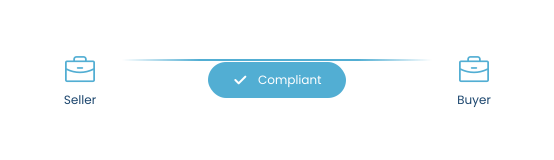
E-commerce checkout compliance complexity
Seller to Buyer compliant invoice flow

Support local & cross-border tax compliant invoicing

Connect DDD with your e-commerce flow and help merchants handle local invoice requirements, OSS-related invoice data, e-invoicing and fiscalization across markets.

  • Cross-border tax-compliant invoice flows
  • Local & OSS tax registrations
  • Localized invoice formats and PDFs
  • E-invoicing and fiscalization where required

Add compliant invoicing without rebuilding your product country by country

With DDD, your SaaS platform can support:

Compliant invoices from ordersB2C and B2B invoice flowsE-invoicing where required
Fiscalization where requiredInvoice archive and historyDashboard visibility

Do not turn local invoicing compliance into your product backlog

Building internally

  • Maintaining local formats
  • Maintaining local tax authority connections
  • Connecting fiscalization logic
  • Country specific archiving rules

Using DDD

  • Single compliance infrastructure
  • 100% compliant transactions
  • Support your customers across all markets
  • Less internal compliance work
Start free integration

FAQ

Common questions from e-commerce teams

See our premade plugins page to see what options we already offer, or connect your software vendor with us to establish an API integration.
Yes. Your e-commerce platform can send order, customer, payment and invoice data to DDD, and DDD processes the data to make it ready for relevant local compliance requirements. Your checkout, order and payment flow stay where they are. DDD sits behind them as the invoice compliance layer.
Yes, depending on the market, workflow and implementation. DDD can support local invoice formats, OSS-related invoice data, e-invoicing, fiscalization, QR/proof data, archiving and other invoice compliance requirements where relevant.
No. DDD is invoice compliance infrastructure. It does not replace your tax calculation or OSS reporting setup. It helps turn order, payment and invoice data into the required compliant invoice flow across markets.
Yes, depending on your implementation. DDD can work behind your e-commerce flow, so merchants can issue compliant invoices without being pushed into a separate invoicing tool or manual process.
You can connect your e-commerce invoice flow to DDD in three ways: API integration (best if you want DDD to work directly behind your checkout, order, payment or invoice flow and support a scalable embedded setup), prebuilt integration (best if your e-commerce setup uses a supported platform or payment system and you want a faster setup without a custom API build), or no-integration path (best if your system is not ready for API work yet, but you still need a way to process invoices through DDD). Most e-commerce teams start by choosing the path that fits their current order and payment setup, then test the invoice flow before moving to production.

Explore other use casesin more detail

See how the same platform model adapts to different software categories.