



Standard
n/a
Tax Portal
n/a
Tax Authority
Direction des Services Fiscaux
CTC Model
Post-audit
B2G
n/a
B2B
n/a
Archiving
10 years
Supported by DDD Invoices
Monaco stands as a unique jurisdiction in the European e-invoicing landscape, closely aligned with France's digital infrastructure while maintaining its principality status. Despite e-invoicing remaining voluntary today, Monaco’s luxury businesses, from prestigious yacht brokers to exclusive real estate firms, are increasingly embracing e-invoicing to maintain the principality’s renowned standards of efficiency.
Looking ahead to mandatory requirements in 2026 for large and medium-sized enterprises and 2027 for SMEs, Monaco businesses are quietly revolutionizing how they handle transactions. The results are surprising even seasoned business owners, as early adopters uncover competitive advantages that go far beyond simple cost savings benefits that late adopters might find impossible to replicate once the digital rush begins in earnest.
.webp&w=1200&q=75)
Latest News
Monaco's e-invoicing framework follows French regulations due to the principality's special customs union and VAT agreement with France. All VAT-registered Monaco businesses, particularly those holding SIREN/SIRET numbers or conducting cross-border operations with French partners, must prepare for upcoming mandatory requirements.
The implementation timeline mirrors France's e-invoicing roadmap, with Monaco businesses required to connect to France's Public Invoicing Platform (PPF) or approved Partner Dematerialization Platforms (PDPs). The system accepts three standardized formats: UBL, CII, and Factur-X, ensuring seamless cross-border transactions within the French-Monaco economic zone.
Monaco continues to support voluntary adoption through 2025, allowing businesses to familiarize themselves with certified service providers before mandatory compliance deadlines arrive in 2026-2027.

Ready to ensure your business meets Monaco's e-invoicing requirements? Contact our experts for seamless compliance integration.
Tired of scrolling through information about e-invoicing?
- Register on the platform as a software vendor or a end-client
- Start and complete the integration
- Send your first invoice into the test environment
- Switch to production!
What Is E-Invoicing and Why Monaco Has Adopted It?
E-invoicing represents a fundamental shift from traditional paper-based processes to structured, machine-readable documents that streamline operations and improve data integrity.
While e-invoicing remains optional in Monaco today, adoption rates among businesses have grown steadily as companies recognize substantial efficiency gains and cost reductions. The principality has adopted this approach to align with European Union standards, facilitate seamless trade with France, and maintain Monaco's reputation for administrative efficiency and business sophistication.
This digital evolution positions Monaco businesses for seamless cross-border trade within Europe's integrated marketplace while supporting the principality's customs union with France and compliance with French VAT guidelines.
The Evolution of E-Invoicing in Monaco
Monaco's e-invoicing journey reflects its close economic relationship with France and strategic approach to digital transformation:
- Pre-2025: E-invoicing is voluntary in Monaco, mainly adopted by large companies and those with French cross-border operations using platforms like Chorus Pro or Peppol.
- 2025: Voluntary consultation period starts, allowing all Monaco businesses to use e-invoicing platforms including France’s PPF and PDPs.
- 2026 (from Sept 1): Mandatory B2B e-invoicing for large and medium enterprises, requiring sending and receiving through approved platforms per French VAT rules.
- 2027: Mandatory e-invoicing expands to all SMEs and micro-enterprises, covering all VAT-registered businesses for B2B, B2C, and B2G transactions.
Monaco's measured approach allows businesses to prepare gradually, with many companies already implementing systems to avoid rushed last-minute integration and potential compliance issues.
Monaco's E-Invoicing Platform Integration
Monaco’s e-invoicing system integrates with France’s digital infrastructure due to their special economic ties. Businesses in Monaco use France’s Public Invoicing Platform (PPF), managed by the French tax authority (DGFiP), for invoice validation and tax compliance.
There are three main submission options:
- Direct PPF Integration: Businesses connect directly to the French platform with secure authentication, suitable for those with strong IT capabilities.
- Partner Dematerialization Platforms (PDPs): Certified providers offer extra features such as ERP integration (SAP, Oracle), automated invoice processing, support for multiple formats (UBL, CII, Factur-X, EDIFACT, XML), secure 10-year archiving, and real-time compliance monitoring.
- Peppol Access Point: Enables standardized cross-border e-invoicing via the Peppol network, converting invoices into Peppol BIS Billing 3.0 format for easy European transactions.
All options ensure secure 10-year invoice storage, error checking, instant confirmations, and audit trails for full compliance.
B2G Electronic Invoicing in Monaco
In Monaco, all suppliers to the public sector must submit electronic invoices through France's PPF platform or approved Peppol Delivery Platforms by 2026.
Invoices must include specific procurement details such as contract references and project codes, comply with public sector payment terms, and meet the government entity’s requirements. These rules apply equally to foreign companies supplying Monaco’s government, ensuring a consistent and standardized e-invoicing process for all public procurement.
B2B Electronic Invoicing in Monaco
Monaco's B2B e-invoicing system operates under regulations including Ordinance 4.199 and Sovereign Order 9.821, establishing strict requirements for digital invoice management that will become mandatory by September 2026 for larger enterprises.
In Monaco, B2B e-invoicing is voluntary through 2025 but increasingly used for cross-border business with France. From 2026-2027, all VAT-registered businesses must submit electronic invoices via France’s Public Invoicing Platform (PPF) or approved Partner Dematerialization Platforms (PDPs).
Standard Electronic Invoice Elements
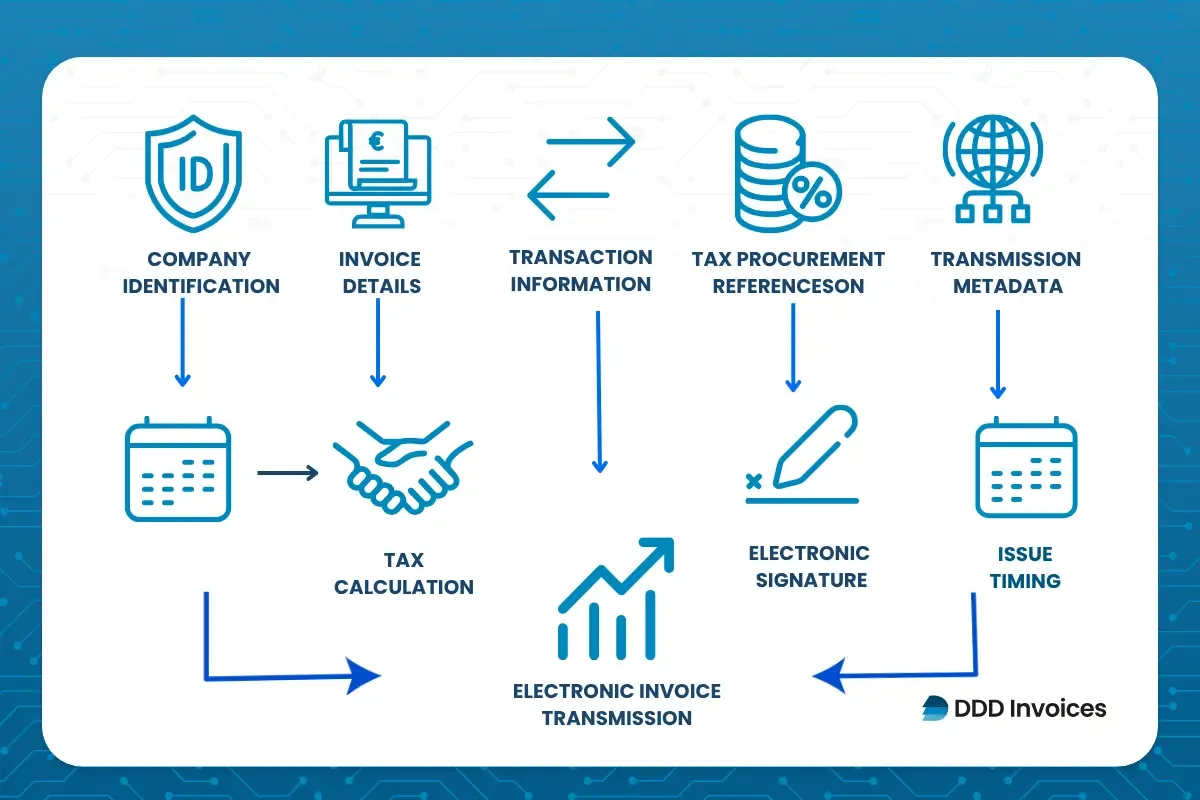
For recurring services, invoices must be issued by the seventh day of the following month, while standard transactions require next-working-day submission.
B2C E-Invoicing and Fiscalization
B2C e-invoicing in Monaco follows the same mandatory timeline as B2B transactions. By September 2026, businesses must issue electronic invoices for consumer transactions through approved platforms, though the system focuses primarily on VAT compliance and reporting rather than consumer-facing features.
Monaco does not currently implement extensive real-time fiscalization systems like those in Croatia, Germany, Turkey, and Italy. The emphasis remains on proper VAT reporting through quarterly SAT (Service des Activités Tertiaires) and FBT (Fonds pour le Bien-Être des Travailleurs) filings, with annual returns due by May 31.
Handling Foreign Electronic Invoices and Cross-Border Compliance
Foreign companies conducting business with Monaco entities face dual compliance requirements:
Monaco Requirements
- Electronic invoice submission through PPF or approved PDPs
- Compliance with Monaco's VAT regulations
- Use of accepted formats (UBL, CII, Factur-X)
- Qualified electronic signatures
Home Country Regulations
- Adherence to supplier's domestic e-invoicing laws
- Local tax reporting obligations
- Country-specific format or platform requirements
Fiscal Representation: Foreign businesses without Monaco VAT registration often appoint fiscal representatives to navigate compliance requirements, manage tax filings, and ensure proper invoice processing.
International suppliers frequently leverage Peppol Access Points to streamline cross-border compliance, as the Peppol network provides standardized connections across European countries, simplifying multi-jurisdictional invoicing processes.
E-reporting and VAT Compliance in Monaco
Monaco follows France’s VAT system, requiring businesses to file quarterly reports (SAT and FBT) and an annual VAT return.
Unlike many European countries, Monaco does not use the SAF-T system for tax reporting but maintains thorough transaction visibility through its e-invoicing platform linked to French tax authorities. Penalties for late filing include 6% interest and further administrative checks for repeat delays.
Penalties and Consequences for Non-Compliance
Monaco enforces strict e-invoicing compliance with financial penalties and operational consequences. Fines can reach significant amounts, similar to other countries like Italy (€2 per incorrect invoice) and Hungary (up to €1,250 per violation). Repeated non-compliance may lead to higher fines affecting company revenue.
Your Trusted Partner for E-Invoicing in Monaco
Since the announcement of Monaco's mandatory e-invoicing timeline, businesses across the principality have sought reliable partners to navigate the complex transition.
With the 2026 deadline approaching for larger enterprises and 2027 for SMEs, now is the time to begin your e-invoicing transition.
At DDD Invoices, we make compliance with Monaco’s e-invoicing requirements straightforward and worry-free. Whether you need integration support or a fully managed service, we’re here to help your business thrive during this important transition.
Still have questions?
In the 30min free call we will discuss:
- your requirements in invoicing
- how integration works
- demo of the product
- next steps
FAQs
When does mandatory e-invoicing start in Monaco?
Mandatory e-invoicing begins September 1, 2026, for large and medium-sized enterprises, with full implementation extending to SMEs and micro-enterprises in 2027. A voluntary adoption period runs throughout 2025, allowing businesses to prepare before enforcement begins.
Is e-invoicing currently required in Monaco?
No, e-invoicing remains voluntary in Monaco through 2025. However, businesses working with French partners or participating in government procurement increasingly adopt electronic invoicing to maintain seamless operations and competitive advantages.
How does Monaco's e-invoicing system help businesses?
Monaco's system reduces processing costs, improves accuracy, accelerates payment cycles, and ensures seamless cross-border transactions with France. Early adopters report significant efficiency gains, better cash flow management, and reduced administrative burden compared to paper-based processes.
Can foreign companies invoice Monaco businesses electronically?
Yes, foreign suppliers must use the same e-invoicing platforms and formats as Monaco domestic companies. International businesses typically connect through Peppol Access Points or appoint fiscal representatives to ensure compliance with both Monaco requirements and their home country regulations.

.webp&w=3840&q=75)
.webp&w=3840&q=75)