What Is a Storno Invoice and How Does It Work?
Learn how storno invoices reverse billing errors, maintain audit trails, and keep your e-invoicing compliant across global tax regulations
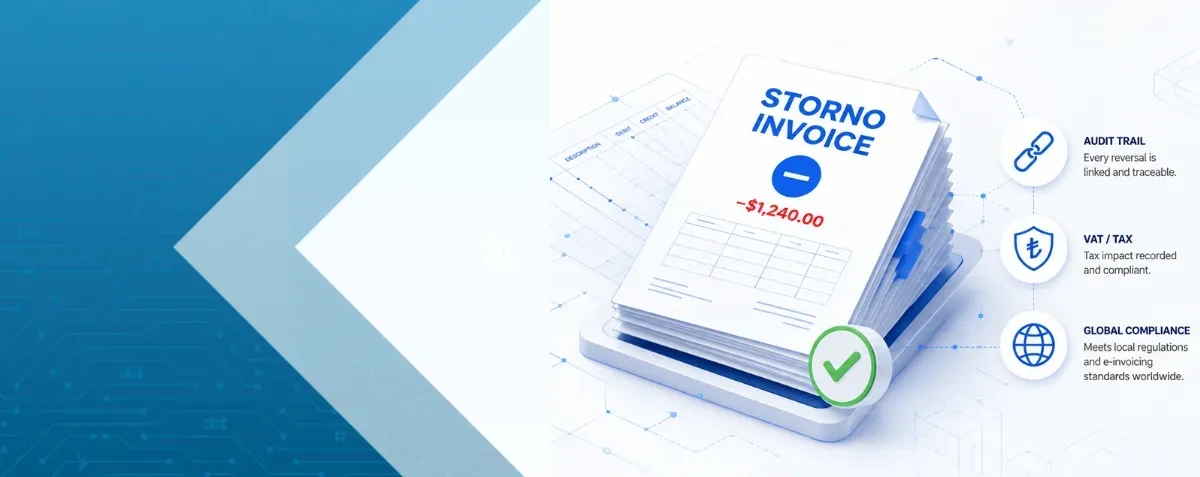
A storno invoice (also called a reversal invoice or cancellation invoice) is a corrective document that annuls or reverses a previously issued invoice, either in full or in part. Instead of deleting an incorrect invoice from the system, a storno invoice neutralizes its financial impact by posting negative amounts, effectively reversing the original transaction from receivables and tax records.
Storno invoices are particularly common in Germany, Austria, and several Central and Eastern European countries where tax-compliant correction mechanisms require a formal reversal document rather than simply editing or deleting an invoice. This makes them essential for accurate financial reporting, complete audit trails, and adherence to local invoicing and VAT regulations.
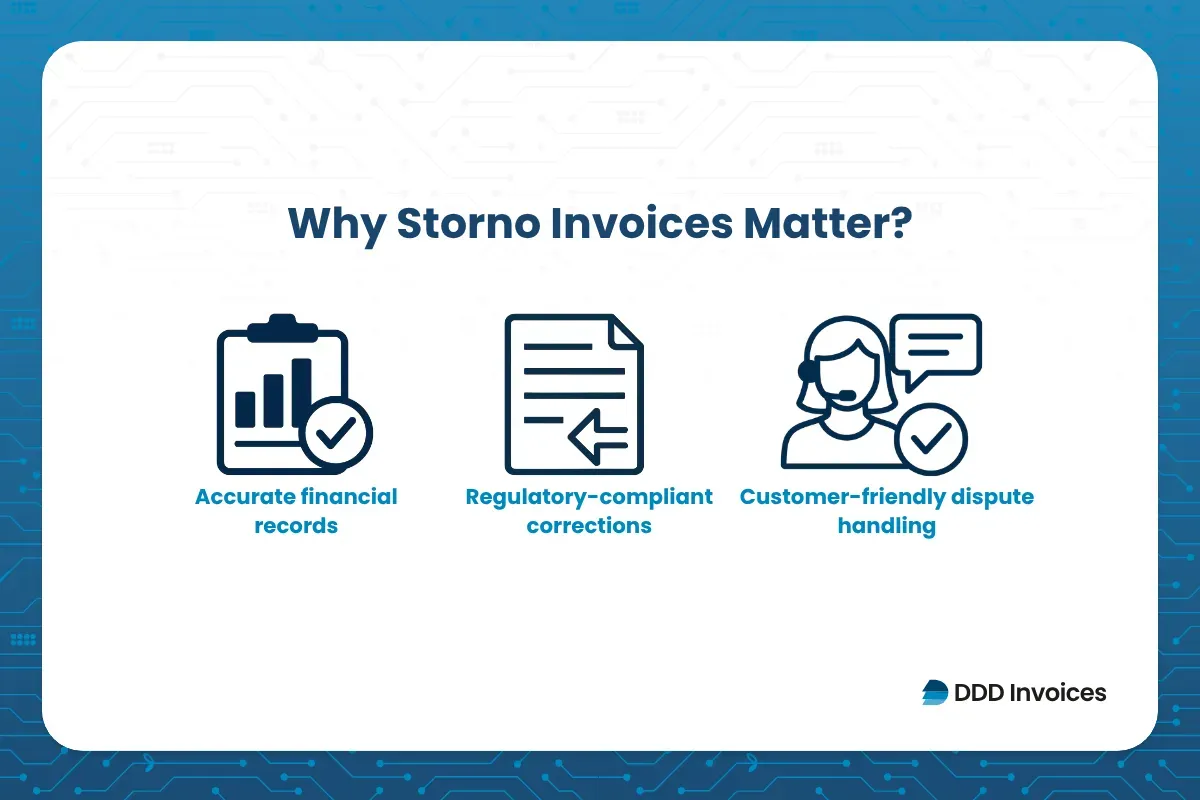
Storno invoices do more than "cancel" an invoice, they protect your accounting integrity, compliance posture, and customer trust.
When an invoice is issued incorrectly or a transaction is cancelled after billing, that invoice must be formally reversed. A storno invoice subtracts the original amounts from receivables using negative values, ensuring your balance sheet and tax-reportable figures reflect actual economic activity. This approach prevents inflated account totals while maintaining a clear audit trail.
In many countries, tax authorities generally prohibit the deletion of invoices once they have been issued or reported. A storno invoice fulfills regulatory requirements by creating a formal reversal document that can be submitted through the same channels as the original invoice, keeping the original invoice traceable for audits while neutralizing its financial impact.
If an order is cancelled, services are not delivered, or you bill the wrong customer, a storno invoice provides a transparent, documented correction. Customers can see the reversal and the reason for it, which reduces disputes and improves billing transparency.
Tired of scrolling through information about e-invoicing?
Storno invoices are used whenever a previously issued invoice must be formally reversed instead of deleted or edited. Common scenarios include:
In each case, the storno invoice references the original invoice and lists the same line items with negative amounts, effectively "undoing" the original transaction.
These three mechanisms all handle erroneous or cancelled billing, but they differ in scope and compliance treatment.
Storno invoice - Fully or partially reverses an invoice by posting negative amounts on the same accounts as the original; commonly used in German-speaking and Central/Eastern European markets as a formal tax-compliant cancellation document.
Credit note - Typically adjusts part of an invoice (e.g., discounts, partial returns) by deducting a specific amount. In some countries, credit notes and storno invoices function similarly, while in others (particularly Germany), a credit note ("Gutschrift") specifically refers to a buyer-issued document.
Void / Delete - Some systems allow you to void or delete an invoice before it is finalized, but this is often not permitted once the invoice has been reported to tax authorities. A storno invoice is required instead to maintain regulatory compliance.
For cross-border compliance, many tax authorities explicitly require a reversal document (storno) rather than silent deletion, so treating storno invoices as a mandatory correction step is best practice.
Elements of a Storno Invoice
A compliant storno invoice must mirror the original invoice while clearly signaling that it is a reversal. At minimum, it should include:
In e-invoicing environments, the storno invoice is often transmitted using specific document type codes, such as UBL Invoice code 380 with negative amounts or UBL CreditNote code 381, and may be subject to the same transmission protocols as regular e-invoices.
Cross-border operations add complexity because each country defines how to handle invoice reversals within its e-invoicing regime.
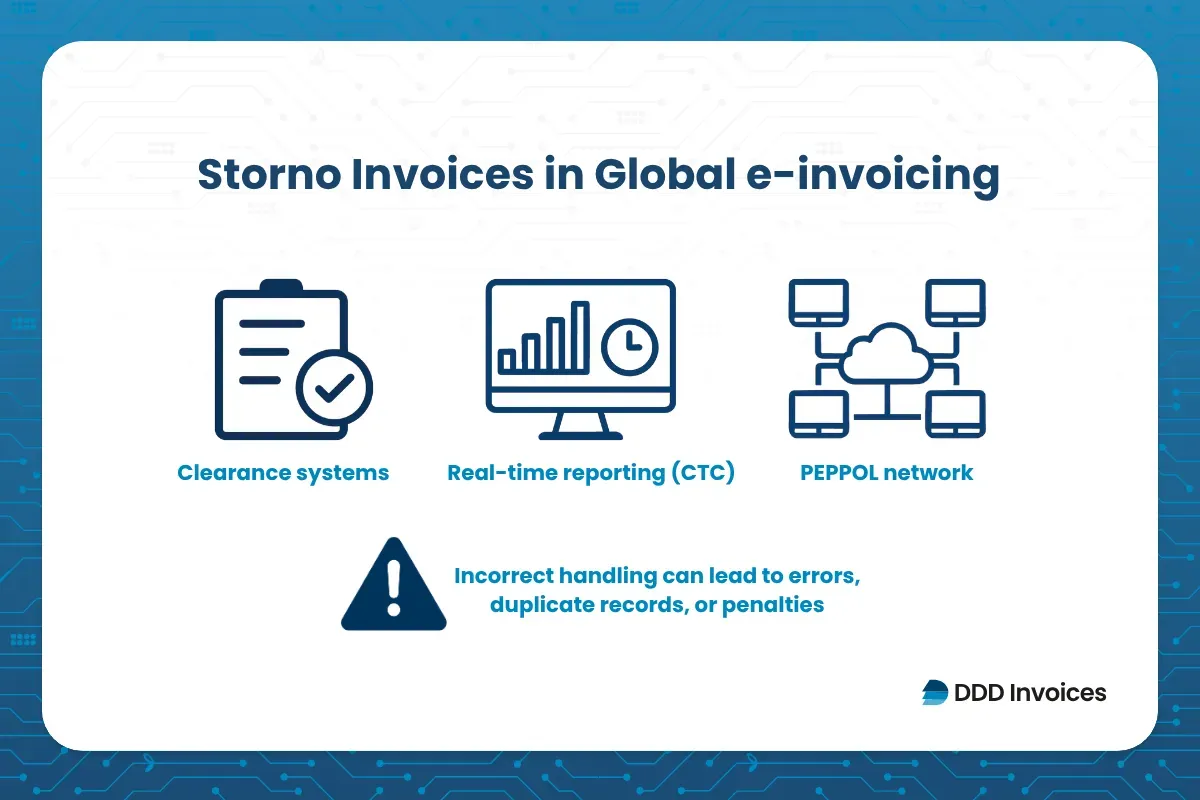
In markets like Italy (SdI) and Poland (KSeF), the original invoice is validated by the tax authority before being considered legally issued. A storno or corrective invoice must be issued as a separate document and also cleared or reported through the same government portal.
In Latin America-style Continuous Transaction Controls, reversal data must be reported to authorities in near real time, often via the same XML format as the original invoice. These systems track all invoice amendments and cancellations to prevent tax evasion.
Within the PEPPOL network, reversal or correction documents (typically credit notes in standardised formats) can be sent as UBL CreditNote messages with code 381 (using positive amounts to represent the credit) or as negative UBL Invoice messages with code 380. Both approaches ensure the original invoice is formally cancelled across the network.
Failure to apply correct storno-invoice logic can result in mismatched tax reporting, double invoices on the books, or penalties for non-compliant corrections.
From an accounting perspective, a storno invoice reverses both revenue and tax entries created by the original invoice.
If the original invoice was recognized as revenue, the storno removes that revenue from the period and adjusts VAT/GST accounts accordingly. The general ledger will show the original entry, the negative storno entry, and (if applicable) a corrected invoice, providing a complete audit trail.
In some cases, if only part of the invoice needs reversal, a partial storno can be used, where only select line items are set to negative amounts.
ASC 606 and IFRS 15 require that revenue reflect only transactions expected to be fulfilled. A storno invoice formalizes the reversal when a contract is canceled or substantially modified, keeping your MRR, ARR, and deferred-revenue figures accurate.
Even small errors in storno-invoice handling can distort financials and break compliance. Typical issues include:
These mistakes can lead to mismatched tax filings, audit findings, and disputes with customers or tax authorities.
DDD Invoices automates storno (reversal) invoices in a tax‑compliant way across PEPPOL‑aligned markets or CTC regulated countries. It generates a reversal document with the same invoice data, negative line items, and matching tax rates, then sends it through the same e‑invoicing channel as the original. This keeps audit trails intact and avoids penalties for voiding or mismatched reversals.
For cross‑border operations, DDD Invoices applies one consistent storno workflow across multiple schemes (SdI, KSeF, PEPPOL, CTC), so you don’t need separate rules per country. This reduces errors, rejected corrections, and double‑billing risks while keeping accounting and revenue‑recognition records aligned with ASC 606 and IFRS 15.
Still have questions?
In the 30min free call we will discuss:
A document that reverses a previously issued invoice by posting negative line items to neutralize the original amounts, keeping the original invoice traceable.
Use a storno when the original invoice is finalized, reported, or cannot be deleted-e.g., after e‑invoicing clearance, customer receipt, or tax reporting.
A clear reversal title, its own sequential number, reference to the original invoice, the same line items with negative amounts, identical tax rates/currency, and a reason for reversal.
It removes the original revenue and tax entries (full or partial), leaving both the original invoice and the reversing entry on the ledger for a complete audit trail.
Written by the Compliance & Growth Team
Reviewed by Denis V. P.



DDD Invoices is an enterprise-grade platform delivering a powerful infrastructure for creating, sending, receiving and storing electronic documents. DDD Invoices enables software providers like ERPs, SaaS, eCommerce, POS systems, accounting & invoicing softwares, billing services and others, to easily adhere to global invoicing compliance requirements and shorten their time-to-market.
-1.webp&w=3840&q=75)