Invoice Status Sync: Real-Time ERP & Tax Compliance
Stop audit gaps before they start. Master invoice status sync across jurisdictions with real-time ERP integration powered by DDD Invoices.
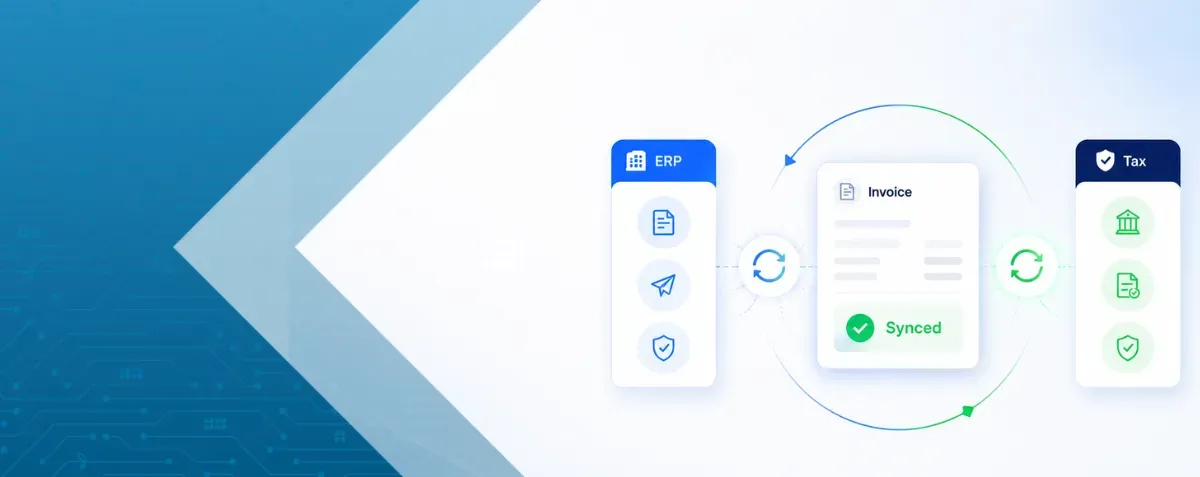
Invoice status falling out of sync across your global platforms is not a minor inconvenience. It creates real audit exposure, delays mandatory tax reporting, and can stall your entire billing pipeline. For financial and tax compliance teams running multi-country operations, the cost of a missed status update compounds fast.
This guide gives you a practical blueprint for achieving reliable invoice status sync, whether you manage a SaaS platform, an ERP integration, or a multi-market billing system trying to stay ahead of rapidly shifting mandates.
Imagine your finance team closes the quarter. The ERP shows 94% of invoices paid. But when the auditor pulls the government clearance hub records, 11% of those "paid" invoices are still pending or rejected at the tax authority. Nobody caught it. Now you have a compliance gap, a potential penalty, and a frantic scramble to reconstruct the audit trail.
Sync failures rarely announce themselves; they surface as quiet mismatches between what your system believes and what the tax authority recorded. An invoice marked paid in your ERP may still be flagged as unacknowledged in Italy's SdI system or pending inside Saudi Arabia's ZATCA Fatoorah framework. When API versions diverge or endpoints change without warning, status updates simply stop flowing.
Warning: Non-compliance in e-invoicing can trigger operational shutdowns, not just fines. Your status sync infrastructure is a business continuity issue.
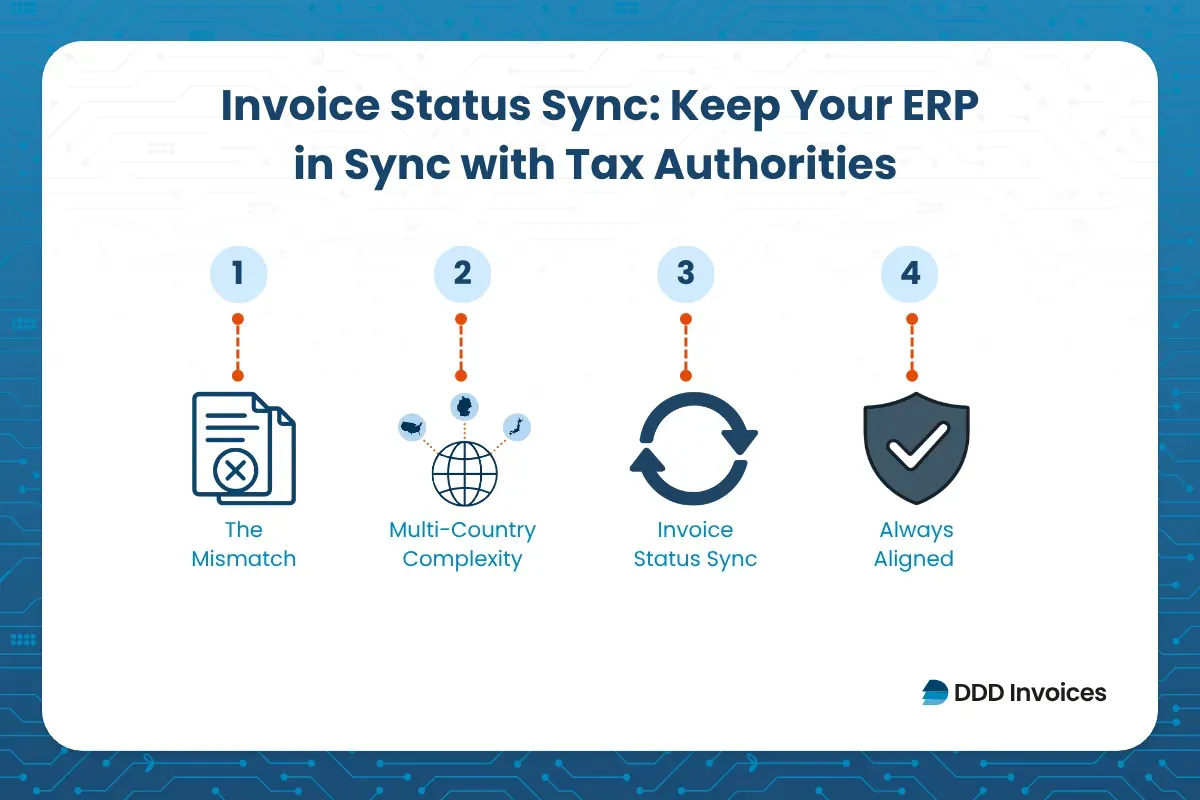
Every invoice moves through a lifecycle: drafted, submitted to a tax authority, acknowledged, accepted or rejected, matched to payment, and archived.
The problem is that status schemas differ dramatically across jurisdictions.
Mexico’s CFDI model is real‑time clearance: invoices only become legally valid once a PAC has validated the XML and returned the UUID stamp. In your ERP, think of the big jumps as “internally drafted,” “submitted for timbrado", “cleared with a UUID", and “cancelled with SAT confirmation".
Italy routes every domestic e‑invoice through the SDI platform, which returns technical statuses like sent, rejected, delivered, accepted, or refused. Your ERP statuses should mirror these SDI outcomes so that users never confuse “sent to SDI” with “delivered and accepted by the buyer".
In Saudi Arabia, ZATCA’s Fatoora platform validates and stamps each invoice, with a unique identifier tracking the entire lifecycle. At the ERP level, you mainly move from “locally generated" to “submitted to ZATCA" to “cleared and compliant", with rejections or failed cancellations treated as blocking states that must be fixed before posting.
Getting invoice lifecycle status mapping right is not a one-time project; it is an ongoing operational discipline.
Many teams underestimate the gap between "We have an API" and "We have a reliable sync architecture." The difference lies in six core areas.
Requirement | Common gap |
|---|---|
Standardized data formats | Proprietary schemas break at borders |
API compatibility review | Version mismatch after mandate updates |
Automated monitoring | Manual checks are too slow |
Offline sync capability | Gaps during network interruptions |
Audit log infrastructure | Logs not retained per jurisdiction |
Staged rollout plan | Big-bang deployments increase error |
Offline sync capability deserves special attention. Mandate transitions, clearance hub outages, and network instability are just as common as software bugs.
Behind the scenes, you need regional collectors that speak each country’s schema (CFDI, SDI, ZATCA’s Fatoora, etc.) and normalize their events into a single internal model. That fabric has to handle different SLAs, retries, and throttling rules per geography, then propagate changes back to your ERP in the right order so finance and tax teams always see a consistent, country‑aware view of each invoice.
Implementation without a clear sequence is how teams end up with partial deployments that fail silently in production. Follow this ordered workflow.
Use both pull APIs (query status on demand) and push APIs with webhooks; this tandem approach closes gaps when webhook delivery is delayed. A pattern of rejected statuses clustering around a specific country is almost always a signal of a schema mismatch or a mandate update you missed.
Building reliable invoice status sync across multiple countries is a solvable problem when you have the right infrastructure. DDD Invoices provides a single API integration that handles status mapping, real-time reporting to tax authorities, and secure archiving with time-stamping across all supported jurisdictions.
The unified JSON format means your developers never handle country-specific XML schemas; all local e-invoice transformations are managed on DDD Invoices' side. Status changes are communicated via both pull APIs and push webhooks, so your ERP receives confirmation the moment a tax authority processes an invoice. The standardised workflow is consistent across all supported countries, meaning the same integration logic your developers build for one market replicates cleanly across others.
Still have questions?
In the 30min free call we will discuss:
Invoice status sync means automatically updating invoice status across all connected platforms in real time, ensuring your ERP and the tax authority portal always show consistent, accurate data.
In markets with CTC mandates, invoice issuance or transaction data must be reported or cleared with the tax authority. Manual processes cannot keep pace; real-time sync is what makes that reporting automatic and audit-proof.
It is the process of aligning your internal ERP status schema with the specific codes required by each jurisdiction's tax authority. It is difficult because every country uses a different schema with no universal standard.
Activate automated alerts immediately, confirm your asynchronous queue is transmitting correctly, and run a reconciliation pass against clearance hub records to identify invoices requiring re-submission.
Written by the Compliance & Growth Team
Reviewed by Denis V. P.

DDD Invoices is an enterprise-grade platform delivering a powerful infrastructure for creating, sending, receiving and storing electronic documents. DDD Invoices enables software providers like ERPs, SaaS, eCommerce, POS systems, accounting & invoicing softwares, billing services and others, to easily adhere to global invoicing compliance requirements and shorten their time-to-market.