e-Invoicing Features Every SaaS Platform Should Have
Expanding into international markets? Here are the 7 e-invoicing features your SaaS platform needs to stay compliant, avoid penalties, and scale up.
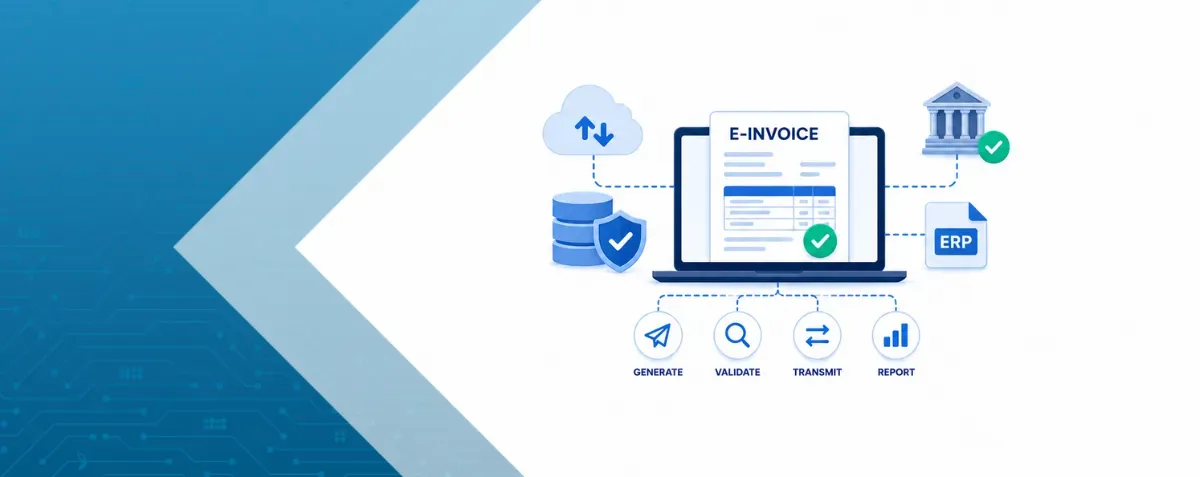
Expanding into international markets is exciting. Until you realise every country has its own e-invoicing rules, tax formats, and reporting deadlines. What works in Germany doesn't fly in Italy. What satisfies France leaves you exposed in Poland, and neither of them is waiting for your dev team to catch up.
This isn't a theoretical problem. Non-compliant invoices mean rejected transactions, fines, and lost business. The good news? The right e-invoicing infrastructure turns compliance from a liability into a non-issue. Here's what needs to be done.
Manual compliance at scale is impossible. When your platform processes invoices across the EU, Latin America, and Southeast Asia simultaneously, you can't have a team manually converting formats and interpreting tax codes per country.
Europe alone runs on roughly 10,000 different ERP and accounting systems, and most cannot natively handle the variety of e-invoicing standards, which is why any-to-any network operators exist.
Your SaaS should apply the correct format, tax codes, and submission channel automatically based on the destination country: Poland via its portal, Chile with local tax rules, and so on, with no separate workflows. To make this work, your platform should support the EN 16931 model with UBL and CII, while a unified JSON of about 60 fields drives country-specific XML behind the scenes.
Real-time reporting means invoice data is pushed to the tax authority as soon as the invoice is issued. The OECD notes that real-time e-invoicing lets tax authorities monitor transactions in near real time and run more effective audits.
Globally, countries are shifting from post-audit models to Continuous Transaction Controls (CTC), where live or near-live reporting is the rule, not the edge case. In the EU, ViDA reforms introduce real-time reporting for cross-border trade and move e-invoicing to the default, with the European Commission projecting billions in extra VAT revenue and reduced compliance costs for businesses.
Your SaaS should treat real-time reporting as an integrated capability, not a bolt-on. A provider like DDD Invoices handles live submissions to tax portals in each covered country and pushes back clear status updates via an API.
An audit letter hits your inbox asking for an invoice from three years ago. What happens next depends entirely on how you archive. A document locked with a qualified e‑signature and trusted time stamp is effectively forensically bulletproof because the signature is mathematically bound to the file contents, and the time stamp proves when it was created.
Your platform should rely on PDF/A‑3 (ISO 19005‑3), a standard designed for long‑term preservation that also allows you to embed structured invoice data (like XML) inside the archived PDF container.
In practice, this feature means your SaaS handles retention rules for each market automatically (for example, 5-10 year retention periods in the EU and key Latin American countries) and keeps documents encrypted, redundantly stored, and backed by eIDAS‑compliant signatures and ISO‑aligned archiving controls.
Manual invoice processing breaks at every step. Data entry, validation, approvals, submission, and archiving, and every step is another chance for a typo, a missed deadline, or a lost document.
With automated workflows, every invoice is validated in milliseconds against your internal rules and the destination country’s requirements at the same time: format, tax codes, mandatory fields, and customer data. If it passes, it moves automatically through approvals and submission; if it fails, it is routed to a human only when necessary. The operational shift is huge. A volume like 5,000 invoices per month across 15 countries usually demands a dedicated team working at full capacity; with automation, the same volume runs with consistent quality regardless of scale, and your team only handles exceptions while the system handles everything else.
Malaysia, Denmark, and Chile each use different standards. Without a common framework, cross-border invoicing becomes endless translation.
Modern e-invoicing uses 4- and 5-corner models where certified providers handle validation, routing, and tax platform connections. International standards like the UN/CEFACT Cross Industry Invoice (CII) define common XML structures reusable across industries and countries. Generate invoices in standardised formats (UBL under EN 16931), and they map reliably to Germany, Brazil, or Australia without per-market rebuilds.
DDD Invoices is a certified Peppol Access Point supporting all EN 16931-based formats; when you enter a new market, your platform already speaks the language through one integration.
Your accounting system, payment processor, CRM, and legacy ERP all need to talk to your e-invoicing layer. A scalable API lets you plug everything in without replacing your system.
Send raw invoice data to standardised endpoints; the API handles validation, formatting, tax codes, and submission. You do not need to build country‑specific logic into every system; the compliance brain lives behind the API.
DDD Invoices runs as a multi-tenant service with identical APIs across markets and unified authentication. When countries change rules, 99% of updates happen in the backend; your integration stays stable, as with Munch.
Your e-invoicing layer touches customer identities, invoice amounts, tax IDs, and bank details (data regulators and attackers both target). Operating across regions means juggling GDPR, LGPD and CCPA simultaneously. Minimum requirements: encryption in transit and at rest, role-based access control, authenticated access, and audit trails. This protects against insider threats, ransomware, and reputational damage from breaches.
DDD Invoices uses ISO 27001 and ISO 9001-certified EU data centres, encrypts all sensitive data, keeps databases off the public internet with redundant encrypted backups, and follows multi-stage disaster-recovery processes. All data is processed per GDPR principles.
DDD Invoices replaces country‑by‑country builds with a single connection, centralising e‑invoicing across tax authorities, networks, and schemas so your SaaS does not need a different integration for every market.
You send one canonical JSON invoice object with multiple data fields to a single endpoint, and the platform maps it into country‑specific formats based on EN 16931, handles authentication with local tax platforms, orchestrates clearance and reporting per country (including via its certified Peppol access point), and returns structured status codes for every invoice across B2B, B2C, and B2G flows.
The same infrastructure is already used by dozens of software providers in production, from ERPs to fintech and e-commerce platforms, proving it can support SaaS products serving mid-market and enterprise customers without each team rebuilding compliance logic themselves.
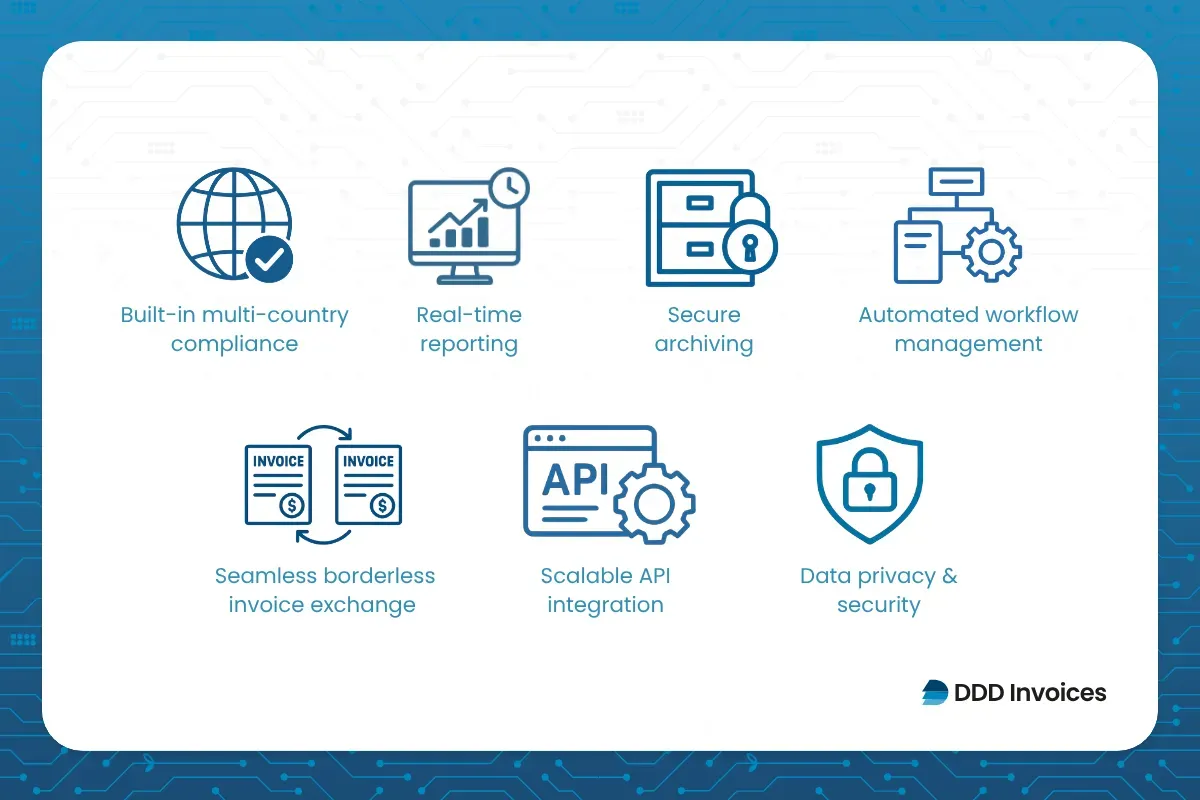
Multi‑country compliance integration, real‑time reporting, secure archiving with e‑signatures, automated workflow management, borderless invoice exchange, a scalable API, and strong data security. Together, these cover the full compliance lifecycle for SaaS platforms in any market.
It sends invoice data to tax authorities at or near the point of issuance, so errors surface immediately instead of during audits months later, which is exactly the direction reforms like the EU’s VAT in the Digital Age (ViDA) are taking with near-real-time digital reporting.
Not if you use a provider that centralises compliance. DDD Invoices exposes a single API and a canonical JSON invoice that maps into country‑specific formats, with authentication, clearance, and reporting handled per jurisdiction in the background.
They make invoices legally defensible. A qualified e‑signature proves the document has not been altered, and a trusted time stamp proves when it was created or received, both of which are key for audit admissibility in many regimes.
ISO 27001 is the global baseline for information security management, and many enterprises also look for a similar auditing standard to verify operational controls. These demonstrate that encryption, access control, and incident management are independently assessed.
Written by the Compliance & Growth Team
Reviewed by Denis V. P.

DDD Invoices is an enterprise-grade platform delivering a powerful infrastructure for creating, sending, receiving and storing electronic documents. DDD Invoices enables software providers like ERPs, SaaS, eCommerce, POS systems, accounting & invoicing softwares, billing services and others, to easily adhere to global invoicing compliance requirements and shorten their time-to-market.
.webp&w=3840&q=75)
.webp&w=3840&q=75)