

.webp&w=3840&q=75)
E-invoicing and tax automation are no longer niche topics. As digital reporting, real-time controls, and structured invoices become standard worldwide, companies must decide how they want to solve compliance: centrally, as an internal function, or embedded directly into their software products.
Fonoa is a broad tax automation suite aimed at large enterprises and global marketplaces that want a single engine for tax calculation, reporting, validation, and e-invoicing. DDD Invoices is a focused, software-provider & multi-legal entity e-invoicing and fiscalization infrastructure layer that companies embed into their own softwares via a white-label, API-driven model.
Understanding the Core Difference
At a high level, the difference is who the product is built for and where it sits in the stack.
Dimension | Fonoa | DDD Invoices |
Primary customer | Enterprises, Fortune 500, global marketplaces | Software providers (ISVs, B2B SaaS, platforms), plus multi-legal entity enterprises |
Product role | End-user tax automation platform | Embedded e-invoicing infrastructure |
Core focus | Real-time tax calculations, e-reporting, e-invoicing, taxpayer validation; VAT and GST reports | E-invoicing width + embedding |
Typical user | Company issuing invoices themselves | Platform embedding invoicing for its end users or multi-legal entities |
Integration model | API-first, enterprise-grade | White-label, API-first, modular |
Multitenancy | Yes | Yes |
Fonoa: Enterprise Tax Automation
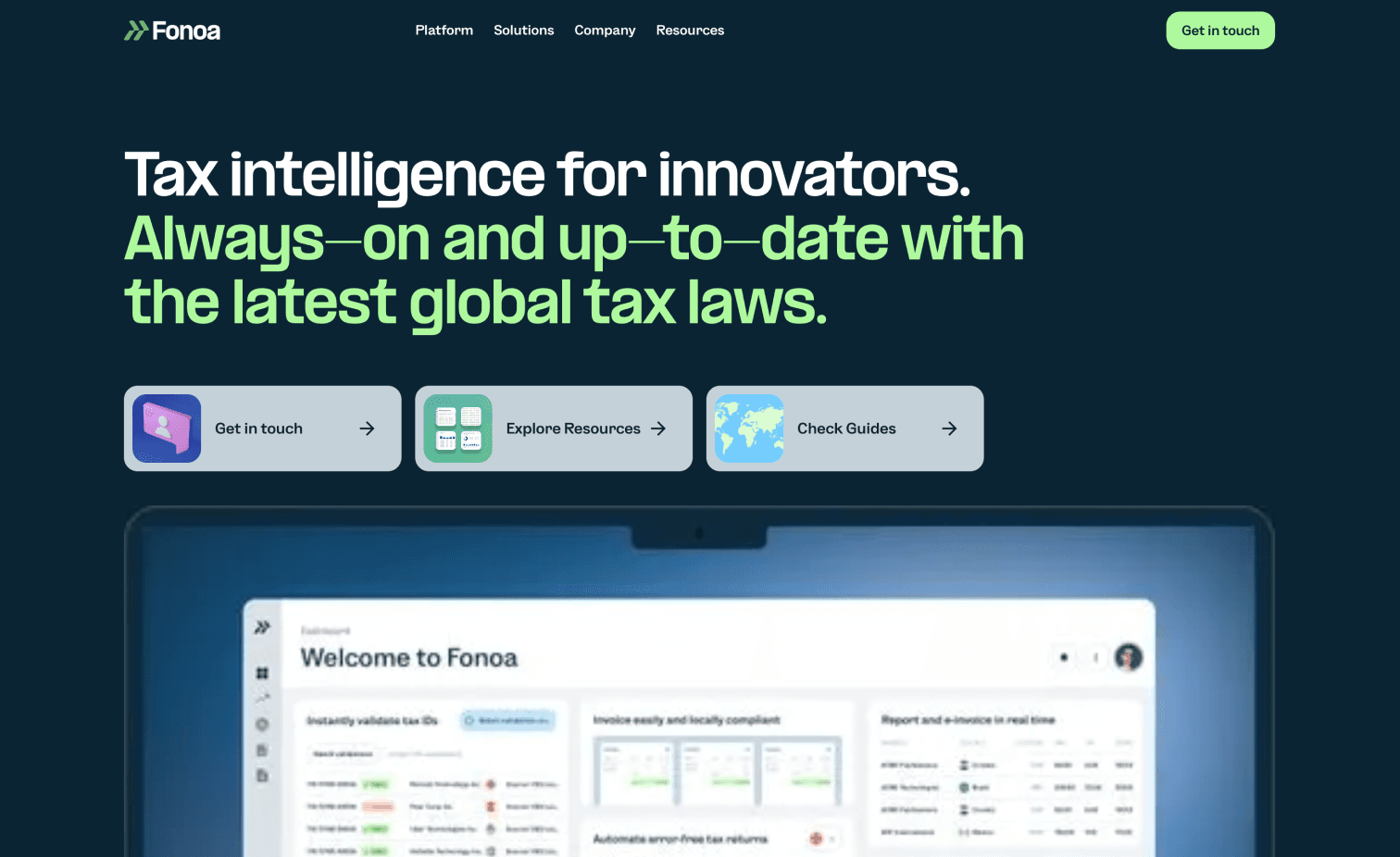
Fonoa is a global tax automation platform designed primarily for large, complex organizations operating across many jurisdictions. Its value proposition is centralizing tax calculation, validation, reporting, and invoicing under one configurable engine.
Strengths
- Real-time tax calculation for VAT, GST, and sales tax
- VAT and GST reporting and filing workflows
- Taxpayer status validation across 100+ countries
- Continuous updates to data-sharing rules
- AI-driven monitoring of regulatory changes
- Enterprise-grade API integrations
- Depth of tax automation features and processes
Target users
- Fortune 500 companies
- Global enterprises
- Marketplaces and platforms acting as merchant of record
Limitations
- Designed mainly for enterprises, not early-stage or mid-market teams
- Broad feature set that many companies may never fully use
- Known to be expensive when multiple modules and jurisdictions are required
DDD Invoices: Embedded E-Invoicing Infrastructure
DDD Invoices is a legally compliant e-invoicing and fiscalization infrastructure layer built primarily for software providers that want to embed invoicing into their own platforms and multi-legal entities who wants to cover CTC compliance and centralization.
Strengths
- Direct connection to tax authorities, Peppol networks, and fiscalization systems
- Local invoice creation, reporting, and automation
- End-to-end invoice issuing and archiving
- White-label, API-first architecture
- One dashboard across countries
- Fast, customizable integration
- Feature-agnostic API: use only what you need
- Wide range of covered countries
- Optimized data delivery for billing and reselling purposes
Target users
- Software providers embedding invoicing for their users
- Companies operating in one or multiple regulated market, or having legal entities in several markets
Limitations
- Narrower scope than full tax automation suites
- Less depth in non-invoicing tax features by design
All Features Compared: Fonoa vs DDD Invoices
Feature | Fonoa | DDD Invoices |
Local invoice creation | ✓ | ✓ |
Local invoice reporting | ✓ | ✓ |
Invoice automation | ✓ | ✓ |
E-invoice archiving | ✓ | ✓ |
One dashboard | ✓ | ✓ |
API-first architecture | ✓ | ✓ |
White-label embedding | Limited | ✓ |
Tax calculation (VAT/GST) | ✓ | — |
Taxpayer validation | ✓ | — |
✓ | — | |
Focus on software providers | — | ✓ |
Modular feature selection | Limited | ✓ |
Strategic Choice of Provider
This is not a “better vs worse” comparison; it is a fit decision.
Choose Fonoa if
- You are a large enterprise or marketplace with significant tax exposure
- You need real-time tax calculation, validation, reporting, and filing in one centralized system
- You have dedicated tax and finance teams managing compliance as an internal function
Choose DDD Invoices if
- You are a software provider or platform embedding invoicing into your own product
- You want to quickly integrate white-label compliant e-invoicing and monetize it
- You operate in one or multiple mandated markets and want a standardized and focused invoicing solution for multiple legal entities
In short:
Fonoa goes deep into tax automation.
DDD Invoices goes wide, standardizing e-invoicing infrastructure and making it embeddable.
Still have questions?
In the 30min free call we will discuss:
- your requirements in invoicing
- how integration works
- demo of the product
- next steps
Trust Other Businesses
DDD Invoices positions itself as an infrastructure partner rather than just a compliance tool. It allows software-driven businesses to launch compliant invoicing quickly, avoid rebuilding country-specific logic, monetize compliance instead of treating it as a cost, and scale across markets with one standardized API.
Read our case study on how Zenoti Expanded into Europe here.
Unsure About Your Invoice Compliance?
Fiscal and e-invoicing requirements are primarily found across EU countries, where many governments already mandate structured electronic invoices and tax authority reporting.
This trend will become EU-wide by 2030 under the VAT in the Digital Age (ViDA) regulation, making compliant e-invoicing mandatory for all member states.
For a detailed country-by-country overview, see our E-Invoicing in Europe 2026 Guide or explore individual country requirements.
What Are the Implications and Penalties?
Non-compliance can result in rejected invoices, blocked payments, penalties, inability to deduct VAT, increased audits and operational disruption. For software providers, the biggest risk is customer churn when invoicing features fail in regulated markets.
FAQs
1. Is Fonoa or DDD Invoices better?
Neither is universally better. Each is designed for a different primary user and use case.
2. Can DDD Invoices be used by end-clients directly?
Yes. While software providers are the primary focus, DDD Invoices also supports companies operating in single or multiple regulated markets.
3. Does Fonoa support e-invoicing?
Yes, as part of a broader tax automation suite focused on enterprise needs.
4. Can DDD Invoices replace a tax engine?
No. DDD Invoices focuses on compliant invoice creation, reporting, delivery, and archiving.
5. Can both solutions be used together?
In principle, a platform could use Fonoa for tax calculation and returns while using DDD Invoices for embedded e-invoicing and fiscalization.
.webp&w=3840&q=75)
.webp&w=3840&q=75)
.webp&w=3840&q=75)