Cloud invoicing explained: 2026 compliance with APIs
Cloud invoicing compliance with APIs in 2026 helps global SaaS teams meet mandates, manage formats, and reduce risk across multiple countries.
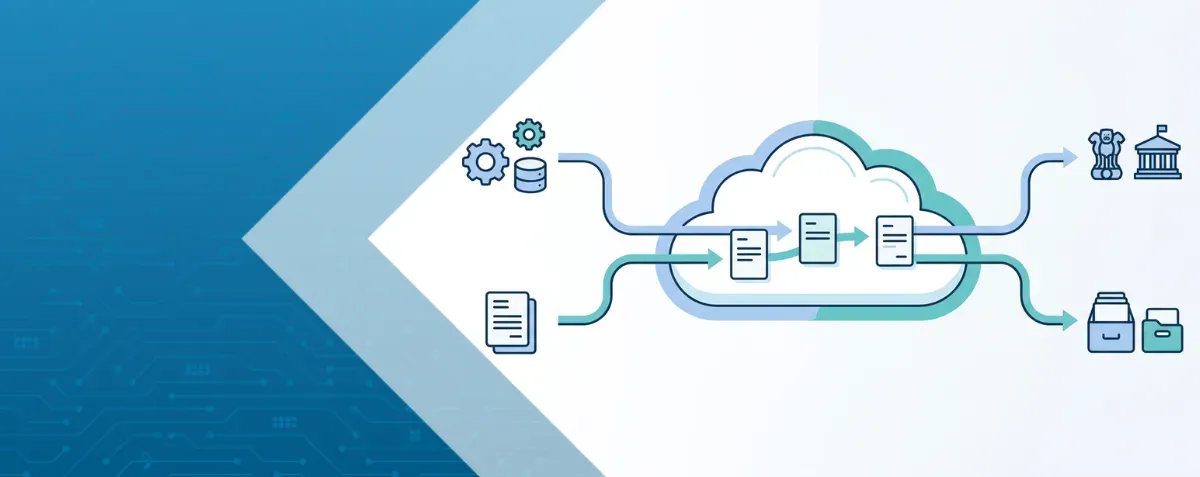
As 2026 brings stricter e‑invoicing mandates across Europe and beyond, cloud invoicing has shifted from a convenience to a compliance necessity for global software companies. Instead of relying on manual workflows and country‑by‑country fixes, financial and tax teams can use automated, API‑driven cloud invoicing to apply the right rules per jurisdiction, keep invoices audit‑ready, and reduce operational friction.
Cloud invoicing is no longer just about generating and sending invoices online. In 2026, it refers to a fully integrated, API-driven process where invoice data is created, validated, transformed into compliant formats, submitted to tax authorities or networks, and archived all within a single workflow.
Instead of handling invoices as static documents, modern systems treat them as structured data flowing through compliance pipelines.
For cross-border software and digital service companies, this shift introduces significant complexity. Supporting standards such as ZUGFeRD (Germany), Factur-X (France), or Peppol (Belgium and EU-wide) means managing not just formats, but entirely different submission and approval workflows.
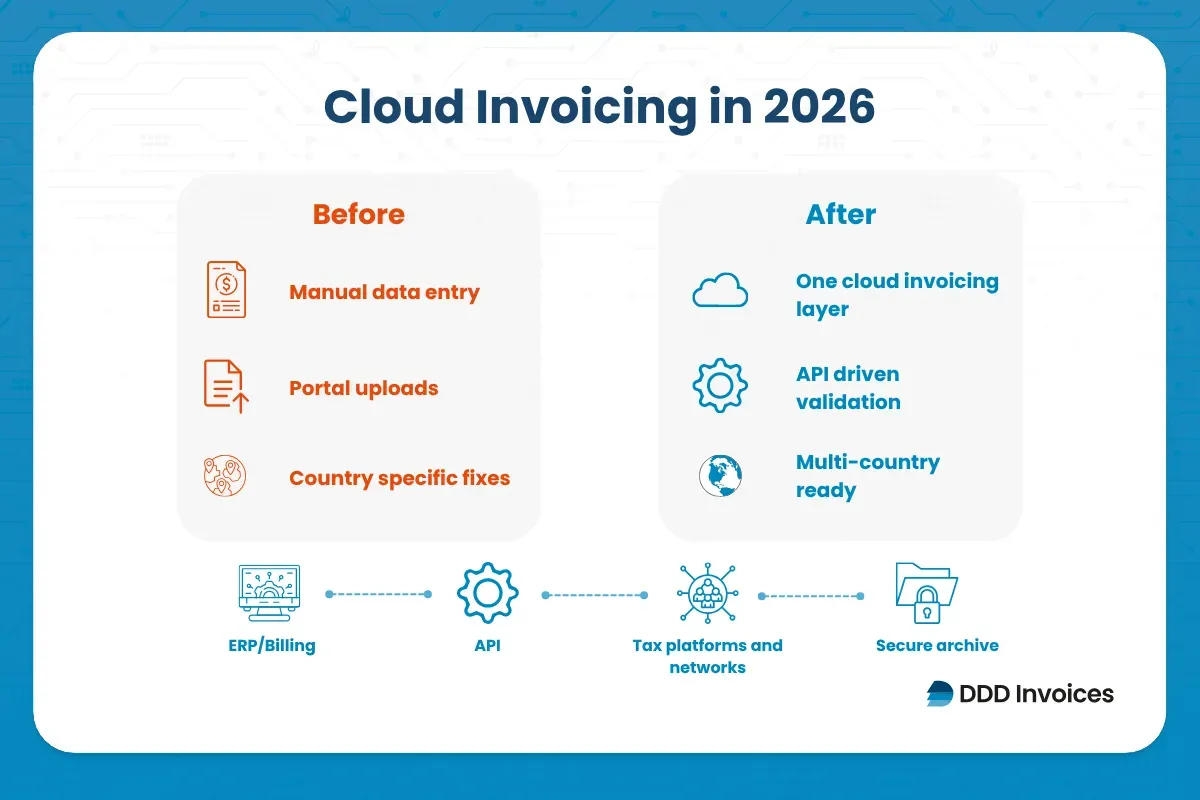
APIs are not just connectors in cloud invoicing; they act as the execution layer where compliance, validation, and invoice lifecycle management actually happen.
Instead of moving invoices between disconnected systems, APIs enable a continuous, event-driven flow of structured invoice data. For instance, when an invoice is created in an ERP or billing system, it is transmitted via API, enriched, validated, transformed into the required format, and routed to the appropriate network or tax authority all before it is considered complete.
This replaces fragmented processes like:
with a single automated pipeline.
APIs also enable interoperability by letting your cloud invoicing layer connect to multiple networks and platforms (like Peppol or national clearance systems) through one standard interface, instead of separate links for every partner or country.
Tired of scrolling through information about e-invoicing?
With 2026 e-invoicing mandates expanding globally, non-compliance is no longer just a technical gap it directly exposes organizations to financial penalties, invoice rejections, and disrupted revenue cycles. While many jurisdictions introduce transitional or “soft-landing” phases, these are not exemptions they are conditional relief periods.
Soft-landing rules typically allow businesses to continue operations despite minor non-compliance, only if they can demonstrate active implementation efforts. This shifts the burden from simply “being compliant” to proving progress toward compliance.
E-invoicing Mandates & Documentation Requirements (2026)
Country/Region | Mandate Effective Date | Grace Period End | Key Documentation Priorities |
|---|---|---|---|
January 1, 2026 | March 31, 2026 | Archived invoice records with validation status, submission logs, and Peppol delivery confirmations | |
September 1, 2026 | December 31, 2026 | PDP/PPF transmission records, invoice lifecycle logs, and compliant digital invoice archiving with timestamps | |
January 1, 2025 | Ongoing | Structured invoice storage (e.g., ZUGFeRD/Factur-X), audit trails, and format justification records | |
Expanded 2026 | June 30, 2026 | KSeF submission IDs, API integration logs, rejection/error history, and archived invoice data | |
Already mandated (NF-e model) | No grace period | SEFAZ authorization logs, invoice approval codes, XML storage, and real-time validation records |
This is where digital invoice archiving becomes critical. It ensures that every invoice, along with its validation status, timestamps, and submission history, is securely stored and retrievable for audit purposes. Which is why solutions such as DDD Invoices place so much emphasis on compliant archiving by design.
Managing global cloud invoicing is messy enough without you rewriting everything for each country. DDD Invoices lets you use one unified API for invoicing and compliance, so you stay locally compliant while keeping your billing stack simple.
This gives you API‑first cloud invoicing across multiple countries, with built‑in compliance and archiving, no country‑specific logic to maintain, and faster expansion without rebuilding invoicing workflows each time.
Still have questions?
In the 30min free call we will discuss:
Cloud invoicing uses online software to create, send, and track invoices with automation and centralized data, replacing manual, paper-based processes to speed up processing and simplify cross‑border compliance.
APIs connect invoicing, accounting, and payment systems so data flows automatically instead of being re‑entered, accelerating invoice creation, payment tracking, and compliance checks even in complex scenarios.
Organizations can reduce penalty risk by using soft‑landing periods to document implementation work, test early with tax platforms, and maintain clear internal processes that demonstrate good‑faith progress toward compliance.
DDD Invoices offers an API‑first platform that automatically applies country‑specific e‑invoicing rules, manages secure delivery and archiving, and provides real‑time status updates through a single integration as you expand into new markets.
Written by the Compliance & Growth Team
Reviewed by Denis V. P.


DDD Invoices is an enterprise-grade platform delivering a powerful infrastructure for creating, sending, receiving and storing electronic documents. DDD Invoices enables software providers like ERPs, SaaS, eCommerce, POS systems, accounting & invoicing softwares, billing services and others, to easily adhere to global invoicing compliance requirements and shorten their time-to-market.